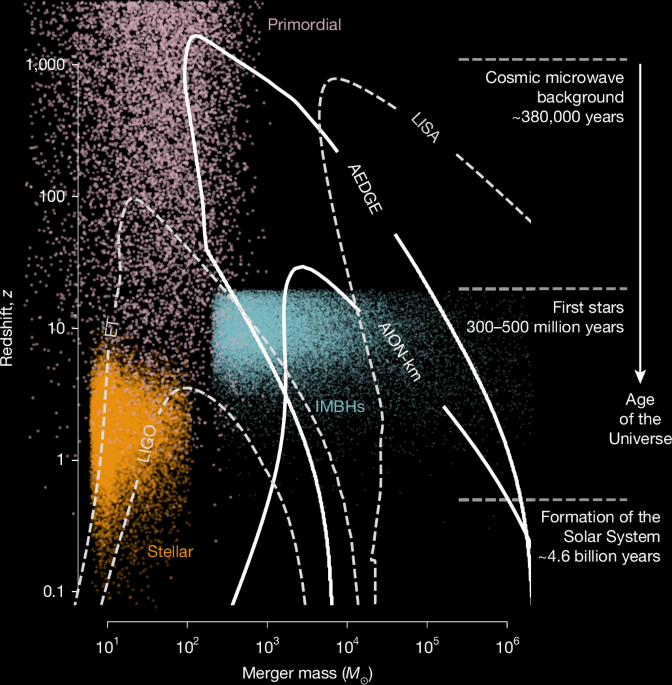
MainThe discovery of gravitational waves by the LIGO and Virgo laser-interferometer experiments10 has opened a new window on the Universe, with prospects for breakthroughs in fundamental physics, astrophysics and cosmology. Just as observations of electromagnetic waves over a wide range of frequencies have provided insights into physical processes within and beyond our Galaxy and in the primordial Universe, it is expected that observing gravitational waves over a wide range of frequencies will offer complementary insights into an equally rich spectrum of phenomena. The operating terrestrial laser-interferometer detectors—LIGO, Virgo and KAGRA—are sensitive to gravitational waves at frequencies around 101 Hz to 103 Hz (refs. 5,11,12), and the Laser Interferometer Space Antenna experiment, now under construction, will be most sensitive to gravitational waves with frequencies around 10−4 Hz to 10−1 Hz (ref. 6), leaving unexplored an intermediate range of frequencies around 10−1 Hz to 101 Hz.Important sources of gravitational waves in this frequency range are mergers of intermediate-mass black holes that are heavier than those detected by ground-based laser interferometers and lighter than those targeted by the Laser Interferometer Space Antenna. Such intermediate-mass black holes are thought to be the building blocks for the supermassive black holes13 at the hearts of most galaxies, so measurements of their mergers using long-baseline atom interferometers14,15 could reveal how supermassive black holes are formed16. Further, observations of the slowly evolving inspiral stages of solar-mass mergers would be possible for days or weeks instead of seconds, which would enable multi-messenger astronomy by pinpointing the locations of gravitational-wave sources in the sky17.Atom interferometers, which use lasers to split and recombine the wavefunctions of atoms, have optimal sensitivities to gravitational waves with frequencies \({\mathcal{O}}(1)\)Hz (refs. 1,2) and, hence, are well suited to explore the frequency gap between terrestrial and space-borne laser interferometers, as seen in Fig. 1. With the gradiometer configuration shown in Fig. 2, a differential, single-photon, pair of atom interferometers separated by a baseline L of approximately 1 km could have sufficient sensitivity to detect gravitational waves18,19 with frequencies of approximately 1 Hz, which, at present, cannot be measured. Such detectors are also sensitive to theorized interactions between atomic constituents and bosonic dark matter fields with masses of approximately 10−15 eV (ref. 8), with potential resolution significantly beyond that of existing experiments1.Fig. 1: The parameter space of black hole mergers probed by various gravitational-wave detectors, both operational and planned.The alternative text for this image may have been generated using AI.Full size imageThe horizontal axis gives the mass M of the black hole merger causing the gravitational wave, in units of the solar mass. The vertical axis is the distance to the gravitational-wave source, expressed as the redshift z. The cyan dots are gravitational-wave signals from a simulation of a 1-year data sample of black hole mergers generated using a hierarchical model of the formation of supermassive black holes13, resulting in 6 × 10⁴ simulated events. The orange dots are gravitational-wave signals from a simulated sample of stellar-mass black hole mergers. The violet dots are gravitational-wave signals from a hypothetical population of primordial black holes (see Methods for details). Also shown are the prospective sensitivities of different detectors, including laser-interferometer detectors5,6,52 and the AION-km9 and AEDGE4 atom-interferometer detectors, which have baselines of 1 km and 40,000 km respectively. This figure was inspired by the Cosmic Explorer proposal52. IMBHs, intermediate-mass black holes. ET, Einstein Telescope.Source DataFig. 2: An illustration of the sensitivity of the detector to gravitational waves.The alternative text for this image may have been generated using AI.Full size imagea–d, In the moments before the final π/2 beam-splitter pulse (Fig. 3), the two atom interferometers can be treated as freely falling atomic clocks (a) accruing phase at a rate ω0; the pulse halts this accrual of phase for the lower cloud (b), resulting in an accrual of differential phase (d) that continues until the pulse reaches the second cloud (c). In the proper frame of the bottom cloud (as pictured), the atoms are displaced by a transient gravitational wave (GW). This has the effect of delaying (or hastening) this second interaction, imparting (at leading order) a detectable differential phase of \({\rm{\delta }}{\phi }_{\mathrm{GW}}=\pm \frac{{\rm{\delta }}L}{c}{\omega }_{0}\) (ref. 36). d, Differential phase accumulated between the two interferometers throughout the sequence, shown with (red) and without (green) a gravitational wave present. Crucially, any phase noise due to the laser pulse itself is strongly suppressed in the differential measurement as it impacts both interferometers equally. The mechanism for sensitivity to dark matter (not pictured) is similar, but results from the modulation of ω0 instead of L (see refs. 8,40,41,53,54 for descriptions). This simplified picture neglects complications arising from other interferometer phases ϕother (ref. 2), the other pulses in the sequence19,55 and the choice of general relativistic gauge35,36.Long-baseline atom interferometers are under development by the Atom Interferometer Observatory and Network (AION)1 and the Matter-wave Atomic Gradiometer Interferometric Sensor (MAGIS)2 collaborations and other projects worldwide20. These join other proposed approaches in the mid-frequency band, including space-based laser interferometers such as DECIGO21 and magnetically levitated superconducting test masses22. See ref. 23 for a review. Realizing the potential of atom-interferometer experiments will require overcoming many technical obstacles to reach the target sensitivity. One open question for these projects is whether the laser phase noise, which introduces noise on each individual atom interferometer that is orders of magnitude higher than the standard quantum limit (SQL; Methods), will cancel sufficiently in the gradiometer configuration to reach the SQL. Although the gradiometer principle has previously been demonstrated in experiments using 88Sr (ref. 24)—or 87Rb (refs. 25,26), to within known limitations27—in this work we quantify the extent of noise cancellation afforded by the scheme. We do this with the more demanding fermionic isotope 87Sr, the hyperfine structure and millihertz-linewidth clock transition of which considerably complicate laser cooling and atom interferometry28,29,30,31,32. Despite these complications, 87Sr is a natural choice for gravitational-wave detection, thanks to its near-ideal properties as an atomic clock isotope33 and 150-s excited-state lifetime34. These qualities are not shared by other candidate species, such as 87Rb or 88Sr, but are essential for very-long-baseline experiments, and they enable the extension to space-scale baselines, as proposed by the Atomic Experiment for Dark Matter and Gravity Exploration (AEDGE) project4. The same differential measurement configuration that enables gravitational-wave detection with 87Sr also provides sensitivity to ultralight dark matter, which would induce coherent oscillations in the clock transition frequency across the detector baseline8.We describe how the AION project has tested a gradiometer configuration in the laboratory using 87Sr, combining atomic clock technology with atom interferometry to form two macroscopically separated interferometers interrogated by a common clock laser. Our prototype detector reached the SQL, even in the presence of several radians of synthetic laser phase noise, which emulates the conditions of a full-scale detector. Our results imply laser noise cancellation consistent with full common-mode rejection to within the measurement resolution of our experiment. Finally, we show that the same differential configuration allows the recovery of coherent time-dependent signals, even under conditions where a single interferometer would retain no recoverable phase information. Although further work will be essential to demonstrate laser phase noise cancellation with larger numbers of atoms (for which the SQL is lower) and at longer baselines where the effects of wavefront propagation become relevant, our work verifies the principles underpinning long-baseline, single-photon atom interferometry and passes an important milestone on the road towards measurement of gravitational waves.Analogously to the interference of light in a laser interferometer, such as that used in the LIGO, Virgo and KAGRA experiments, atom interferometry relies on the interference of quantum matter waves. In the search for gravitational waves, both techniques probe a long baseline whose length in the proper detector frame is modulated by a gravitational wave, which converts the variations in the time of flight of light along this baseline to a variation of the phase in an interference measurement (Fig. 2). For a discussion in a fully relativistic framework, see refs. 35,36. In laser interferometers, the interference is between light beams that travel along different paths. In atom interferometers, the interference is between the wavefunctions of atoms that are manipulated by laser pulses to follow spatially separated paths before recombination.In a single-photon atom interferometer, the atomic wavefunction is manipulated using pulses of light that drive a single-photon transition in the atom, often referred to as a clock transition. For the pulse sequence shown in Fig. 3, the phase of a single interferometer can be written in the simplified form $$\phi ={\int }_{-\infty }^{\infty }{\omega }_{0}\,g(t)\,{\rm{d}}t+{\phi }_{\mathrm{laser}}+{\phi }_{\mathrm{other}},$$
A prototype differential atom interferometer for fundamental physics - Nature
A prototype differential atom interferometer operates at the standard quantum limit with no excess noise beyond atom shot noise, achieving performance in line with the specifications for future long-baseline atom interferometers.
11,008 words~50 min read