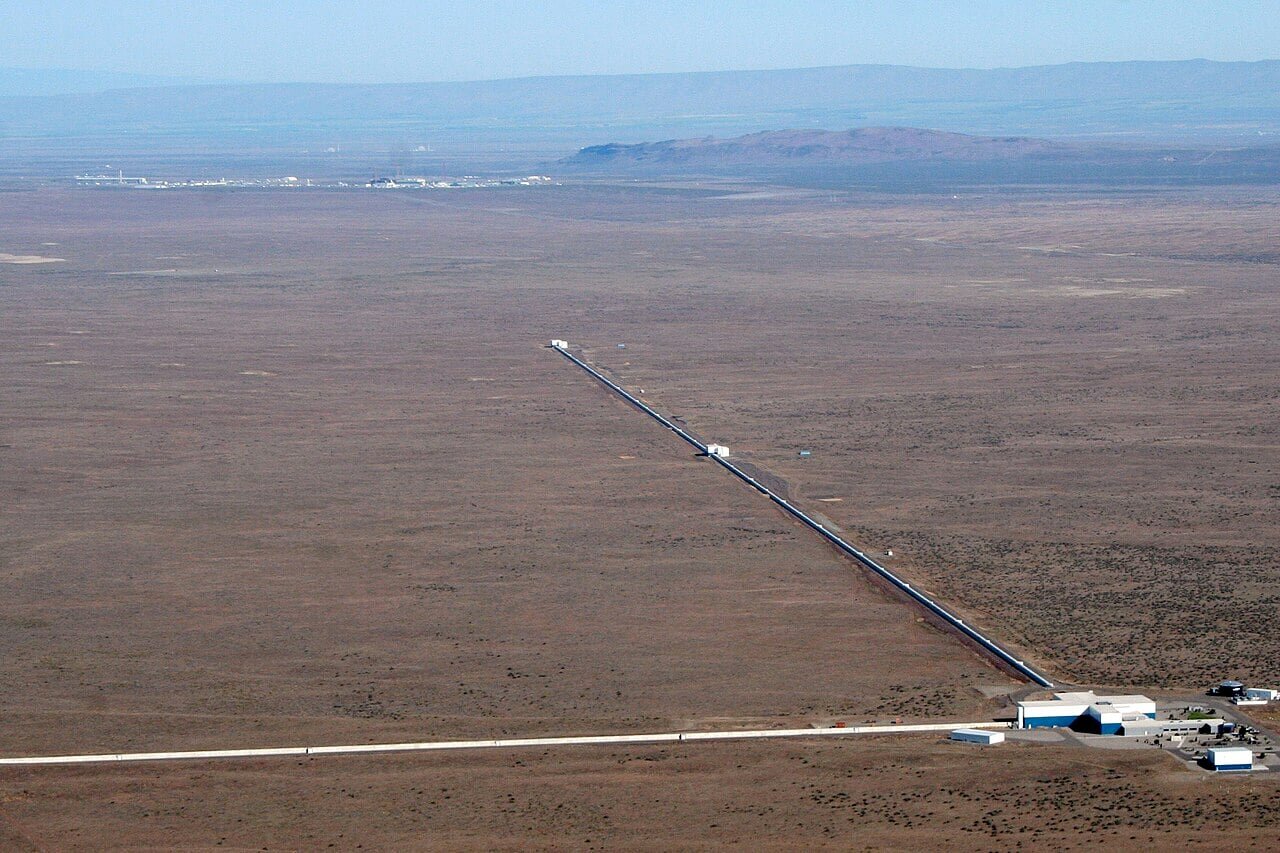
An aerial view of LIGO's Hanford, Washington observatory, showing the L-shaped facility with its two 4 kilometer arms. Credit: Caltech/MIT/LIGO Lab
There's a nice kind of irony buried in this story: One of the most sensitive instruments ever built, capable of measuring distortions smaller than the width of a proton, has been quietly held back by something as mundane as heat. And the fix, it turns out, is not some exotic new sensor but a thermal camera you could genuinely buy off the shelf.
LIGO detects gravitational waves, ripples in spacetime thrown off by colliding black holes and neutron stars, by watching for impossibly tiny changes in distance along its 4-kilometer (2.5-mile) arms. To do that, it circulates laser light at power levels approaching a megawatt. The trouble is, even LIGO's mirrors, among the purest optical components ever manufactured, absorb a sliver of that light. That absorbed energy heats the mirror, warping its shape by just a few nanometers, and that tiny warp is enough to distort the beam and quietly erode the detector's sensitivity.
Scientists already knew how to correct for this: by applying carefully controlled counterheating to the mirror. What they didn't have was a reliable way to know exactly how each mirror was distorted in the first place, so the correction could be properly targeted.