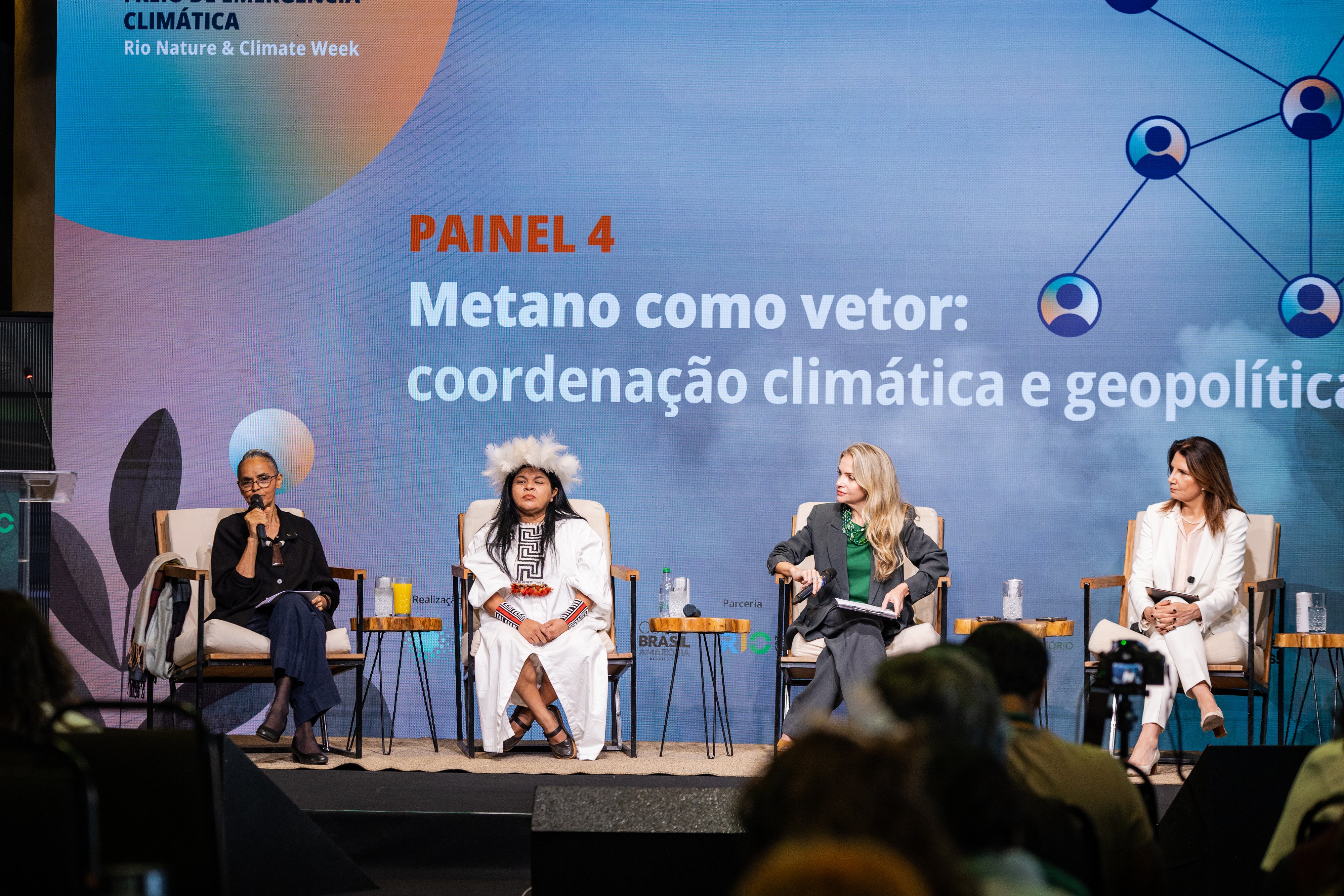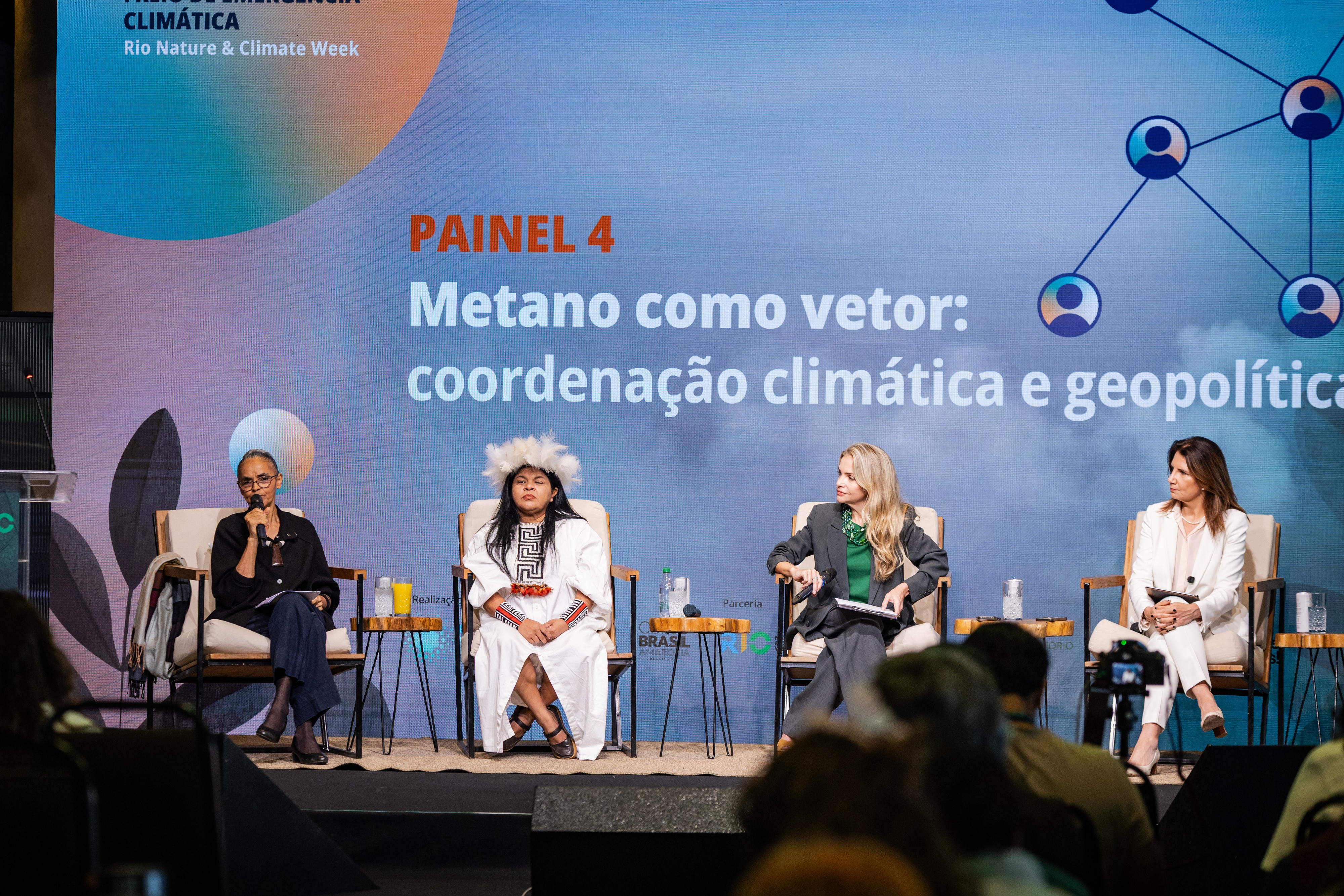
Speaking at RNCW, Ana Toni, Marina Silva and Sonia Guajajara argued that cutting methane emissions could help position Brazil as a leader in the climate transition 0.5x 1x 1.25x 1.5x 2x 00:00 00:00 At a panel during Rio Nature & Climate Week, Marina Silva, Sonia Guajajara, Leila Sterenberg, and Ana Toni discuss the importance of reducing methane emissions. — Foto: Publicity photo Methane, responsible for about a quarter of global warming, is gaining focus in international climate negotiations due to its unique potential: reducing its emissions can yield relatively swift results in combating climate change. During discussions at the inaugural Rio Nature & Climate Week (RNCW), held in Rio de Janeiro from June 2-6, officials and experts emphasized this topic as a key opportunity to accelerate climate action amid a landscape marked by geopolitical disputes and increasing challenges to international cooperation. - Reducing methane emissions is one of the quickest ways to buy time in the fight against climate change. It is an extremely potent greenhouse gas, approximately 80 times more impactful than CO₂ in the short term, but it remains in the atmosphere for a relatively shorter period. Therefore, addressing methane yields more immediate results - said COP30 Executive Director Ana Toni during a debate at the panel “Methane as a Driver: Climate Coordination and Geopolitics.” Moderated by journalist Leila Sterenberg, the discussion explored pathways to reduce gas emissions in sectors such as agriculture, waste, and energy, along with the challenges of turning global commitments into practical actions. Participants included former Minister of Environment and Climate Change Marina Silva and Congresswoman Sonia Guajajara. The panel was part of the Methane Forum: Emergency Climate Brake, which gathered representatives from global organizations, public policy makers, scientists, communicators, and representatives from the productive sector and civil society across five sessions. The speakers highlighted that methane reduction now occupies a strategic position in the global climate agenda because, unlike CO₂, which remains in the atmosphere for over 100 years, methane has a much shorter lifespan of about 12 years. This means that emission cuts can produce quicker effects on the pace of global warming, providing countries more leeway as they advance long-term structural transformations. Brazil ranks as the fifth-largest methane emitter globally, following China, the United States, India, and Russia. Simultaneously, it is also among the countries with the greatest potential to lead its reduction. The combination of natural resources, productive capacity, and accumulated experience in environmental policies, highlighted the former minister, positions Brazil favorably to attract investments and accelerate low-carbon solutions. - Brazil sees this as a significant opportunity to seek more investments, achieve technological advancements, and thus, tackle climate change not as a problem, but as a chance to create a new cycle of economic, technological, and new productive base prosperity - she said. - It's a huge challenge. But the future outlook, with the commitment made [at COP30] to reduce methane emissions by 30% by 2030 compared to 2020 levels, is already a much better prospect. Former Minister Marina Silva at a panel during the Emergency Climate Brake Forum at Rio Nature & Climate Week — Foto: Publicity photo Achieving this goal will require distinct strategies for different economic sectors. Ana Toni emphasized that reducing emissions involves specific challenges in agriculture, waste management, and the oil and gas industry, necessitating coordinated efforts from governments, companies, and local authorities. Subnational governments, for instance, can contribute more in the area of solid waste, a central topic for COP31. For Toni, the debate also offers an opportunity to strengthen international cooperation at a time of increasing geopolitical fragmentation. While countries face difficulties advancing broader topics on the climate agenda, she noted, methane is consolidating as an area capable of building consensus and producing short-term results: rapid cuts in methane emissions could slow global warming by the next decade, potentially reducing the average global temperature by up to 0.5°C. Former Minister Marina Silva at a panel during the Emergency Climate Brake Forum at Rio Nature & Climate Week — Foto: Publicity photo - If we want to buy time in the face of the possibility of exceeding 1.5°C or even 2°C of warming, we must commit to this - she asserted. - There is no better example of multilateralism working than committing to concrete actions to reduce methane. Another recurring theme throughout the debate was the need to increase societal involvement in the climate agenda. For Sonia Guajajara, the implementation of methane-related goals will depend not only on government decisions or technological advancements but also on the ability to mobilize various social sectors around the issue. She stated that indigenous peoples have historically contributed to the conservation of Brazilian ecosystems and argued that the recognition of this role resulted from decades of political mobilization and participation in international forums. - No sector, neither government, civil society, nor the private sector, will find solutions to tackle the climate crisis alone without shared involvement and responsibility - she said, adding that expanding society's awareness of the issue is a necessary condition to accelerate the implementation of measures capable of addressing the climate emergency. - We need to talk about this with society. We need to disseminate, converse, and occupy different communication spaces to address what is urgent. Congresswoman Sonia Guajajara at a panel during the Emergency Brake Climate Forum at Rio Nature & Climate Week — Foto: Publicity photo At the same time, former Minister Marina Silva emphasized that the discussion on methane should not be isolated from broader efforts to tackle the climate crisis. In her assessment, measures aimed at reducing gas emissions can yield significant short-term gains but must align with long-range strategies to reduce dependency on fossil fuels and strengthen environmental protection policies. - Public policy works and produces results. But there is no avoiding the reduction of dependence on oil and gas if we want to address the climate emergency at its root. Congresswoman Sonia Guajajara at a panel during the Emergency Brake Climate Forum at Rio Nature & Climate Week — Foto: Publicity photo The translation of this text into english was carried out by Project Irineu, O GLOBO's initiative to develop artificial intelligence tools. Here is the link to the original report.
Reducing methane emissions could accelerate the fight against the climate crisis and create opportunities for Brazil, leaders say
Speaking at RNCW, Ana Toni, Marina Silva and Sonia Guajajara argued that cutting methane emissions could help position Brazil as a leader in the climate transition
TL;DRAI
Brazil targets 30% methane reduction by 2030, leveraging its status as 5th-largest emitter to lead clean-tech transition. Tech play: methane cuts drive rapid climate results (0.5°C per decade), catalyzing clean-tech and AI investments in agriculture and waste sectors.
1,035 words~5 min read