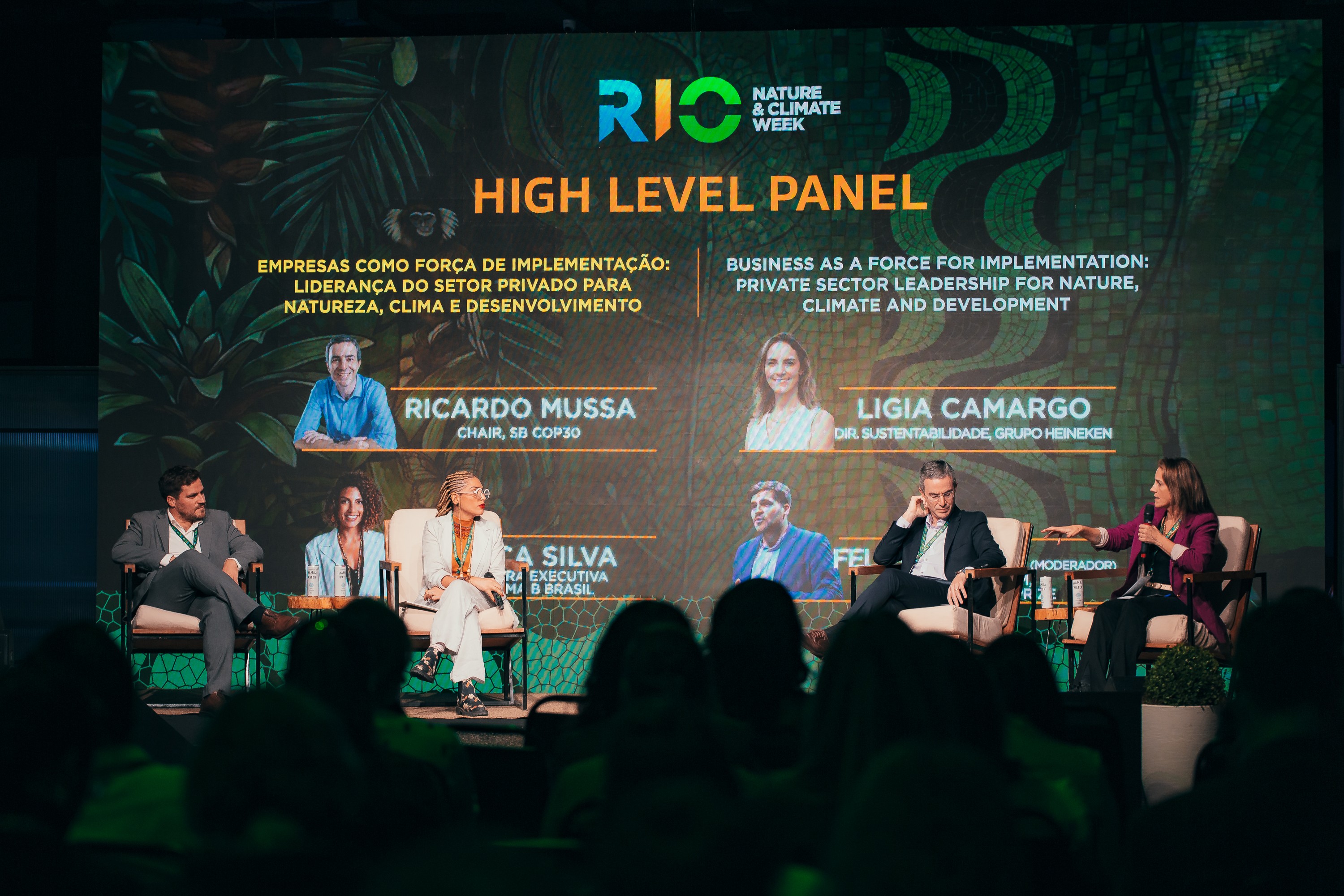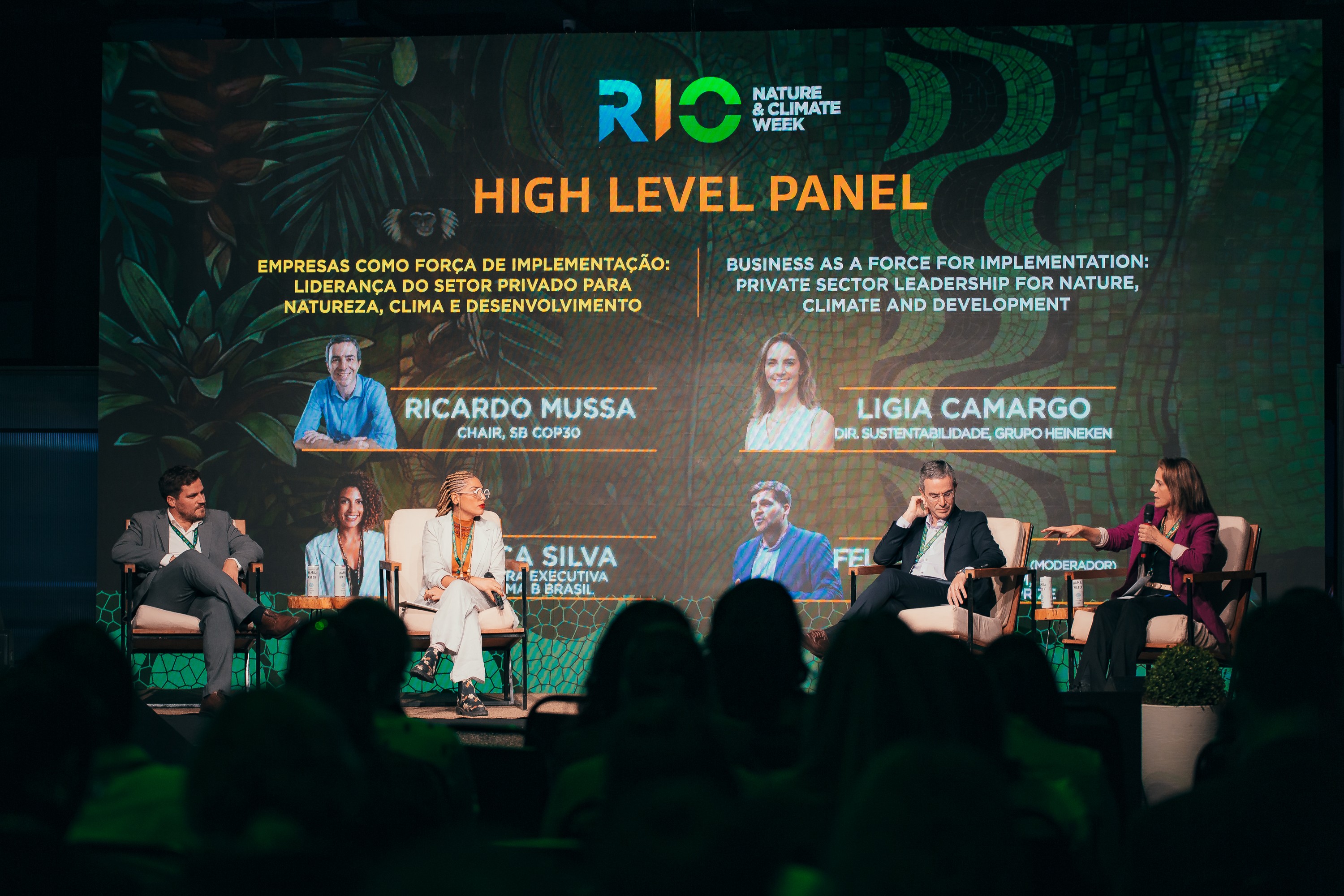
The panel explored the private sector’s role in advancing the climate agenda and the opportunities available to Brazil in areas such as renewable energy, agriculture and bio-inputs. 0.5x 1x 1.25x 1.5x 2x 00:00 00:00 At a panel during Rio Nature & Climate Week, Felipe Villela, Jéssica Silva, Ricardo Mussa, and Ligia Camargo discuss the role of the private sector in implementing solutions for climate, nature, and development. — Foto: Publicity photo Transforming climate and environmental commitments into concrete results requires sustainability to stop being seen as a separate agenda and start guiding strategic decisions, investments, and business models. This was a key message from the panel "Businesses as a Driving Force for Implementation: Private Sector Leadership for Nature, Climate, and Development," held on the opening night of Rio Nature & Climate Week (RNCW) last Tuesday, October 2, in Rio de Janeiro. The discussion, moderated by Felipe Villela, Director of the Earthshot Prize, featured Ricardo Mussa, President of the Sustainable Business COP 30 (SBCOP); Ligia Camargo, Sustainability Director at the Heineken Group; and Jéssica Silva, CEO of Sistema B Brasil. The conversation began with the observation that, although corporate commitments to issues like carbon neutrality and positive impact generation have increased in recent years, the urgency now lies elsewhere: - Discussing the role of the private sector not as a spectator of the transition but as a central part of the solution - began Villela. According to Mussa, one of the private sector's contributions is its capacity for collective articulation. He cited SBCOP, an initiative launched in 2025 inspired by the B20 model. Led by the Brazilian productive sector, it brings together business associations from dozens of countries to ensure the engagement of entrepreneurs and entities in fulfilling the agreements made during the COPs. Today, the alliance represents around 43 million companies, said Mussa, emphasizing that this structure can be used to enhance dialogue between governments and the market. - When we sit at the negotiating table, we have the legitimacy to be heard because we represent a very significant portion of the global economy - he stated, adding that the challenge now is to turn this representativeness into influence in negotiations. Camargo, on the other hand, emphasized that setting targets is just the first step. For her, the greatest challenges arise precisely in implementation, especially when initiatives need to go beyond the company's boundaries and involve suppliers, partners, clients, and other members of the value chain. In a context of economic pressures and geopolitical uncertainties, she said, the survival of sustainability agendas depends on their ability to demonstrate concrete results for the business. - Sustainability needs to be integrated into the company's strategy and show economic, social, and environmental value simultaneously. Only then can it be maintained consistently - she affirmed. - It is essential to develop solid projects that generate real results and can demonstrate their competitiveness over time. Ligia Camargo, Director of Sustainability at the Heineken Group, speaks on a panel at Rio Nature & Climate Week. — Foto: Publicity photo This logic guides initiatives being developed by Heineken itself. Camargo cited as an example the partnership established with Rizoma Agro to restore over 800 hectares in areas near the company's plant in Itu, in the São Paulo countryside, through agroforestry systems. Besides carbon capture and water recovery, the project seeks to increase the operation's resilience in a strategic region for the company's production. - Our goal is to return to nature 100% of the water volume we use in our products. Besides being a public commitment, it is an operational necessity. Ensuring water means ensuring business continuity - said the director. Ligia Camargo, Director of Sustainability at the Heineken Group, speaks on a panel at Rio Nature & Climate Week. — Foto: Publicity photo Defending the integration between impact and business strategy, Silva cited initiatives that aim to measure the socio-environmental effects of operations similarly to traditional financial indicators. As an example, she mentioned Natura and its IP&L (Integrated Profit and Loss) model, a tool developed to attribute economic value to the social and environmental impacts generated by the company. Such instruments, she said, help make visible benefits that often appear only as costs. Another case highlighted by her was Manioca, a Pará-based company certified by Sistema B that works with products from the Amazon's socio-biodiversity. According to Silva, by investing in supplier qualification, technical knowledge dissemination, and strengthening local production chains, the company generates positive social and environmental impacts while strengthening its own business model. - The private sector moves between 70% and 80% of global financial capital. There is no solution to the climate emergency without financing - said Silva, adding that the discussion about sustainability is, in practice, also about business strategy. - We are talking about business decisions. Jéssica Silva, CEO of Sistema B Brasil, on a panel at Rio Nature & Climate Week — Foto: Publicity photo In the case of Brazil, there is yet another fundamental point, according to Mussa: the country has unique conditions to position itself as one of the leading global destinations for investments linked to the new economy. The advancement of renewable generation, he stated, has placed Brazil in an unprecedented situation of energy abundance, creating opportunities for attracting industries and expanding strategic sectors. - Brazil, with its abundant and renewable energy, naturally becomes an attractive destination for investments - he stated, noting that the country has undergone significant transformations in agriculture and energy over the past decades: whereas it once relied on imports, it now has surpluses in areas like solar and wind generation. - It is necessary to understand Brazil's strengths and how to turn them into economic development. Jéssica Silva, CEO of Sistema B Brasil, on a panel at Rio Nature & Climate Week — Foto: Publicity photo The translation of this text into english was carried out by Project Irineu, O GLOBO's initiative to develop artificial intelligence tools. Here is the link to the original report.
Companies must turn environmental commitments into business decisions, leaders say at RNCW
The panel explored the private sector’s role in advancing the climate agenda and the opportunities available to Brazil in areas such as renewable energy, agriculture and bio-inputs.
TL;DRAI
At Rio Nature & Climate Week, leaders argued ESG must guide business operations; Heineken targets 800-hectare restoration and water return. For IT managers, climate targets are capex and supply-chain decisions with ROI measurement—competitive necessity.
1,014 words~5 min read