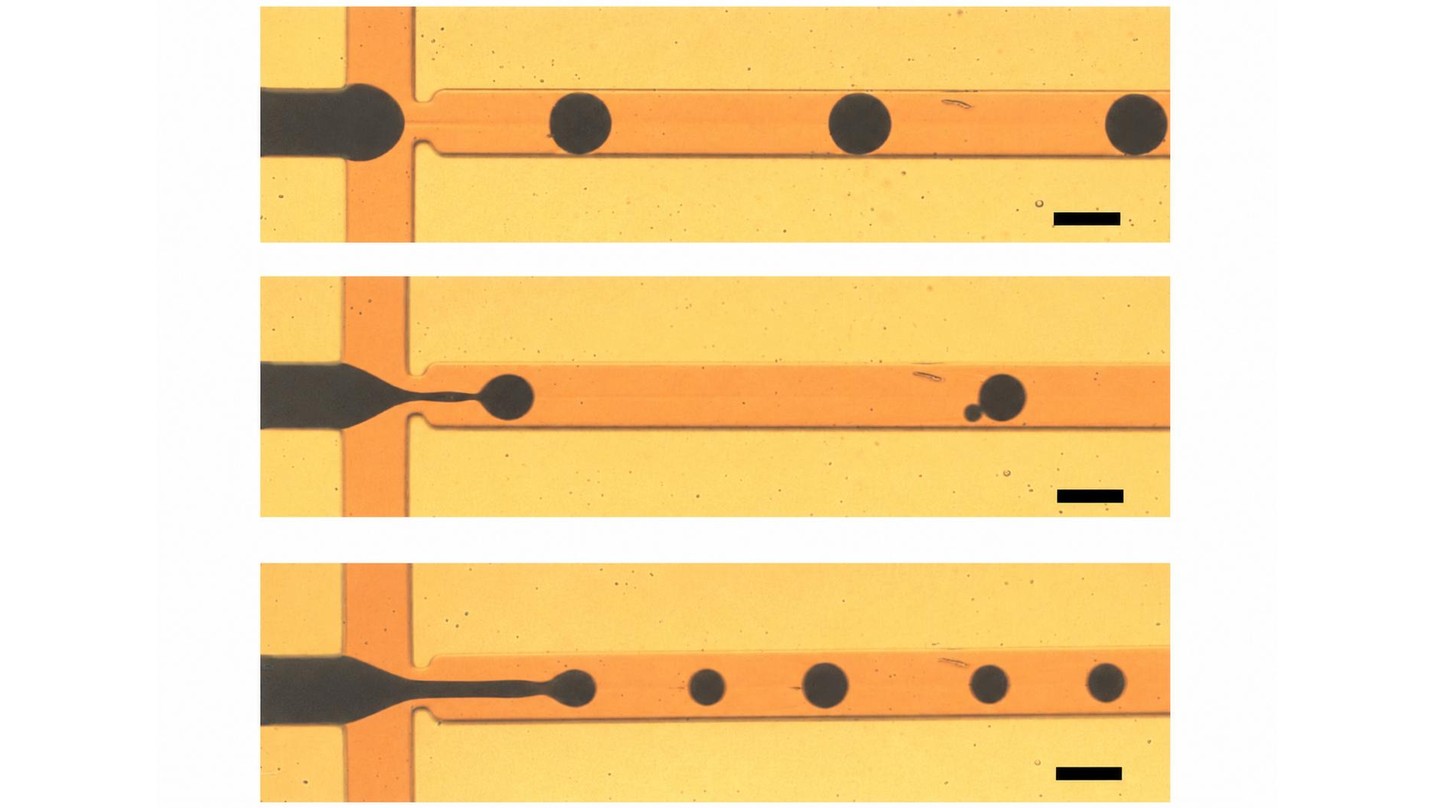
Congratulations to our colleague Tao Zhang, for his recent publication entitled "Microfluidic synthesis of alumina particle-laden beads via capillary number tuning for varying particle concentrations" in the journal "Microfluidics and Nanofluidics".Colloidal particle-laden inks are increasingly used in additive manufacturing to produce functional components with tailored properties, and droplet-based microfluidics enables precise generation of high-viscosity, particle-rich droplets. Despite extensive studies on particle-free shear-thinning fluids, the coupled influence of particle concentration on both flow regimes and droplet size in microfluidic systems remains insufficiently understood. Here, we showed that particle concentration in shear-thinning, alumina-laden inks governs droplet formation dynamics through a dual effect on viscosity and interfacial tension. We investigated the droplet formation of a solvent-free, alumina-laden acrylate ink dispersed in a continuous aqueous phase using a flow-focusing microfluidic device. Inks containing 10%, 20%, and 30% (w/w) alumina particles (500 nm) were characterized in terms of rheology and interfacial tension. By adjusting flow rates of both phases and particle concentrations, we modulated the capillary number and mapped the resulting droplet formation regimes. Unlike polymer-only shear-thinning systems, where interfacial tension remains nearly constant, alumina particles modified both viscosity and interfacial tension of alumina particle-laden inks, shifting flow regimes and droplet size. Higher particle concentrations promoted jetting and altered droplet size, whereas dripping produced highly uniform droplets (< 100 μm). Downstream UV polymerization produced solid beads, and sequential exposure enabled assembly into two-dimensional structures. These results provided quantitative insight into how alumina particle concentration governs droplet genera tion through coupled rheological and interfacial effects, and demonstrated a bead-based assembly route for microfluidic particle-laden inks. For more details, please visit:https://doi.org/10.1007/s10404-026-02905-zFundingSwiss National Science Foundation (SNSF, grant number: 219165)
Microfluidic Synthesis of Alumina-Laden Beads via Capillary Number
Congratulations to our colleague Tao Zhang, for his recent publication entitled "Microfluidic synthesis of alumina particle-laden beads via capillary number tuning for varying particle concentrations" in the journal "Microfluidics and Nanofluidics".
271 words~1 min read