Biomimetic multi‑responsive superwettable materials for oil–water separation
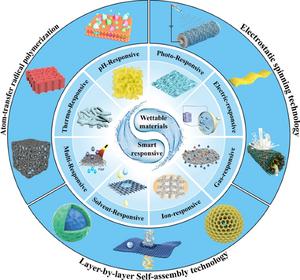
Industrial oily wastewater discharges and marine oil spills pose a serious threat to ecosystems. A new strategy for efficient and controllable oil–water separation is provided by smart-responsive wettability materials, owing to their ability to dynamically switch surface wettability in response to external stimuli. Under this premise, we reviewed the research progress and applications of such materials. First, we described the theoretical basis of wettability and the mechanism of oil–water separation. Subsequently, we comparatively analyzed the structural characteristics and separation properties of four types of special wettable materials. We focused on eight categories of smart response wetting materials: temperature, pH, light, electricity, gas, ion, solvent, and multi-response. For each type, we analyzed the response mechanisms, advantages, and limitations in oil–water separation. In addition, we compared the advantages and disadvantages of key preparation techniques such as layer-by-layer self-assembly, electrostatic spinning, and surface-initiated atom transfer radical polymerization. Finally, we summarized the current research status and challenges in the field of smart-responsive wetting materials and looked forward to future development directions.
By integrating Young's equation, the Wenzel model, and the Cassie–Baxter model, the critical influence of biomimetic micro-/nano-structures and surface chemical regulation on achieving superwettability and smart switching is revealed, providing a theoretical foundation for the design of high-performance separation materials.
In analyzing stimulus-responsive catalytic cleaning membranes, the four-level synergistic coupling mechanism between the physical barrier effect of the surface hydration layer and the degradative action of catalytically generated reactive oxygen species is elucidated, offering theoretical support for achieving long-term antifouling performance and integrated separation degradation functionality.
The response principles and oil-water separation performance of temperature, pH, photo, electric, gas, ion, solvent, and multi-responsive materials are systematically reviewed and comparatively analyzed. Notably, a comprehensive evaluation framework is established through comparative tables across multiple dimensions, such as response speed, regulation precision, reversibility, and energy consumption, thereby providing an intuitive reference for material selection.