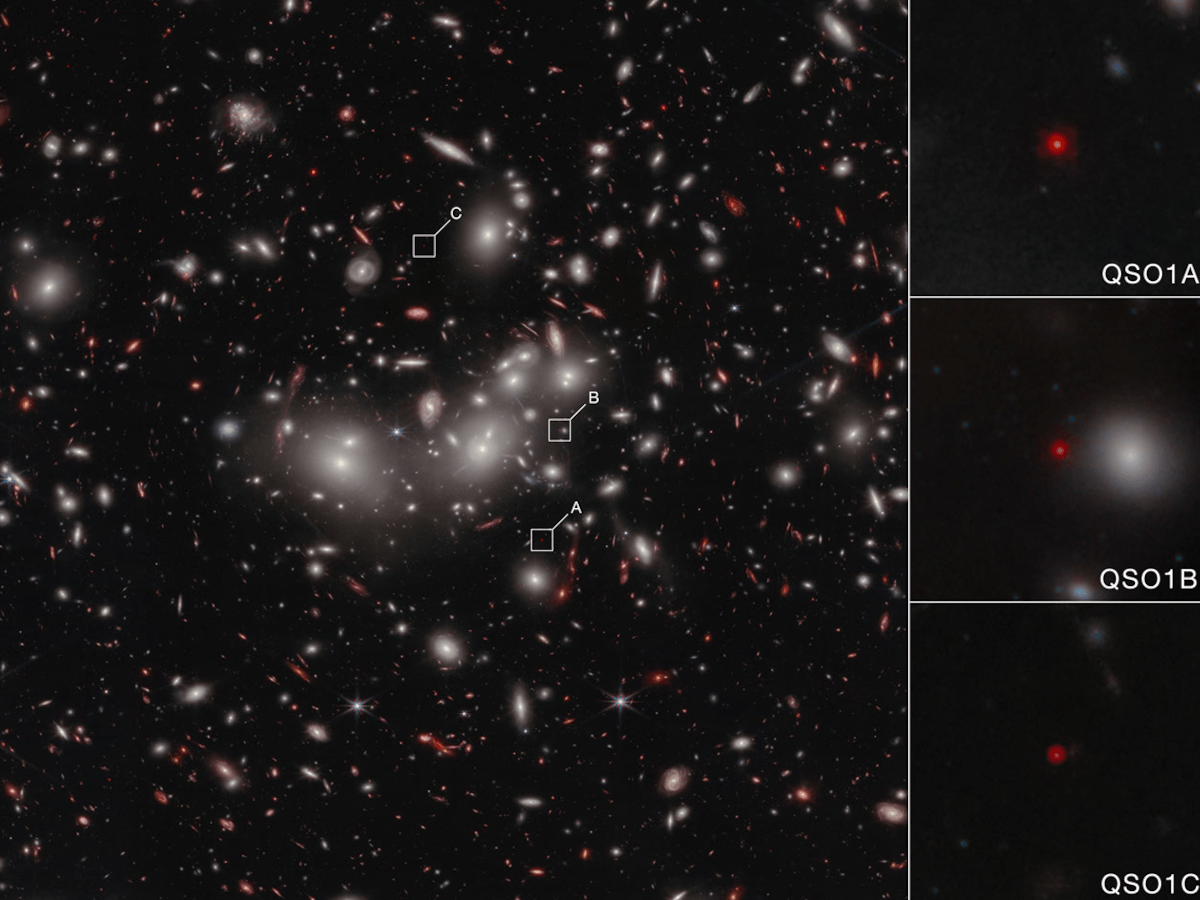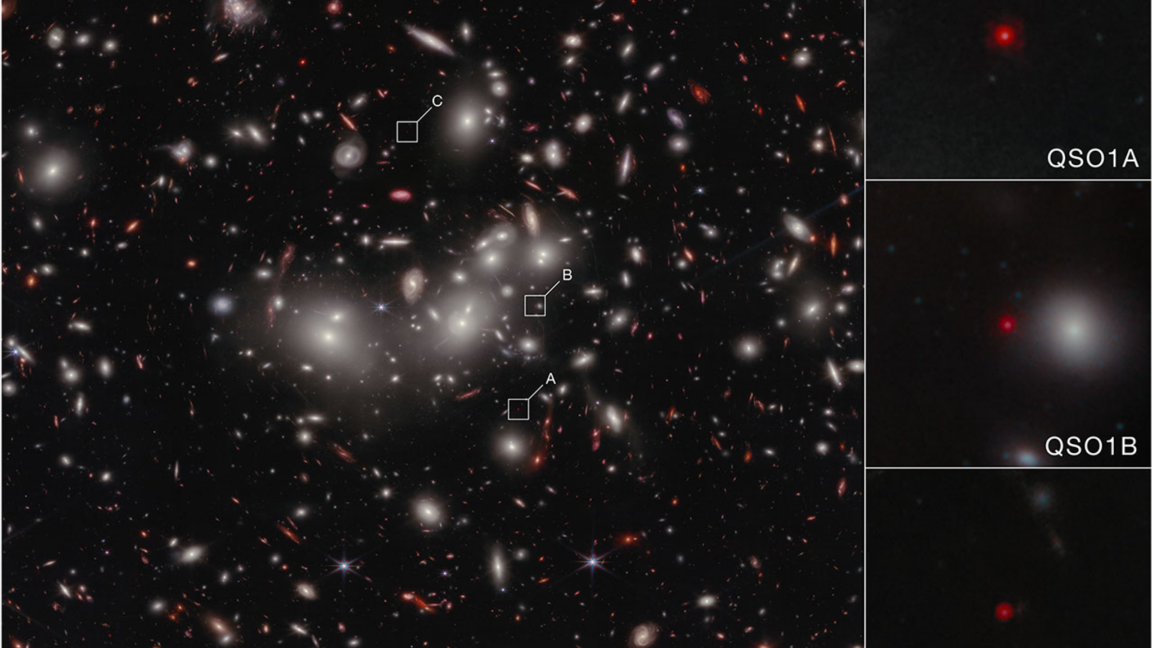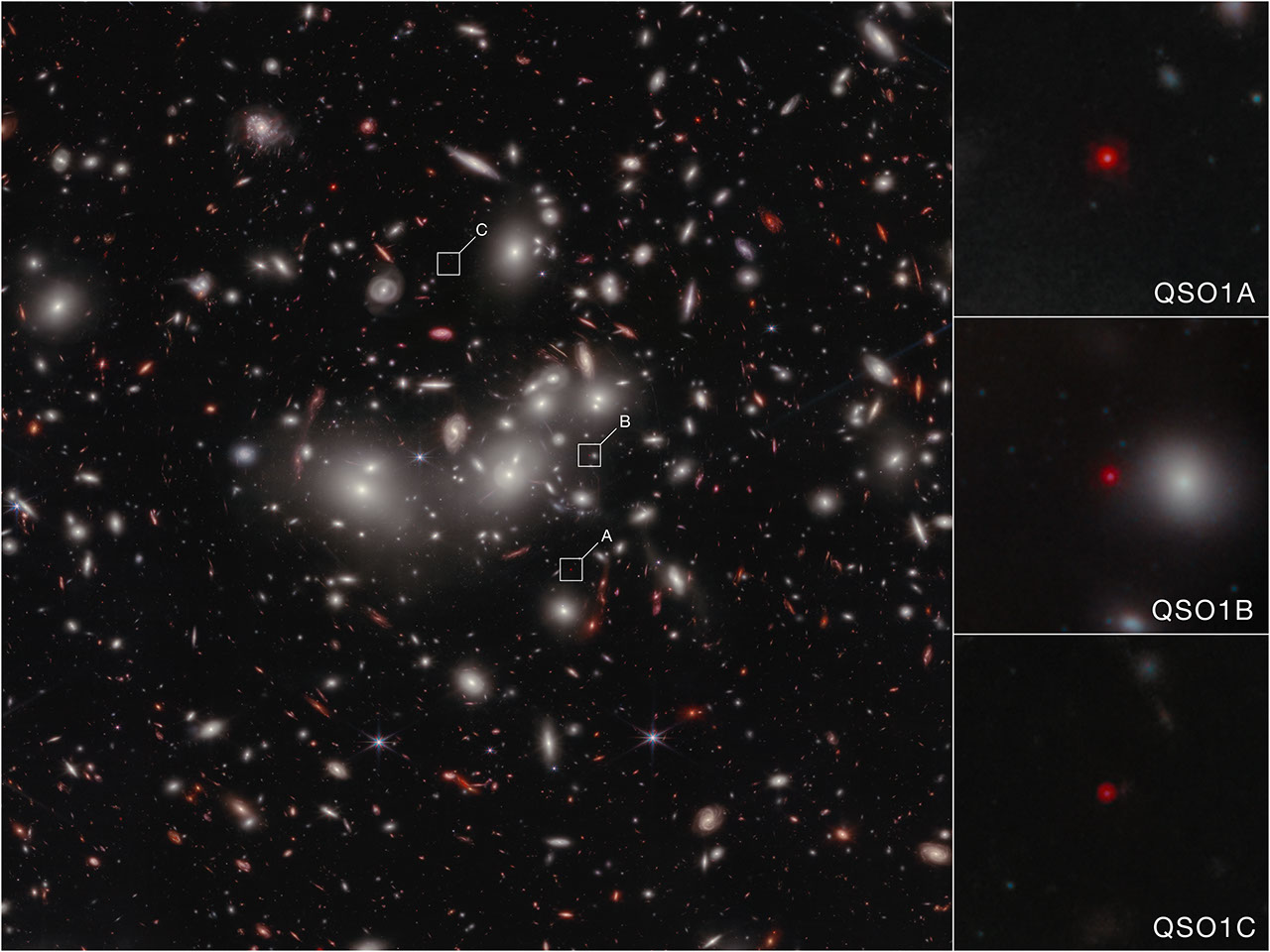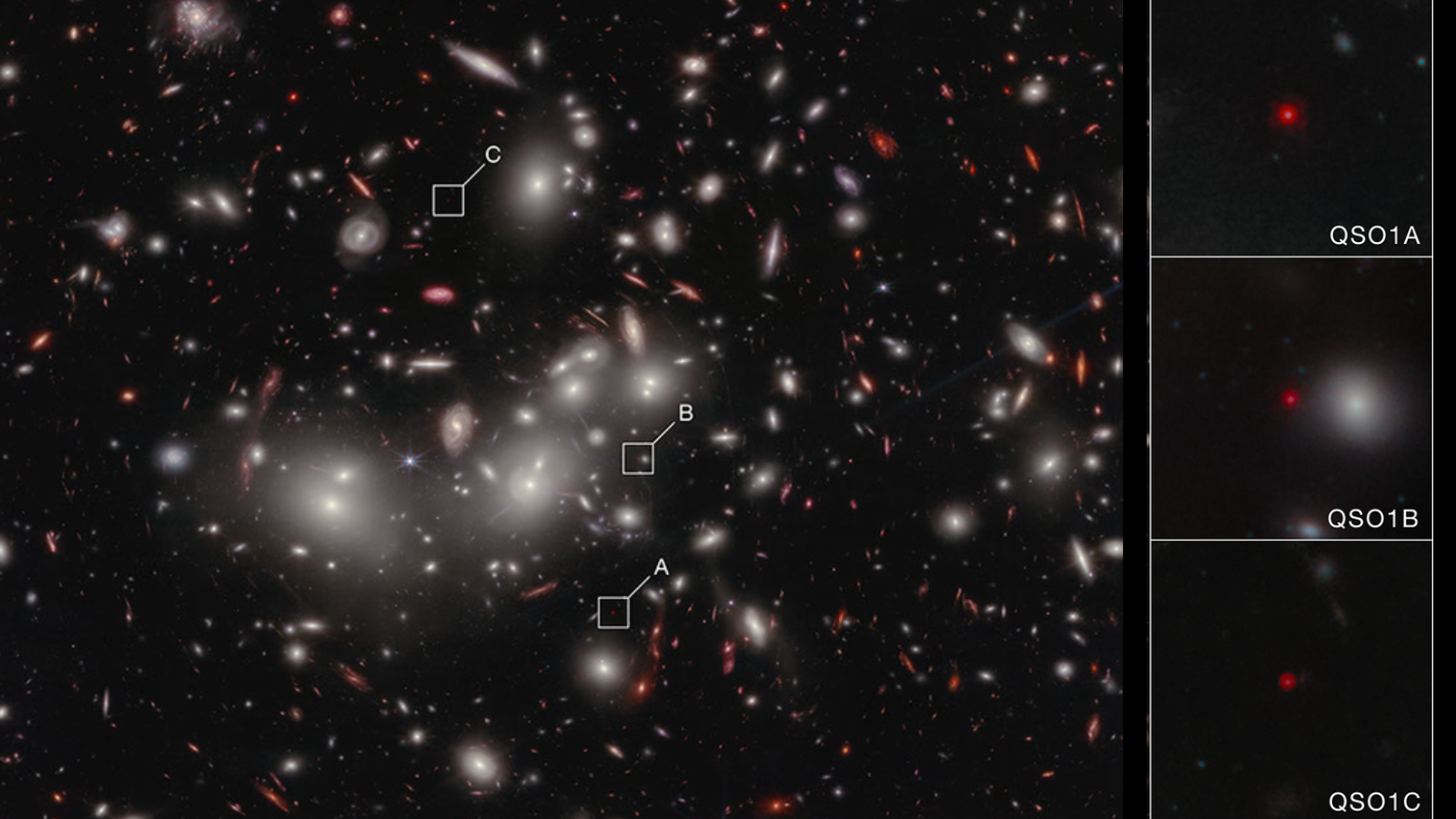
An image from NIRCam on NASA’s James Webb Space Telescope shows Little Red Dot Abell2744-QSO1, magnified and triply imaged by galaxy cluster Abell 2744 (Pandora’s Cluster).
(Image credit: NASA, ESA, CSA, Lukas Furtak (Ben-Gurion University); Image Processing: Alyssa Pagan (STScI))
Observations of ancient galaxies called "Little Red Dots" by the James Webb Space Telescope (JWST) could finally answer the question: which comes first, the black hole or its galaxy? It turns out that the answer isn't what scientists expected and could thus represent a complete paradigm shift in our understanding of how black holes grow.Little Red Dots were first spotted in 2022 by the JWST, immediately presenting themselves to astronomers as something completely new, perhaps a type of galaxy never seen before. The mystery of these objects deepened when scientists discovered that they are remarkably common in the infant universe but seem to disappear around 1.5 billion years after the Big Bang. But Little Red Dots are far from the only cosmic mystery that the JWST has dropped into the lap of scientists. The $10 billion space telescope has also discovered a wealth of supermassive black holes with masses millions to billions of times that of the sun prior to the universe being 1 billion years old. That is problematic because the feeding and merging processes that allow black holes to grow to supermassive status had always been thought to take longer than 1 billion years.This new study of Little Red Dots by the JWST indicates that maybe supermassive black holes were born directly without needing a massive star to live for millions of years before collapsing to birth a stellar-mass black hole. It also means that these early supermassive black holes would not need to gorge on copious amounts of gas and dust from their host galaxies to grow. That means these black holes could form before the galaxies that will eventually host them come together."This is a remarkable finding," team member Roberto Maiolino of the University of Cambridge in the United Kingdom, said in a statement. "It's a paradigm shift, a total revisiting of the classical scenarios of how black holes form and grow." The team's research was published on Wednesday (May 27) in the journals Nature and the Monthly Notices of the Royal Astronomical SocietyLittle Red Dots put black holes on the spot with help from EinsteinTo reach their conclusion, scientists focused on the Little Red Dot designated Abell2744-QSO1 (QSO1), which existed 700 million years after the Big Bang. This means that the light from this ancient galaxy, which is just 1,300 light-years wide, has been travelling to Earth for just over 13 billion years. QSO1 is easier to study than other Little Red Dots because of a phenomenon called gravitational lensing.First suggested by Einstein in 1915, gravitational lensing occurs when an object of great mass sits between a more distant background object and Earth. As light passes this middle or "lensing" object, its path is curved by the warp in spacetime the lensing body causes; the closer to the object the light passes, the more curved its path is. This means light from the background objects can arrive at our telescopes at different times, thus magnifying the background object.In the case of QSO1, this Little Red Dot is being gravitationally lensed by the galaxy cluster Abell 2744, also known as Pandora's Cluster.