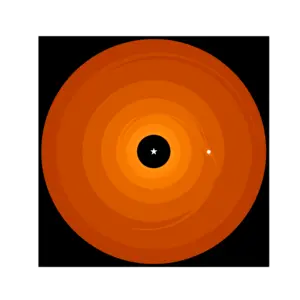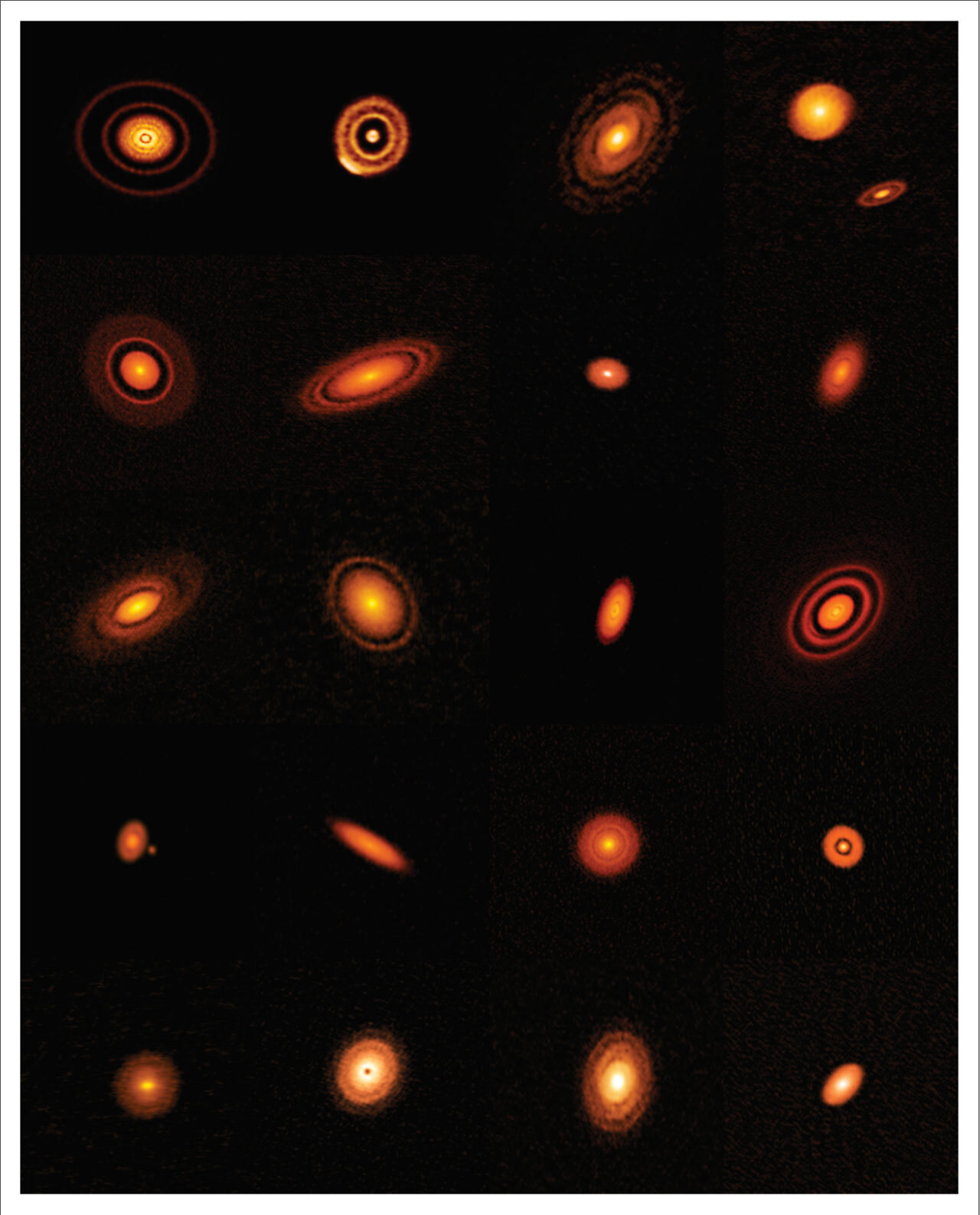
Known as the Disk Substructures at High Angular Resolution Project (DSHARP), this "Large Program" of ALMA has yielded stunning, high-resolution images of 20 nearby protoplanetary disks and given astronomers new insights into the variety of features they contain and the speed with which planets can emerge. Credit: ALMA (ESO/NAOJ/NRAO), S. Andrews et al.; NRAO/AUI/NSF, S. Dagnello.
A team of astronomers, led by University of Warwick in collaboration with researchers at MIT and McMaster, have developed a novel method to use the properties of dust rings around stars to estimate the masses of newborn planets. Published in The Astrophysical Journal, this research offers astronomers a new way to find and characterize planets that are too deeply embedded in their birth environment to be seen directly.
Swirling disks of gas and dust surrounding young stars are the environments in which planets form. New powerful telescopes, such as ALMA, have revealed that many of these protoplanetary disks contain striking ring-shaped structures. These have long been suspected to be clues to the planets potentially orbiting within the disks, but until now robust methods to interpret them have proved elusive.