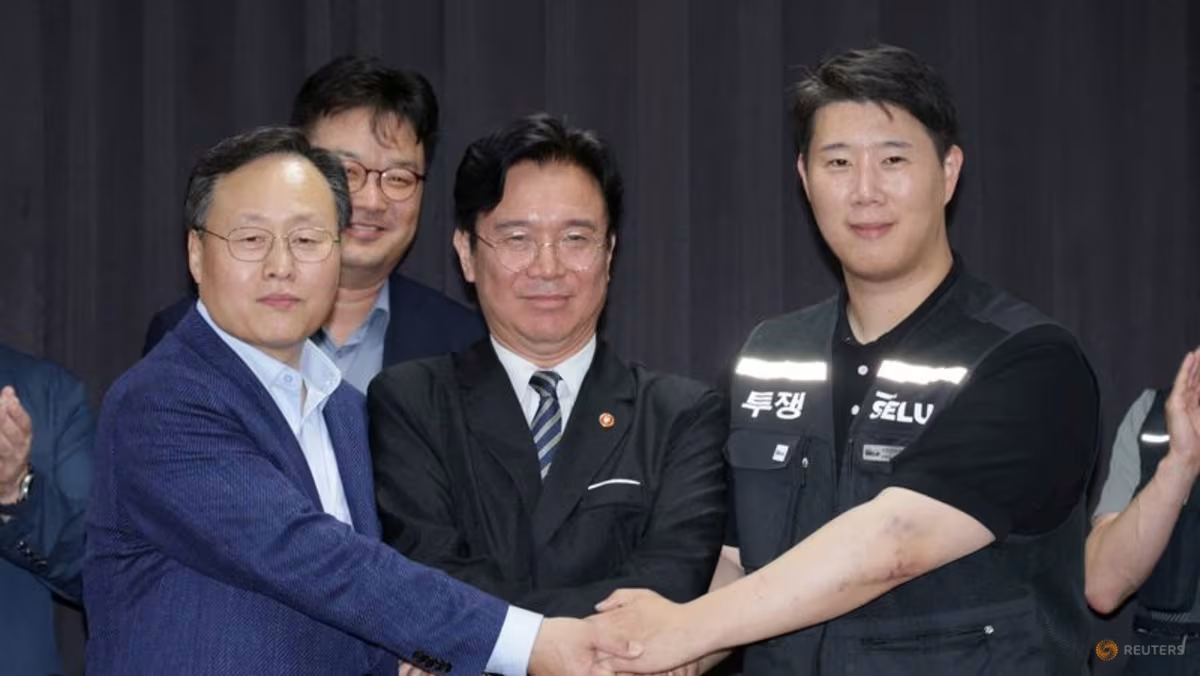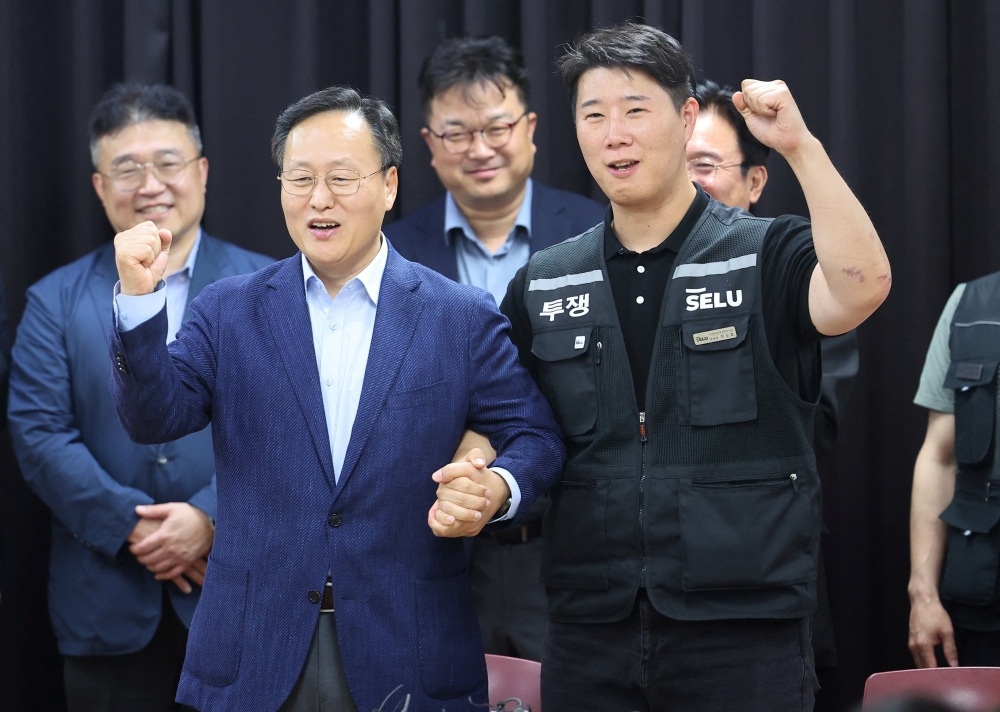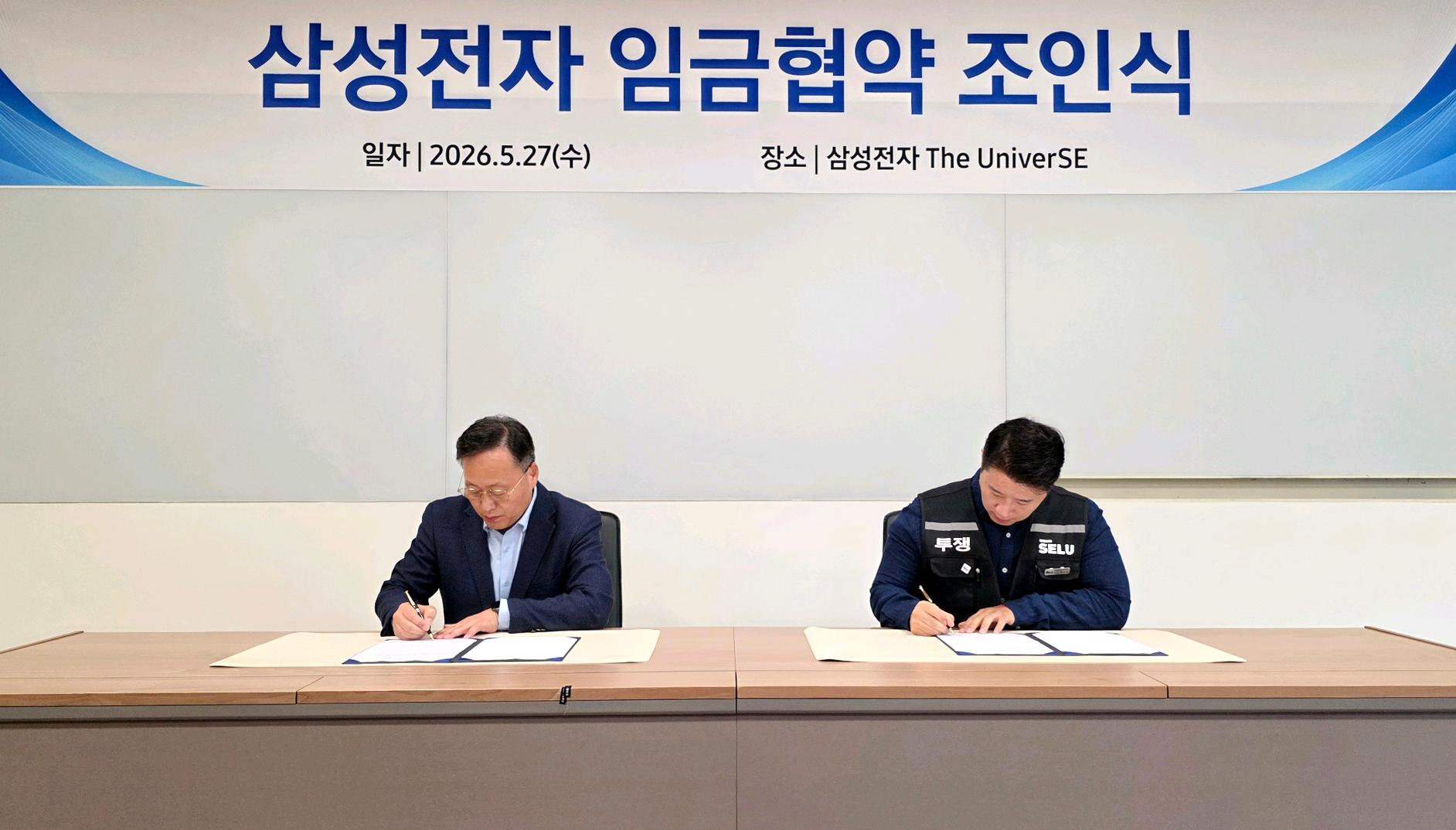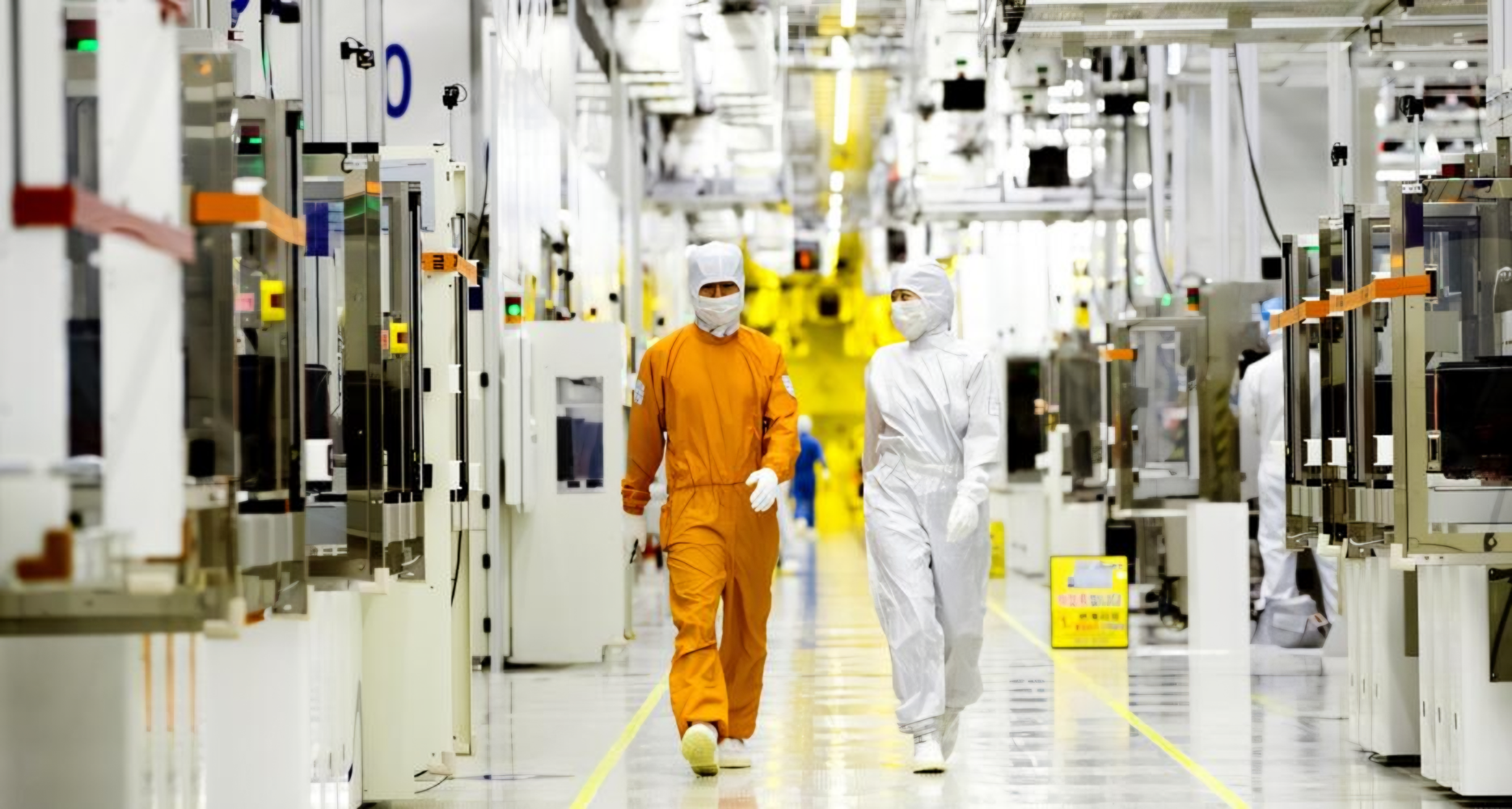
Workers walk through a semiconductor cleanroom at a Samsung Electronics chip fabrication facility in Pyeongtaek, Gyeonggi Province, April 24, 2019. Courtesy of Samsung ElectronicsThe tentative agreement signed between Samsung Electronics management and its labor union coalition on Wednesday night averted an unprecedented 18-day general walkout through a state-engineered compromise.Crucially, it also marks the birth of a new corporate-political playbook in Korea, where state pressure and minority shareholder litigation are combined to neutralize union leverage in vital hi-tech sectors.This settlement represents a significant departure from standard collective bargaining outcomes.By transforming the financial architecture of the bonus pool from immediate cash allocations to equity-linked instruments with multi-year vesting locks, the compromise established a precedent for managing labor actions within Korea’s strategically vital export industries, which introduces corporate governance frameworks as a structural counterweight to union demands.Prime Minister Kim Min-seok holds a press conference at the Government Complex Seoul, May 17, warning that the government could consider emergency adjustment measures if a planned strike at Samsung Electronics proceeds. Courtesy of Prime Minister’s OfficeStrategy of deterrence The Lee Jae Myung administration’s approach to the dispute exposed the sharp tension between its public emphasis on labor-management coexistence and the state’s reduced tolerance for operational instability within sectors critical to economic security.Throughout the standoff, the government operated a coordinated, multi-tiered messaging campaign designed to maximize psychological pressure on both negotiating teams without prematurely exhausting its administrative options.While the labor ministry maintained a public focus on facilitating dialogue, the industries ministry framed any potential disruption to automated fabrication lines as a direct threat to macroeconomic stability, export targets and Korea’s position within the global artificial intelligence supply chain.This rhetorical groundwork culminated in direct warnings from Prime Minister Kim Min-seok regarding the potential invocation of the Emergency Adjustment Authority under the Trade Union and Labor Relations Adjustment Act.In practice, the authority’s immediate value appears to have been deterrence. By law, the measure suspends all strike activities for 30 days and forces mandatory, binding arbitration upon the parties.Historical precedent illustrates why the mere mention of this authority carries such immense weight. Since its introduction in 1963, the power has been invoked only four times, most notably during the 1993 Hyundai Motor dispute and the 2005 Korean Air crisis, where the state intervened to forcibly end walkouts that threatened national transport networks and manufacturing supply chains.Rather than invoking the decree during Wednesday’s Cabinet meeting, which would have alienated the administration’s pro-labor political base less than two weeks before the June 3 local elections, the government used the imminent threat of state intervention to create a high-pressure environment.This approach helped produce an overnight breakthrough at the Gyeonggi Employment and Labor Office, allowing the administration to safeguard its economic management credentials with moderate voters while preserving the principle of an autonomous resolution.Semiconductor chips on a circuit board of a computer / Reuters-YonhapJudiciary's operational firewall The primary variable that altered the balance of leverage was the legal determination issued by the judiciary.On May 18, the Suwon District Court granted a partial injunction sought by Samsung management to restrict illegal dispute activities. The court’s decision designated 7,087 specific workers — including 2,396 safety personnel and 4,691 security and essential operations technicians — as prohibited from participating in the planned walkouts.The long-term significance of this ruling rests on the court’s interpretation of the Trade Union Act. The judiciary explicitly determined that preventing the physical degradation or spoilage of sub-nanometer semiconductor wafers during the manufacturing process qualifies as a mandatory security and maintenance task.To ensure the integrity of this firewall, the court carefully demarcated the roles of the barred personnel. While the 2,396 safety and infrastructure workers secure the physical facilities, data centers and power systems, the 4,691 security technicians are deployed across core technology pipelines: 2,454 in memory, 1,109 in foundry, 566 in the Semiconductor Research Institute and 162 in System LSI.By separating non-essential back-end logistics from automated cleanroom maintenance, the court built an operational firewall around the physical infrastructure of the technology sector.For international observers and analysts mapping supply chain vulnerabilities, this precedent demonstrates that the Korean legal framework possesses robust, institutional mechanisms to maintain baseline chip production, ensuring that critical global pipelines cannot be fully disrupted by localized industrial disputes.Samsung Electronics holds its annual general meeting of shareholders in Suwon, Gyeonggi Province, March 18. Joint Press Corps Shareholder revolt variable While the state and the judiciary restricted union leverage from an administrative perspective, investors introduced a new variable into Korean corporate risk modeling.On Thursday morning, the Korea Shareholders Movement Headquarters — an activist group representing individual and minority investors — launched a coordinated legal challenge against the financial terms of the tentative agreement.The shareholder coalition’s formal opposition rests on a precise interpretation of mandatory provisions within Korea’s Commercial Act. The group asserts that the core of the labor agreement, which allocates 10.5 percent of the semiconductor division’s operating performance to a special bonus pool, violates basic principles of corporate governance.The shareholder coalition argues that operating profits ultimately fall under the authority of the corporation’s governance and shareholder approval framework and can only be distributed to stakeholders after a corporation clears its tax liabilities, calculates net income and obtains a formal resolution from the Annual General Meeting of shareholders.Notably, President Lee stated during Wednesday’s Cabinet meeting that distributing a set percentage of gross operating profits — before taxes are deducted — is something “even investors and shareholders cannot do,” as shareholders are only entitled to dividends from net income after taxes.The legal mechanism driving this mobilization is Article 403 of the Commercial Act, which allows minority investors who hold no less than 1 percent of a company’s shares to initiate shareholder derivative lawsuits.The group also relies on Article 382 and Article 393 of the Commercial Act, which dictate the statutory duty of loyalty and duty of care for board members. They argue that a private contract between corporate management and a labor union cannot systematically parcel out a multi-billion-won slice of pre-tax operating profits.Doing so reduces the surplus capital available for research, development and advanced capital expenditures, which directly diminishes long-term shareholder value. Consequently, individual board directors could face civil liability claims if they vote to ratify an agreement that bypasses the general meeting of shareholders.This legal challenge provides a new defensive strategy for financial institutions and multinational corporations. In an era where the passage of the Yellow Envelope Act has emboldened unions to demand broader profit-sharing mechanisms, corporate management teams in globally exposed industries can now utilize the imminent threat of minority shareholder litigation as a legal shield.Board directors can formally refuse union demands regarding pre-tax profit allocations by citing their direct civil and criminal liabilities under the Commercial Act, effectively shifting the terrain of labor negotiations from factory floors to corporate governance frameworks.However, the emergence of this framework also carries long-term political risks for industrial relations. If labor unions conclude that the state, judiciary and shareholder structures are systematically aligned to constrain collective bargaining leverage within strategic sectors, future disputes may become more confrontational and less responsive to traditional mediation mechanisms.Members of the Federation of Korean Trade Unions participate in a Labor Day rally in front of the National Assembly in Seoul, May 1. Yonhap Restricted equity compromise The final terms of the tentative agreement reflect these legal and structural constraints, demonstrating how management successfully protected short-term cash liquidity and corporate stability.By refusing the union’s initial demands for an uncapped cash bonus linked to revenue, the management structured the special performance bonus to be paid entirely in after-tax treasury shares with a mandatory two-year vesting lock.This mechanism avoids immediate cash depletion while directly aligning the personal wealth of the labor union’s rank-and-file members with the daily performance of the company’s stock, effectively converting a labor force into corporate equity stakeholders.Further, management successfully defended its principle that compensation must follow performance. While the union demanded equalized baseline payouts across all business units, the final agreement imposes a financial penalty on divisions operating at a loss, limiting those units to a lower payout rate for the performance-linked portion of the bonus pool.This structural distinction preserves management’s ability to allocate resources flexibly.The structural compromises achieved at Samsung Electronics provide a blueprint for upcoming labor negotiations across other high-performing sectors of the Korean economy, including the shipbuilding industry and major digital platform providers like Kakao.As these sectors face parallel union pressures regarding profit sharing and structural bonuses, the Samsung precedent suggests that the outcome of future industrial disputes will be shaped not only by traditional labor actions, but also by a complex convergence of preventative state intervention, judicial essential-worker designations and shareholder activism.Read the article at Korea Pro.
Samsung labor settlement reveals Korea's new industrial strategy - The Korea Times
The tentative agreement signed between Samsung Electronics management and its labor union coalition on Wednesday night averted an unprecedented 18-...
1,432 words~7 min read