Skip to content
GQINewsNews – RecentNews Archive 2025News Archive 2024News Archive 2023News Archive 2022News Archive, 2021News Archive, 2020News Archive, 2019News Archive, 2018News Archive, 2015-2017AnalysisQnalysisPlayersPublic CompaniesPrivate/Startup CompaniesUniversitiesGovernment/Non-ProfitVenture CapitalVenture Capital – Sorted by Quantum CompanyResourcesConferencesToolsOther Websites and Industry AssociationsEducationBooksScorecardsGate Level Software PlatformsIBM Qiskit, Rigetti Forest, Microsoft QDK, Project QReview of the Cirq Quantum Software FrameworkQubit Implementation DashboardQubit CountQubit QualityQubit TechnologySoftware/Startup PartnersCloud Platform Hardware PartnersPodcastsAboutQCR Alerts Sign-Up FormAdvertising InquiriesQCR in the NewsContactPrivacy PolicyMembership
Flatiron Institute Tensor Network Algorithm Overturns Historical D-Wave Quantum Supremacy Claim
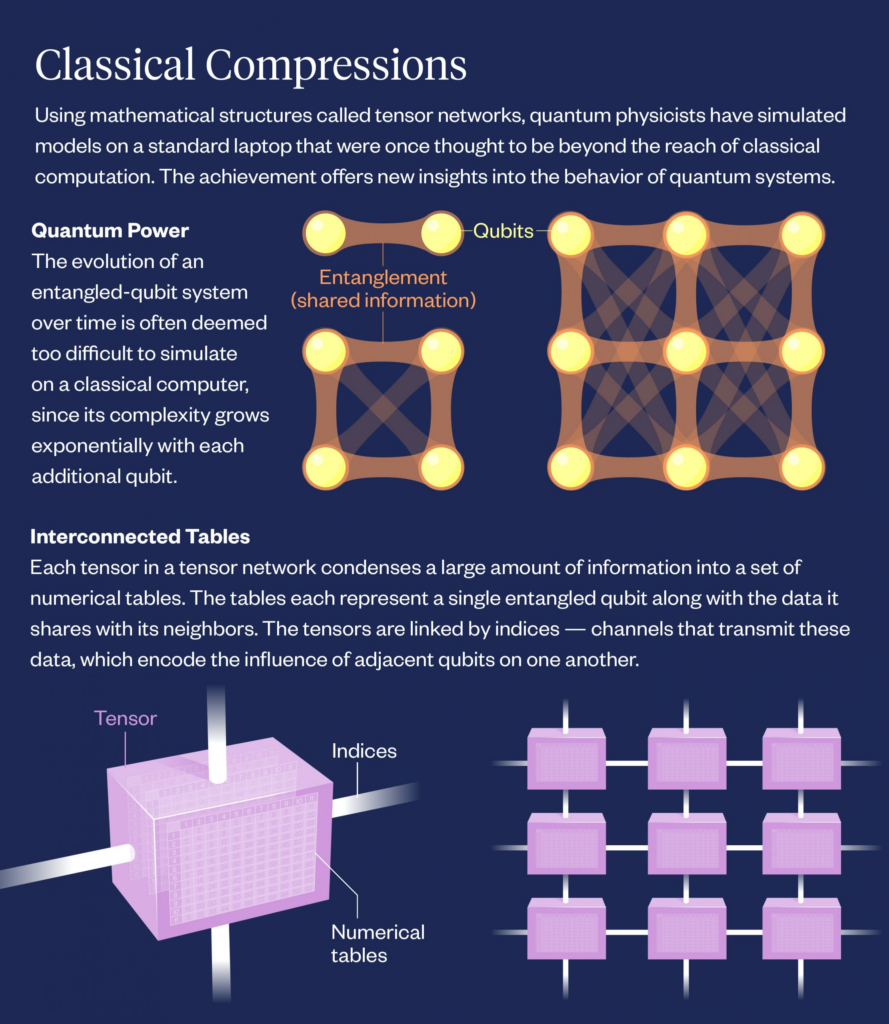
Physicists at the Center for Computational Quantum Physics (CCQ) at the Simons Foundation’s Flatiron Institute, in collaboration with Boston University, have developed a classical algorithm that successfully simulates complex three-dimensional quantum dynamics previously claimed to be impossible without a quantum computer. Published in Science, the study refutes a high-profile “beyond-classical” computation milestone reported in March 2025 by researchers utilizing D-Wave Systems’ 5,000-qubit Advantage2 superconducting quantum annealing processor. By repurposing and optimizing decades-old data compression and mathematical routing techniques, the CCQ team proved that classical workstations—and in some configurations, standard commercial laptops—can achieve state-of-the-art accuracy when calculating highly entangled quantum state progressions.