Insider Brief
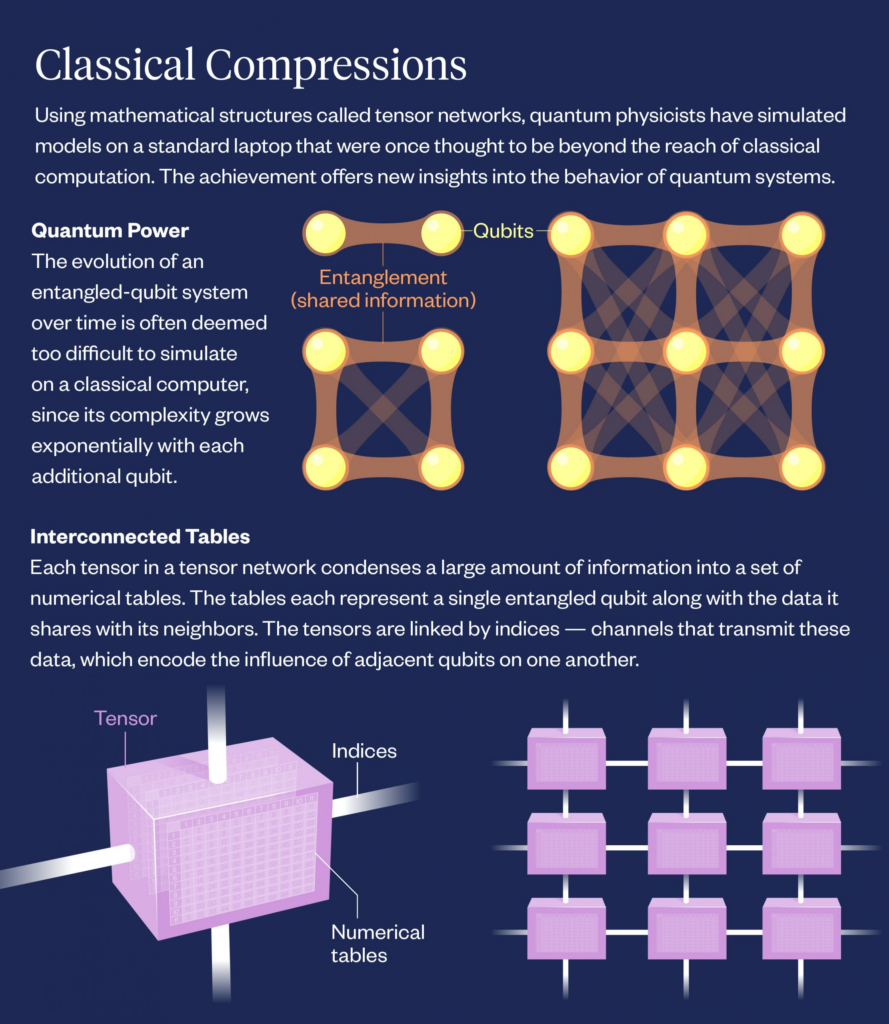
Researchers at the Simons Foundation’s Center for Computational Quantum Physics and collaborators at Boston University reported a new tensor-network-based method that allowed classical computers to simulate a complex quantum system previously claimed to be solvable only with quantum computers.
The team used advanced mathematical compression techniques and adapted “belief propagation” algorithms to model the dynamics of hundreds of interacting qubits on relatively modest hardware, including a personal laptop.
The researchers said the results matched both theoretical predictions and prior quantum computer outputs, while also pointing toward future applications in simulating quantum materials and solving large-scale optimization problems.
PRESS RELEASE — Using a conventional computer and cutting-edge mathematical tools and code, physicists at the Center for Computational Quantum Physics (CCQ) at the Simons Foundation’s Flatiron Institute and collaborators at Boston University have cracked a daunting quantum physics problem previously claimed to be solvable only by quantum computers.