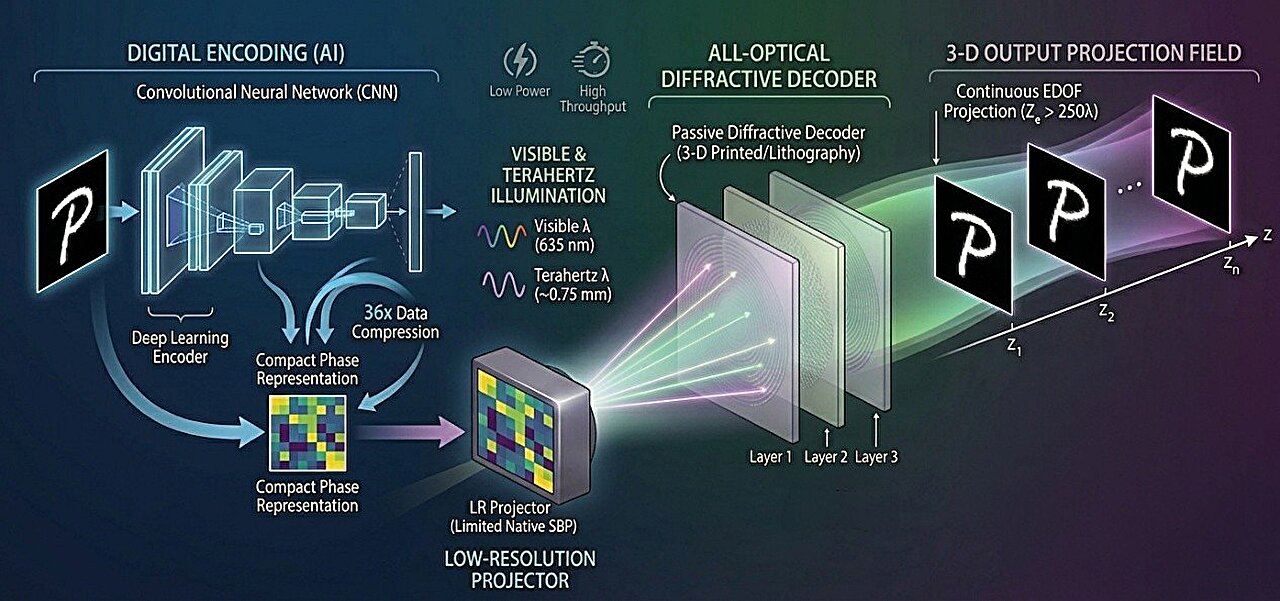
Schematic of a super-resolution diffractive image projection system featuring an extended depth of field. Credit: Ozcan Lab, UCLA
Researchers at the University of California, Los Angeles (UCLA) have developed a novel image projection system that delivers super-resolution images over an extended depth of field. By combining a neural network-based digital encoder with a passive all-optical diffractive decoder, the system drastically compresses image data for efficient transmission of image information. This platform operates without extra power at the decoding stage, promising advancements for next-generation virtual and augmented reality displays.
The study is published in the journal Light: Science & Applications.
A research team led by Professors Aydogan Ozcan and Mona Jarrahi, along with UCLA graduate student Hanlong Chen, designed a system that divides the image projection workload into two parts.
First, a digital encoder compresses input images into highly compact phase representations, significantly reducing the required data footprint; after this encoding, the resulting compressed patterns are displayed by a low-resolution phase projector.