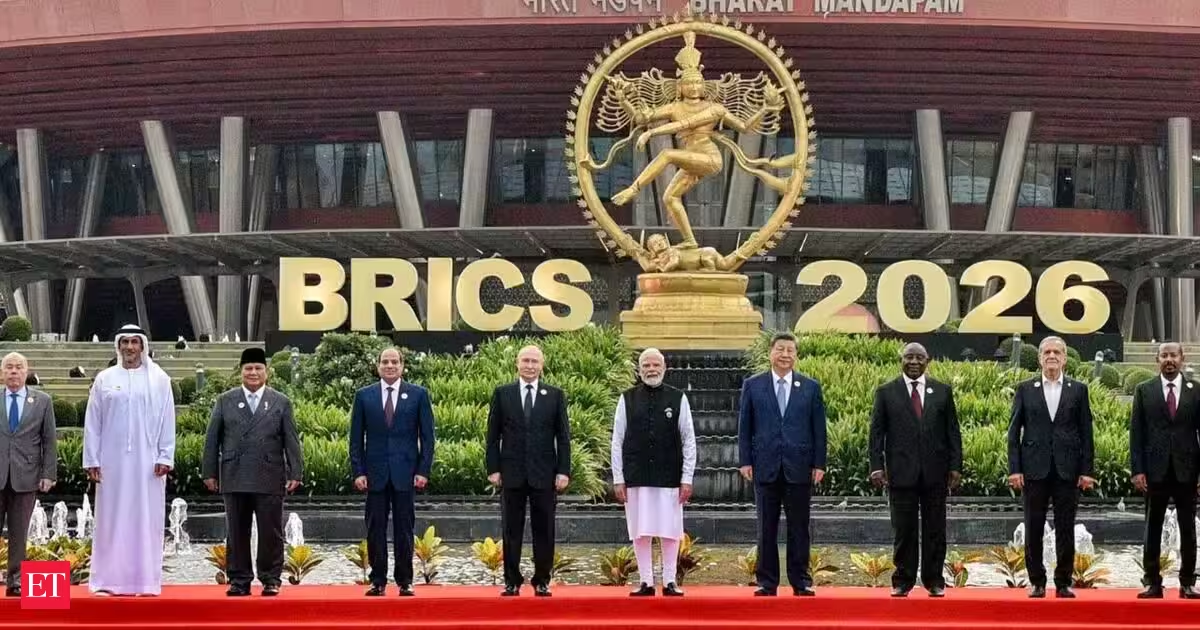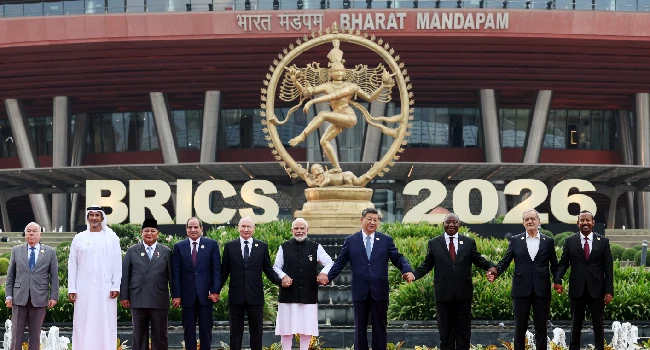
Brics’ New Delhi Declaration on Saturday condemned unilateral coercive measures such as economic and secondary sanctions, opposed discriminatory trade practices such as the carbon border tax, and sought practical solutions for cross-border payments in local currencies.India NewsLeaders acknowledged that the multilateral trading system was at a crossroads because of trade-restrictive actions, including the “indiscriminate rising of tariffs and non-tariff measures” and “protectionism under the guise of environmental objectives” — a reference to instruments like the European Union’s carbon border adjustment mechanism (CBAM).The declaration did not name any country or grouping for such violations of multilateral rules, but the allusion is unmistakable to recent tariff actions by the US government and the carbon levy imposed by developed European nations.The US and the EU have imposed economic sanctions against Russia and Iran, freezing assets worth billions of dollars, and imposed penal tariffs on third countries — so-called secondary sanctions — for buying energy from them. India itself faced a 25% punitive tariff in August 2025 for purchasing Russian crude oil and American lawmakers are poised to debate a bill that court further penalise the country as well as China.The CBAM is a levy on carbon-intensive imports such as cement, aluminium, fertilisers, chemicals including hydrogen, and iron and steel, applied mainly on goods from developing countries. Developing-country exporters could face additional duties of up to 35% in European markets under CBAM, making their merchandise uncompetitive, experts have said.Such actions, the declaration said, threaten “to further reduce global trade, disrupt global supply chains, and introduce uncertainty into international economic and trade activities, potentially exacerbating existing economic disparities” and negatively affect prospects for global economic development.“We voice serious concerns about the rise of unilateral tariff and non-tariff measures which distort trade and are inconsistent with WTO rules,” the document said. At the Brics Business Forum in New Delhi on Friday, Russian President Vladimir Putin said Russia had been hit with more than 30,000 sanctions.“We condemn the imposition of unilateral coercive measures that are contrary to international law, and reiterate that such measures, inter alia in the form of unilateral economic sanctions and secondary sanctions, have far-reaching negative implications for the human rights, including the rights to development, health and food security, of the general population of targeted states, disproportionally affecting the poor and people in vulnerable situations, deepening the digital divide and exacerbating environmental challenges,” the declaration said.The declaration also acknowledged the efforts of the Brics Payment Task Force (BPTF) in exploring pragmatic solutions for cross-border payment mechanisms, “drawing on the guidance, provided by us in the Kazan and Rio Declarations, on the Brics Cross-Border Payments Initiative”, and the work done to study “the cross-border interoperability of payment and messaging channels, and the discussions on promoting trade settlements and investments using Brics local currencies, while respecting national priorities and acknowledging that there is no one-size-fits-all approach.”The Kazan Declaration of October 2024 and the Rio Declaration of July 2025 — cited by leaders in New Delhi as the guidance basis for the payments task force — had earlier drawn sharp responses from US President Donald Trump. Days after the Kazan Summit, where Brics leaders discussed non-dollar trade settlements, Trump — then President-elect — threatened a 100% tariff on member states if they created a new Brics currency or backed any alternative to the US dollar. He repeated the threat in late January 2025, and while leaders were meeting in Rio last July, warned of an additional 10% tariff on any country “aligning themselves with the anti-American policies of BRICS”.The task force was encouraged to continue work “to facilitate practical solutions for cross-border payments among Brics countries, which are fast, low-cost, more accessible, efficient, transparent, and safe”. The BPTF became part of the Brics financial agenda during Russia’s chairship in 2020 and was specifically mentioned in the Moscow Declaration adopted at the XII Brics Summit on November 17, 2020.Brics leaders called for the elimination of such “unlawful” measures that undermine international law and the principles and purposes of the UN Charter.Brics is a bloc of 21 countries. Its 11 members are Brazil, China, Egypt, Ethiopia, India, Indonesia, Iran, Russia, Saudi Arabia, South Africa and the United Arab Emirates, and its 10 partner countries are Belarus, Bolivia, Kazakhstan, Cuba, Malaysia, Nigeria, Thailand, Uganda, Uzbekistan and Vietnam.Experts said the bloc was keen to promote local currencies to reduce over-dependence on the whims of developed countries and insulate itself against unilateral sanctions.Leaders reaffirmed their commitment to deepen “pragmatic economic cooperation” and to advance a “closer economic partnership” among members. “We recognise that the Strategy for Brics Economic Partnership continues to serve as the overarching framework guiding our cooperation, providing the basis for the further development of sectoral strategies, programmes and roadmaps under the ownership of member countries,” they said.
BRICS backs local currency transfers, flags ‘indiscriminate’ tariffs and sanctions
The New Delhi declaration did not explicitly name any country or grouping for such violations of multilateral rules. | India News
789 words~4 min read