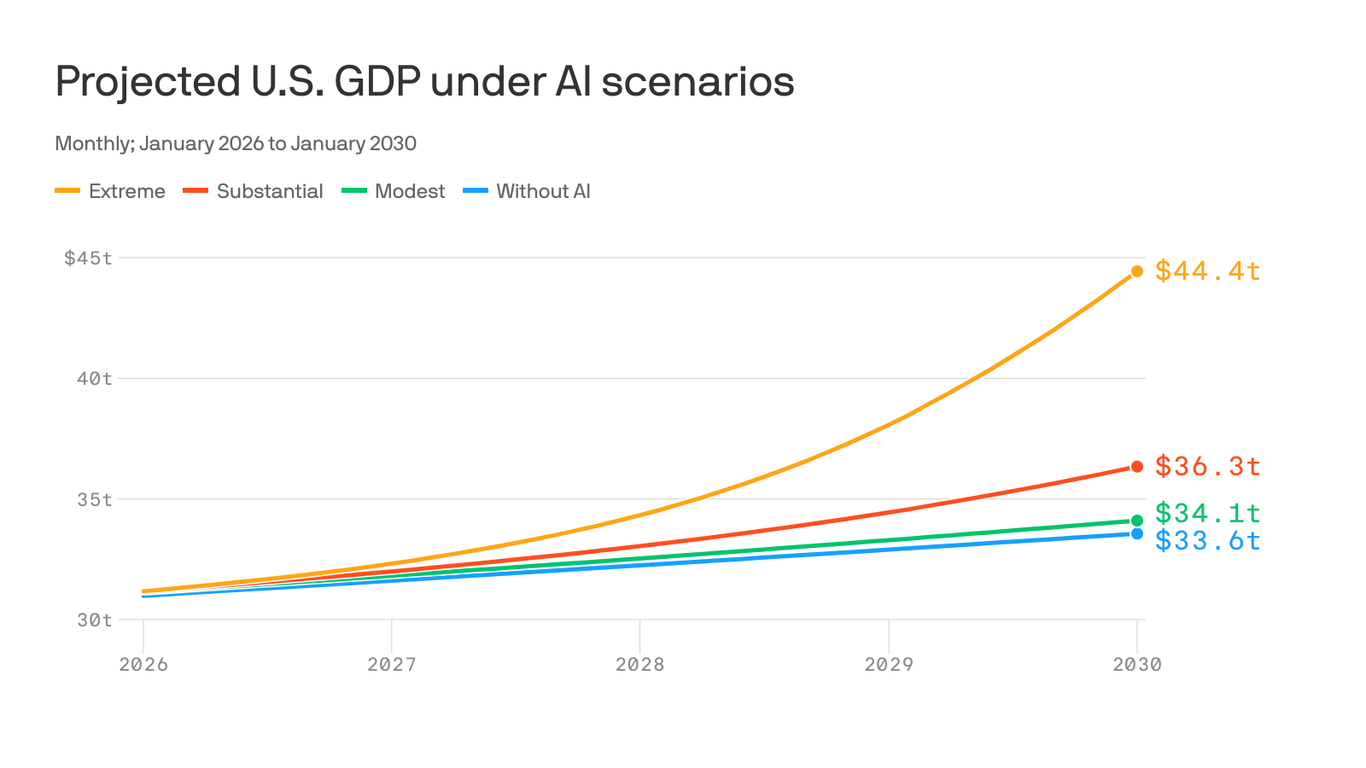
Artificial intelligence could significantly accelerate economic growth by 2030, but faster AI adoption may also put pressure on employment and wages of knowledge workers, particularly in scenarios where AI becomes capable of autonomously performing a large share of knowledge-intensive tasks, according to Anthropic's latest economic outlook.Anthropic's Economics team, in its "Scenarios for our Economic Future" report, has modelled three possible paths for the US economy by 2030 — modest, substantial and extreme — depending on the pace of AI capability development, adoption and productivity gains. The report said AI is expected to increase economic output across all three scenarios, although the scale of gains could vary significantly."AI drives GDP growth in all scenarios, although the scale varies enormously depending on the scenario," Anthropic said.Under the modest scenario, AI's economic impact is comparable to that of the internet and results in gradual gains within the historical range of technological advances. Under the substantial scenario, AI could perform half of all knowledge work by 2030, with the economy growing at about twice its normal rate.In this scenario, US GDP in 2030 is projected at $36.3 trillion, or 8.3 per cent higher than it would be without AI. In the extreme scenario, GDP could reach $44.4 trillion, 32.4 per cent above the baseline. However, the report cautioned that the economic gains may not be evenly distributed among workers. In the substantial scenario, wages of knowledge workers could remain broadly flat, while workers in other occupations could see stronger wage growth.The extreme scenario presents a much sharper transformation, with AI becoming more productive than humans across most knowledge-work tasks and performing nearly all such work autonomously. Anthropic said annual GDP growth could reach 15 per cent in this scenario, allowing the economy to double in size every 4.5 years. At the same time, the rapid automation of knowledge work could result in significantly higher unemployment and lower wages for affected workers.Anthropic noted that workers displaced from knowledge-intensive occupations could face difficulties in transitioning to other professions, as changing occupations often requires acquiring new skills and finding suitable employment.The report also highlighted a potential shift in the distribution of economic gains from labour towards capital as AI adoption increases. Currently, about 60 per cent of economic output goes to workers and 40 per cent to capital, but the capital share could rise substantially in more transformative AI scenarios.In the extreme scenario, Anthropic estimates that labour could receive 45.2 per cent of GDP, while capital's share could rise to 54.8 per cent."The future is not predetermined," Anthropic said, stressing that the eventual economic outcome would depend on AI capabilities, adoption decisions by companies and workers, and how the financial benefits of the technology are distributed.The report noted that the central challenge in the most transformative scenario may not be generating economic growth, but ensuring that the gains from AI are broadly shared while limiting the costs of job displacement and unequal distribution. Published on September 10, 2026
Anthropic sees AI driving GDP growth, but warns of job losses, wage pressure for knowledge workers
The report projects substantial economic gains from faster AI adoption, but cautions that displaced workers could struggle to transition as automation reshapes knowledge-intensive jobs and pushes more income towards capital.
TL;DRAI
Anthropic projects AI drives US GDP to $36.3-44.4 trillion by 2030, but risks wage stagnation and displacement for knowledge workers. Capital's share could rise to 54.8% (from 40%), signaling a wealth shift that requires tech leaders to rethink workforce strategy.
491 words~2 min read