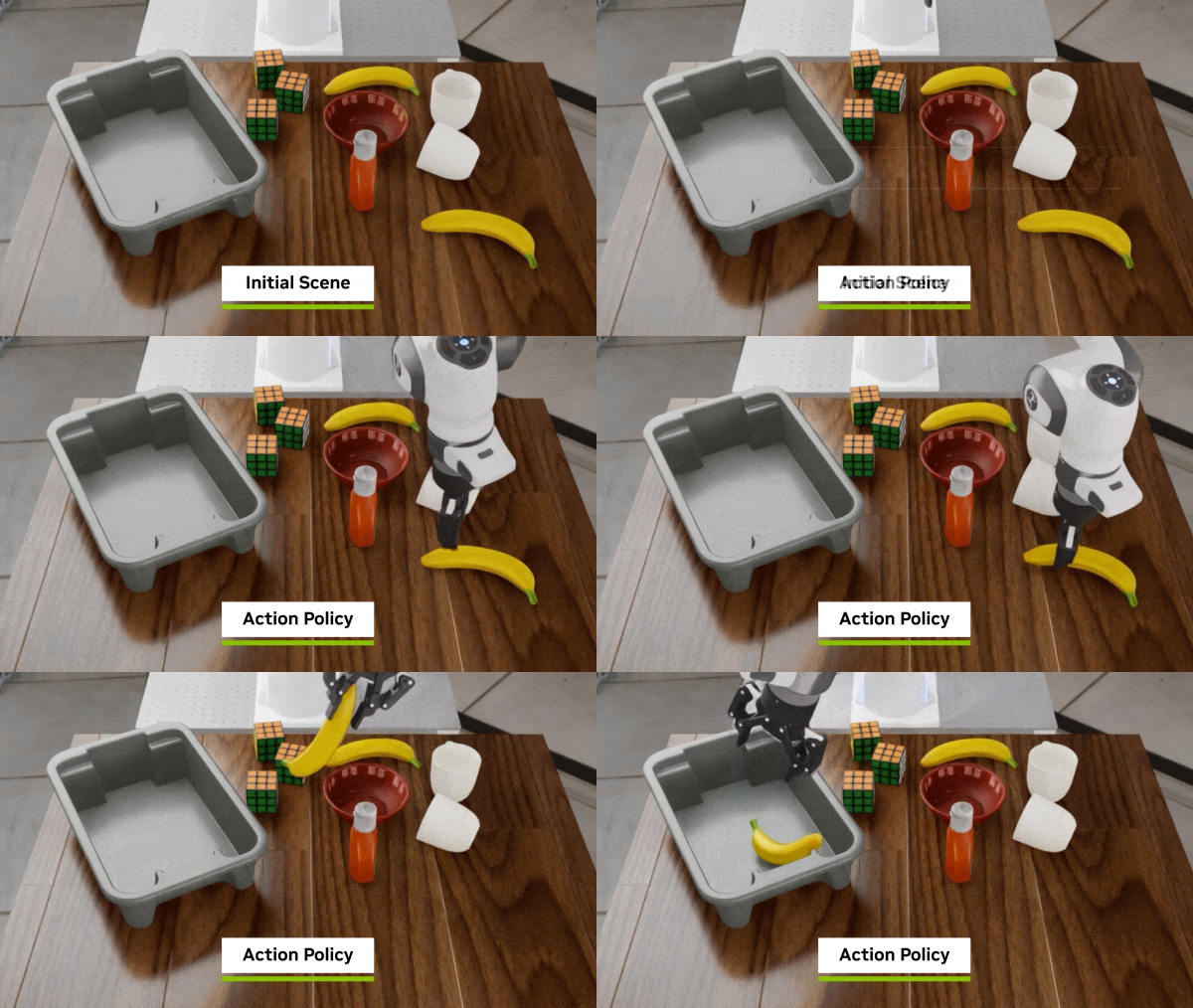
A vision‑language backbone can significantly reduce robot training data requirements, addressing the reliance on extensive teleoperation recordings. EXIMO flips that script: a pretrained multimodal encoder drives exploration, letting the robot learn long‑horizon manipulation with dramatically fewer environment interactions.
Before EXIMO, state‑of‑the‑art manipulation relied on behaviour cloning from massive teleoperation datasets and on‑policy reinforcement learning that spirals in sample cost. The dominant VLA models sit at billions of parameters and demand hundreds of hours of human control to cover new tasks — a bottleneck that has limited rapid iteration in embodied AI.
EXIMO compresses the finetuning workflow into three stages—explore, imitate, and optimise—thereby eliminating redundant data collection loops. The three‑stage design lets a vision‑language model plan subgoals for the VLA, which then gathers an orchestrated dataset before a brief off‑policy RL polish [1].
When the VLM planner is added, success rates jump sharply while wall‑clock time to solve each task stays unchanged. “VLM orchestration significantly increases the success rate of GROD while maintaining similar time to success,” the authors report, showing that richer visual‑language reasoning does not slow execution [1].