Navigation enables a robot to turn perception and motion into purposeful autonomy. Unlike locomotion, which produces stable movement, navigation must be used to continuously localize the robot, interpret changing surroundings, select a route, and avoid obstacles to reach a goal safely.
Moving this capability to a new robot or scene can require new data, simulation assets, robot interfaces, training, diagnosis, and evaluation. Repeating that work for every robot-scene pair is expensive and difficult to reproduce.
An agent-driven workflow reduces this burden. The developer defines the robot, scene source, and navigation goal. A coding agent uses repository skills to validate dependencies, prepare assets, run smoke tests, launch training, diagnose failures, and compare checkpoints. Human approval gates control scene acceptance, the one-environment smoke test, and checkpoint promotion.
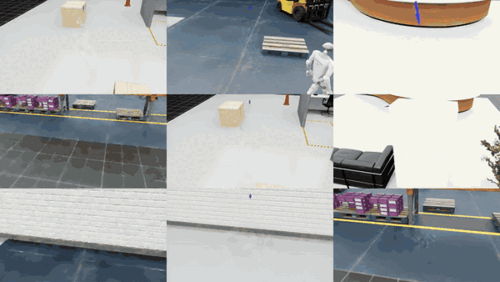
Using Spot as the reference robot, this post tutorial applies an agent-driven COMPASS workflow to a built-in scene and a SAGE-10K scene, while showing how NVIDIA Omniverse NuRec supports captured environments. It follows the policy workflow through smoke testing, residual training, checkpoint evaluation, and runtime integration, including optional odometry.