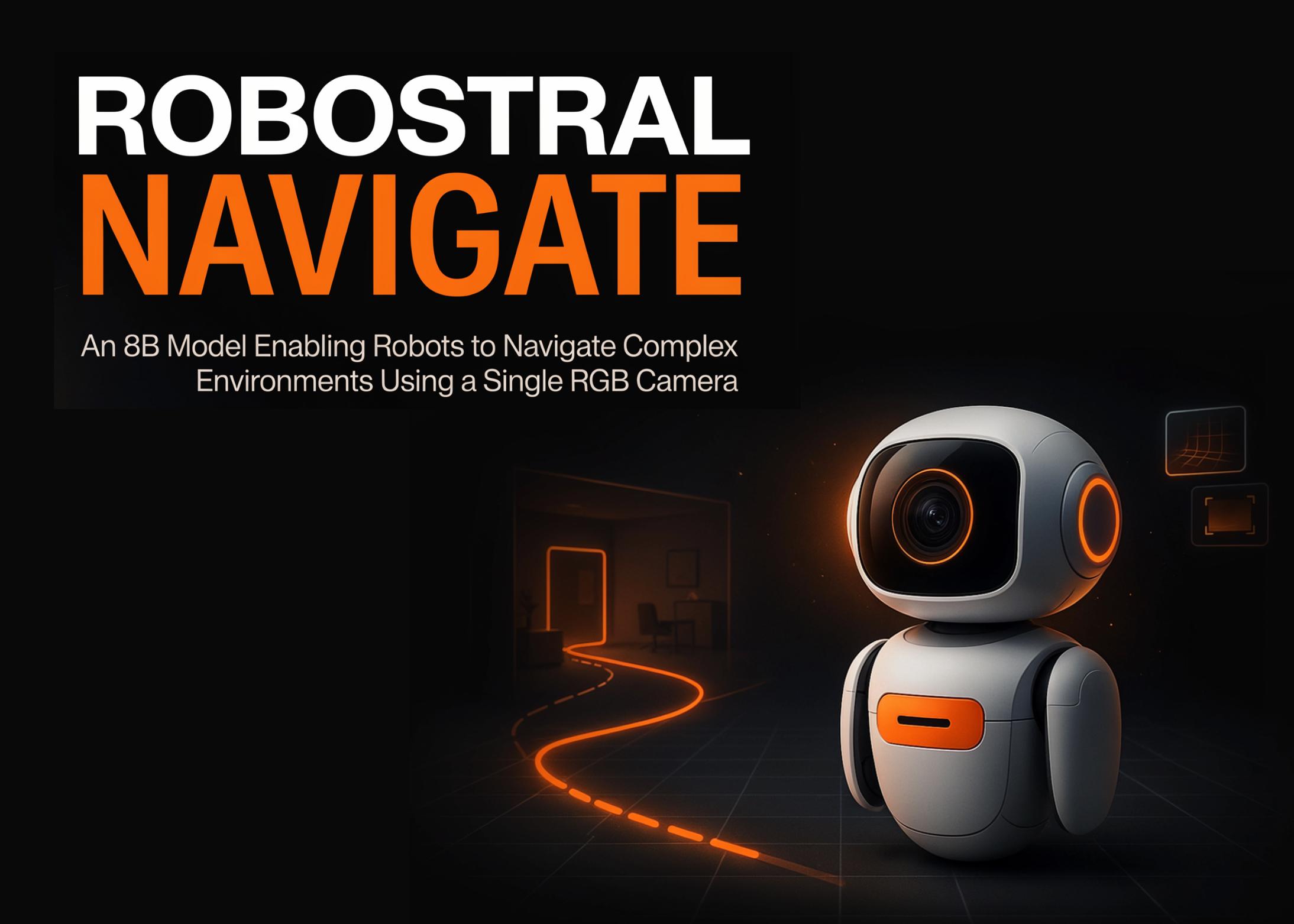
Mistral AI has made its first serious move into robotics with Robostral Navigate, an 8-billion-parameter model designed to help robots move through real-world spaces using a single camera and natural language instructions.About The AuthorAshna is a content writer who focuses on making everyday choices easier and smarter. With a strong eye for detail and a natural sense of what works in real life, she creates content that feels honest, relatable, and genuinely helpful. She is a geek for writing stories around fashion, beauty, and influential products, while bringing the same depth and detail in reviewing tech products and gadgets of day-to-day use.
Her work mainly revolves around product reviews, tech buying guides, and lifestyle edits, where she breaks down features in a way that is simple to understand but still meaningful. Instead of just listing specs, she connects products to real needs, whether it’s comfort, style, practicality, or value for money.
Her writing style is clear, conversational, and reader-first. She believes that good content should not confuse people but guide them. With a background in journalism and mass communication, she utilises content writing as a means to convey her emotions. When she puts her pen down, she keeps looking for the best movies to watch while enjoying her cold brew.The French AI company says Robostral Navigate can take a live RGB camera feed and a command such as asking a robot to leave one room, move through a corridor and stop facing a specific object. The model then decides where the robot should go next. The important part is what it does not need: no LiDAR, no depth sensor, and no multi-camera rig. Mistral says the model uses only one ordinary RGB camera.That is why the launch matters. Robot navigation usually depends on several sensors working together. LiDAR helps a robot judge distance. Depth cameras help it understand 3D space. Multiple cameras can give the robot a wider view. These systems work, but they make robots more expensive, more complex and harder to deploy at scale.Robostral Navigate tries to simplify that setup. It asks a direct question: can a robot move through a complicated space using the kind of camera that already exists on cheap hardware? Mistral's answer is yes, at least on the benchmark results it has published.What Makes Robostral Navigate Special?Robostral Navigate is special because it lets robots navigate using only one RGB camera and a text instruction. Most robot navigation systems rely on LiDAR, depth sensors or multiple cameras to understand the world around them. Mistral's model uses a simpler setup and still claims strong benchmark performance, scoring 76.6 per cent on the R2R-CE unseen-environment test and 79.4 per cent on the seen-environment test. It is meant for robots used in offices, warehouses, logistics, delivery, manufacturing and service environments.Why Mistral Is Entering Robotics NowMistral built its reputation on language models. Robostral Navigate moves the company into embodied AI, a field where AI systems control machines that move in physical spaces.This is not a small shift. The AI industry is moving beyond chatbots, coding assistants and document tools into robots that can understand instructions and act in the real world. Reuters reported that Mistral's robotics launch is aimed at industrial use cases such as factories, warehouses and automation, and follows the company's acquisition of Austria-based Emmi AI in May.More articles by AuthorTrending StoriesThat acquisition is part of the wider picture. Emmi AI works on models for physical simulation, including airflow, heat transfer and material stress. Reuters reported that Mistral sees these capabilities as useful for industrial clients in sectors such as aerospace, automotive and semiconductors.Robotics is a natural next step. If AI can understand text, images and code, the next commercial challenge is getting it to understand space, motion and physical constraints. That is where models such as Robostral Navigate come in.How Robostral Navigate WorksRobostral Navigate uses a method Mistral calls pointing-based navigation.In simple language, the model looks at what the robot's camera can see and predicts a point in the image where the robot should move next. It also predicts the direction the robot should face when it reaches that point.This matters because the model does not need to build a detailed 3D map in the traditional way. It does not need a LiDAR scan of the room. It does not need a depth camera to calculate every distance. It works from the visual scene in front of it.When the target is not visible, the model falls back on local movement instructions such as moving forward, shifting left or turning by a certain angle until it can continue. Mistral says this approach makes the model more robust to changes in camera specifications and world scale.That sounds technical, but the basic idea is easy to follow. Instead of telling a robot, "Build a full 3D map, calculate the shortest route, then move," Robostral Navigate tells it, "Look at what you can see, pick where to go next, and keep adjusting as the scene changes."Why No LiDAR MattersLiDAR is useful, but it adds cost.A LiDAR sensor sends out light pulses and measures how long they take to return. That helps robots, autonomous vehicles and drones understand distance and shape. It is powerful, especially in industrial and autonomous driving systems.But LiDAR also increases hardware cost, power use and complexity. It can make a robot more expensive to build and harder to maintain. For companies trying to deploy robots in warehouses, offices, hotels or delivery routes, that matters.A single-camera system could lower the barrier.If Robostral Navigate works reliably outside benchmarks, it could make autonomous navigation cheaper and easier to integrate into different kinds of robots. A warehouse robot, a service robot in a hotel, a delivery robot or a small inspection robot may not need the same expensive sensor stack if a camera-only navigation model can do enough of the job.That does not mean LiDAR will disappear. For safety-critical use cases, multi-sensor systems will still matter. A camera-only model can struggle in low light, glare, smoke, reflective surfaces or visually confusing environments. But Mistral's approach is important because it challenges the assumption that advanced navigation always needs expensive hardware.How Well Did It Perform?Mistral says Robostral Navigate achieved a 76.6 per cent success rate on the R2R-CE validation unseen benchmark and 79.4 per cent on the validation seen benchmark. R2R-CE, or Room-to-Room in Continuous Environments, is used to test how well an embodied agent can follow language instructions in realistic 3D environments.The unseen score matters more because it tests performance in environments the model has not seen during training. That is closer to the real-world challenge. A robot may work well in a room it knows, but the real test is whether it can handle a different office, warehouse, hotel corridor or home layout.Mistral also claims Robostral Navigate beats the best single-camera approach by 9.7 points and the best system using depth sensors or multiple cameras by 4.5 points on the unseen benchmark, despite using only one RGB camera.These are Mistral's own reported results. They are important, but they should still be treated as company-published benchmarks until independent researchers and customers test the model in more varied real-world settings.MetricRobostral NavigateModel size8 billion parametersCamera requirementSingle RGB cameraLiDAR requiredNoDepth sensor requiredNoR2R-CE seen success rate79.4%R2R-CE unseen success rate76.6%Training dataAbout 400,000 simulated trajectories across 6,000 scenesRobot types supportedWheeled, legged and flying robotsPublic pricingNot announcedHow Mistral Trained ItMistral says Robostral Navigate was trained entirely in simulation. The company generated around 400,000 trajectories across 6,000 scenes, giving the model a large set of navigation examples without needing to physically run robots through thousands of real spaces.That is important because robotics data is hard to collect. Training a chatbot can involve large amounts of text from digital sources. Training a robot is messier. Robots need examples of movement, space, obstacles, mistakes and recovery. Collecting that data in the real world takes time, hardware and money.Simulation helps reduce that cost. It lets researchers create many virtual environments, run navigation tasks at scale and train the model before trying it on physical robots.Mistral also says it used a training method based on prefix caching, which reduced training tokens by 22 times compared with a more direct training approach. The company says this helped turn training runs that could take months into runs that finished in days. It then used online reinforcement learning to improve performance, with the reinforcement learning stage adding 3.2 percentage points to the success rate.In simple terms, the model first learns from examples. Then it improves by trial and error.What Kinds Of Robots Can Use It?Mistral says Robostral Navigate is built to work across different robot types, including wheeled robots, legged robots and flying robots. It also says the model can generalise across robot sizes and different camera specifications.That is an important claim.Many robotics systems are tightly linked to one hardware platform. A model trained for a wheeled warehouse robot may not work on a drone. A system built around a specific camera placement may not work well if the camera is moved or replaced.If Robostral Navigate can adapt across hardware, it becomes more useful for businesses that already have different robot fleets. A logistics company may use wheeled robots. A factory may use inspection drones. A research lab may test legged robots. One navigation model that can operate across those bodies would be easier to scale than a separate navigation stack for each machine.Again, this is the promise. Real-world deployment will decide how far the claim holds.What It Can And Cannot DoRobostral Navigate is a navigation model. It helps robots move through space.It does not solve the entire robotics problem.It does not pick up boxes, fold clothes, open doors, manipulate tools or handle delicate objects. Reuters also noted that the system is focused on navigation rather than object handling or manipulation.That distinction matters. Robotics is not one problem. It is many problems stacked together. A useful robot must understand instructions, see the world, plan a route, avoid people, move safely, recognise objects, manipulate items and recover when something goes wrong.Robostral Navigate addresses one major part of that stack: movement.That still matters because navigation is one of the foundation layers. Before a robot can clean a room, deliver a package, inspect a shelf or assist a worker, it first needs to get to the right place without crashing into people or objects.Where It Could Be UsedMistral is pointing Robostral Navigate towards practical indoor and industrial use cases. The company mentions offices, homes, commercial buildings and outdoor settings, while also naming manufacturing, delivery, logistics and hospitality as target areas.The most realistic early use cases are likely to be controlled environments.Warehouses are one obvious example. Robots already move goods inside storage facilities, but many still rely on maps, beacons, markers or controlled paths. A model that can follow a plain-language instruction through a changing space could make deployments more flexible.Hotels and hospitals are another possible area. Service robots need to move through corridors, lifts and rooms while avoiding people. Offices and factories could use navigation models for inspection, delivery or patrol tasks.Homes are harder. Domestic spaces are unpredictable. They have pets, children, furniture, clutter, mirrors, cables and awkward lighting. A camera-only navigation system would need strong safety checks before it could be trusted there.Outdoor navigation is even more difficult because lighting, weather, terrain and moving objects change constantly. Mistral says outdoor spaces are part of its ambition, but the immediate value is likely to come from indoor and semi-controlled deployments.The Competition: Google, Nvidia, Genesis And OthersMistral is entering a crowded race.Google DeepMind has already introduced Gemini Robotics, a vision-language-action model built to help robots understand instructions and perform physical tasks. The Gemini Robotics research paper describes models that can directly control robots, deal with unseen environments and handle tasks involving manipulation, spatial understanding and motion.Nvidia has also pushed heavily into physical AI. Its GR00T N1 research paper describes an open foundation model for humanoid robots that uses a vision-language-action architecture and is trained on robot trajectories, human videos and synthetic data.Mistral also faces European competition. Reuters reported that Paris-based Genesis AI unveiled a broader robotics model earlier this year that includes both navigation and manipulation features, along with a robotic hand aimed at dexterous tasks.That is what makes Robostral Navigate interesting. Mistral is not trying to solve every robotics problem in one launch. It is starting with navigation, and it is doing so with a cost-reduction argument: one camera, no LiDAR, fewer sensors.Why This Matters For MistralRobostral Navigate shows that Mistral wants to be more than a language model company.The company already competes in enterprise AI, coding, document intelligence and multimodal models. Robotics gives it a way to enter industrial AI, where European companies may have a stronger natural customer base.Reuters reported that Mistral has clients including Stellantis, Veolia and drone manufacturer Helsing, and that the company believes purpose-built models trained around client data can beat general off-the-shelf models for industrial work.That matters because Europe has deep manufacturing, automotive, aerospace and industrial robotics expertise. Mistral can pitch itself as the local AI layer for those sectors, rather than trying to compete only as a chatbot company against OpenAI, Google or Anthropic.The Big CaveatRobostral Navigate looks promising, but it is not yet proof that camera-only robot navigation is solved.Benchmarks are useful, but robots fail in strange ways in the real world. Reflections, glass doors, moving people, poor lighting, narrow corridors, confusing signage and unexpected obstacles can all break systems that look strong in simulation.Mistral says the model can handle obstacles and spaces it was not shown during training. That is encouraging. But businesses will still want field trials, safety validation, uptime data and clear deployment costs before putting robots into real operations.There is also no public pricing yet. Mistral's post directs interested users to talk to its team, which suggests this is not a simple open consumer product with a ready-made public price list.Why Robostral Navigate Is ImportantRobostral Navigate matters because it targets one of the biggest barriers in robotics: cost and complexity.If robots need expensive sensors, custom maps and heavy engineering for every site, adoption remains slow. If they can navigate with a cheaper camera setup and natural-language instructions, more companies may be willing to test them.The larger shift is clear. AI companies are no longer satisfied with models that only answer questions on a screen. They now want models that can see, move and act.Mistral's bet is that navigation is the right first step.Frequently Asked QuestionsWhat is Mistral AI Robostral Navigate?Robostral Navigate is Mistral AI's first model built for embodied navigation. It is an 8-billion-parameter model that helps robots move through environments using a single RGB camera and plain-language instructions.Does Robostral Navigate need LiDAR?No. Mistral says Robostral Navigate uses only one ordinary RGB camera and does not require LiDAR, depth sensors or multiple cameras.How does Robostral Navigate work?The model uses pointing-based navigation. It looks at the robot's camera view, predicts the next target point in the image and decides the direction the robot should face. If the target is outside the current view, it can use local movement instructions such as moving forward or turning.How accurate is Robostral Navigate?Mistral says the model achieved a 79.4 per cent success rate on the R2R-CE seen benchmark and 76.6 per cent on the unseen benchmark. The unseen score is important because it tests environments that were not part of training.What kinds of robots can use Robostral Navigate?Mistral says the model can run across wheeled, legged and flying robots, and can generalise across robot sizes and different camera specifications.What industries could use Robostral Navigate?Possible use cases include warehouse automation, logistics, delivery robots, manufacturing, hospitality, office navigation, commercial buildings and eventually outdoor navigation.Can Robostral Navigate pick up objects?No. Robostral Navigate is focused on navigation. It helps robots move through space, but it does not handle object manipulation or physical tasks such as picking up items.How was Robostral Navigate trained?Mistral says the model was trained entirely in simulation using about 400,000 trajectories across 6,000 scenes. It was also improved using online reinforcement learning.Is Robostral Navigate publicly available?Mistral has not announced public pricing or a standard self-serve release. Its website directs interested customers to contact the company, so availability appears to be enterprise-led for now.Why is Robostral Navigate important?It could reduce the cost and complexity of robot navigation by removing the need for LiDAR, depth sensors and multi-camera systems. If it performs reliably in the real world, it could make robots easier to deploy in warehouses, offices, hotels, factories and delivery environments.end of article