Back to Articles
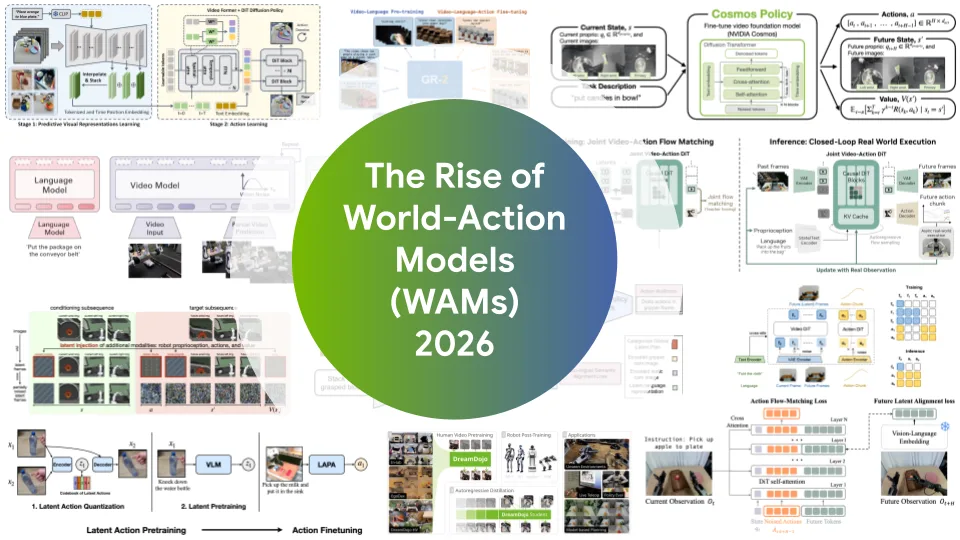
TL;DR Table of contents World models: policies that imagine VLA-JEPA LingBot-VA FastWAM VLAs: the model zoo keeps growing GR00T N1.7 MolmoAct2 EO-1 Multitask DiT EVO1 Reward models: knowing when your robot succeeds Robometer TOPReward Datasets: faster loading, richer data Your codec, your rules Depth support, end to end Language annotations at scale Up to 2x faster data loading Benchmarks: one CLI to evaluate them all Training & inference lerobot-rollout: deployment gets its own CLI FSDP: train models bigger than your GPU Cloud training with HF Jobs Codebase: leaner and cleaner Community & ecosystem Final thoughts This new release is about closing the robot learning loop: policies that imagine the future before acting, reward models that tell you when your robot succeeds, a deployment CLI that turns failures into training data, and six new simulation benchmarks to measure it all. It also brings depth sensing, VLM-powered dataset annotation, custom video encoding, cloud training on HF Jobs, and a much leaner install.
TL;DR
LeRobot v0.6.0 introduces world model policies (VLA-JEPA, FastWAM, LingBot-VA) that learn to imagine the future, a wave of new VLAs (GR00T N1.7, MolmoAct2, EO-1, EVO1, Multitask DiT), and a new reward models API (Robometer, TOPReward). It ships six new simulation benchmarks unified under lerobot-eval, the lerobot-rollout CLI with DAgger-style human-in-the-loop corrections, FSDP training, and cloud training on HF Jobs. Datasets get depth support, an automatic language annotation pipeline, custom video encoding, and up to 2x faster data loading, all on top of a leaner installation.