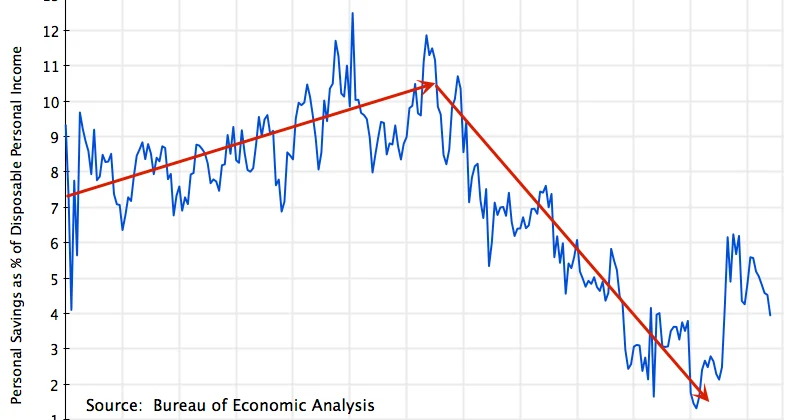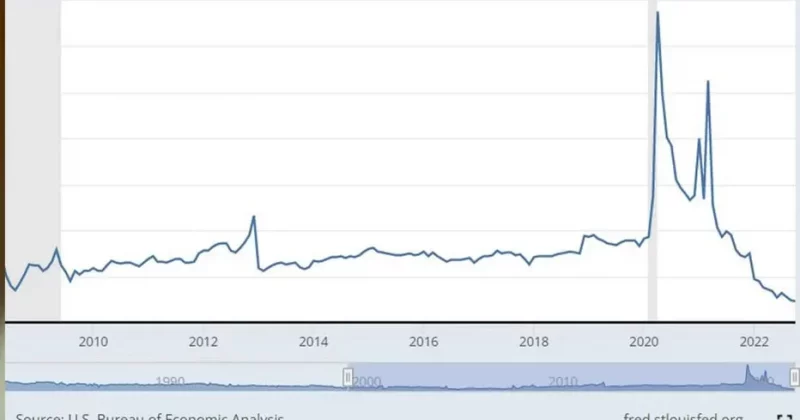
This is just one of the stories from our “I’ve Always Wondered” series, where we tackle all of your questions about the world of business, no matter how big or small. Ever wondered if recycling is worth it? Or how store brands stack up against name brands? Check out more from the series here.David H. asks: I'm wondering what personal savings have been like over the last century? Adjusted for inflation are we saving more or less?Our personal savings rate, or the percentage of their disposable income that we’re saving, stands at just 2.7%."We are definitely saving less, and less than any other time in history outside of the pre-2008 financial crisis," said Inga Timmerman, an associate professor of finance at the University of North Florida and a financial planner. The personal savings rate was higher in the 1960s and the 1970s, typically hovering between 10% and 15%. People had more money to save because after World War II, incomes began to rise consistently and there was a big push for pensions, Timmerman said. People also didn't have credit cards like they do now, so they needed to save more money to make bigger purchases, said Mengya Wang, an assistant professor of human development and family science at Oklahoma State University.In the 1990s and 2000s, the personal savings rate began to dip significantly. But while it was low, it's not low for the same reasons it is now, Timmerman said."When you think back to the 1990s and early 2000s, you had this huge wealth effect because people had a lot of stocks and investments, and the stock market was booming. So people didn't need to save as much because they could rely on the income from other sources," Timmerman said. People are still investing in the stock market, which is performing well, but these days, people are relying on credit cards "as the ultimate saving mechanism," Timmerman said. And that's due to the high cost of living, Timmerman said. Since January 2020, overall consumer prices have risen nearly 30%. And housing prices have climbed almost 55% across the country between the first quarter of 2020 and the third quarter of 2025. "They are thinking of credit cards as potentially where they will go and dip if they need the money. And that's important to realize because it's not like we're all rich and we don't need to worry about money," Timmerman said. She added that people are also looking to HELOCs, or home equity lines of credit, which allow you to borrow money against your house. HELOC balances rose by $13 billion in the second quarter of this year, making it the 17th quarterly increase in a row, according to a recent report from the Federal Reserve Bank of New York.Timmerman, who helps advise families across different incomes, said people who are conscious about their household budgets are more stressed out than usual."They constantly tell me that they don't have as much money as they used to have because the share of food and basic housing is bigger than it used to be. So they have less to save," she said. Timmerman said wealthier families who do have a lot of investments are also concerned. Even though the stock market is doing well, they're concerned about potential dips and feel like they can't rely on that money. "So everybody is stressed out, but for different reasons," Timmerman said. Luisa Blanco, a professor of public policy and economics at Pepperdine University, said she recently conducted a personal finance survey of Latinos in California, finding that people are struggling to afford basic necessities. There are stark differences among different racial groups when it comes to the ability to handle unexpected expenses, Blanco pointed out. In 2025, 77% of Asian adults and 73% of white adults were able to cover a $400 emergency expense. But only 46% of Hispanic and 40% of Black adults were able to, according to survey data from the Federal Reserve Board. Contrast the current savings rate with the percentage just six years ago, at the start of the COVID-19 pandemic. In 2020, people were socking away nearly a third of their disposable income. The government distributed stimulus checks, while there were shutdowns that stopped people from frequenting restaurants and traveling, Blanco said. Consumers were able to save more, naturally. And people were also just fearful and uncertain, Blanco said.Emergencies will happen, so if you don't have access to money, you'll have to rely on credit cards or loans at a time when interest rates "are quite high," Timmerman said. "The proportion of money that goes towards servicing the debt is going to be higher, which means now you have less money for retirement, less money for other things. So it's just overall a cycle that is not good," Timmerman said. Generally, when there's a recession or people are dealing with bad economic conditions, people tend to save more, like we saw in the immediate aftermath of the 2007 financial crisis, Timmerman said. "What I'm concerned about this time around is that people are uncomfortable, but they just don't have the money to save," Timmerman said. So what can consumers do at a time like this? Matt Schulz, chief consumer finance analyst at LendingTree, previously told Marketplace that they should look into putting whatever savings they can into an online, high-yield savings account which might offer you higher rates than a traditional savings account from a megabank. Timmerman said while there's always something you have to save for, you should prioritize building up your emergency fund with a few thousand dollars ahead of other types of savings. "It makes a huge difference if you have a little bit of money saved," Timmerman said.
Why Americans are saving less money than they did in the '60s and '70s
The personal savings rate is currently just 2.7%, much lower than it was in decades past.
954 words~4 min read