The High Bandwidth Flash consortium has released its first technical specification, roughly six months after launching in February 2026. The spec outlines a new class of NAND-based memory designed to tackle one of AI’s most stubborn infrastructure problems: there simply isn’t enough fast, affordable memory to feed the models.
Led by Sandisk and SK Hynix, the consortium counts Google and Tenstorrent among its members. The group’s goal is straightforward, even if the engineering isn’t: build an open standard for flash memory that can keep up with AI inference workloads without carrying the eye-watering price tag of high-bandwidth memory, or HBM.
What the spec actually promises
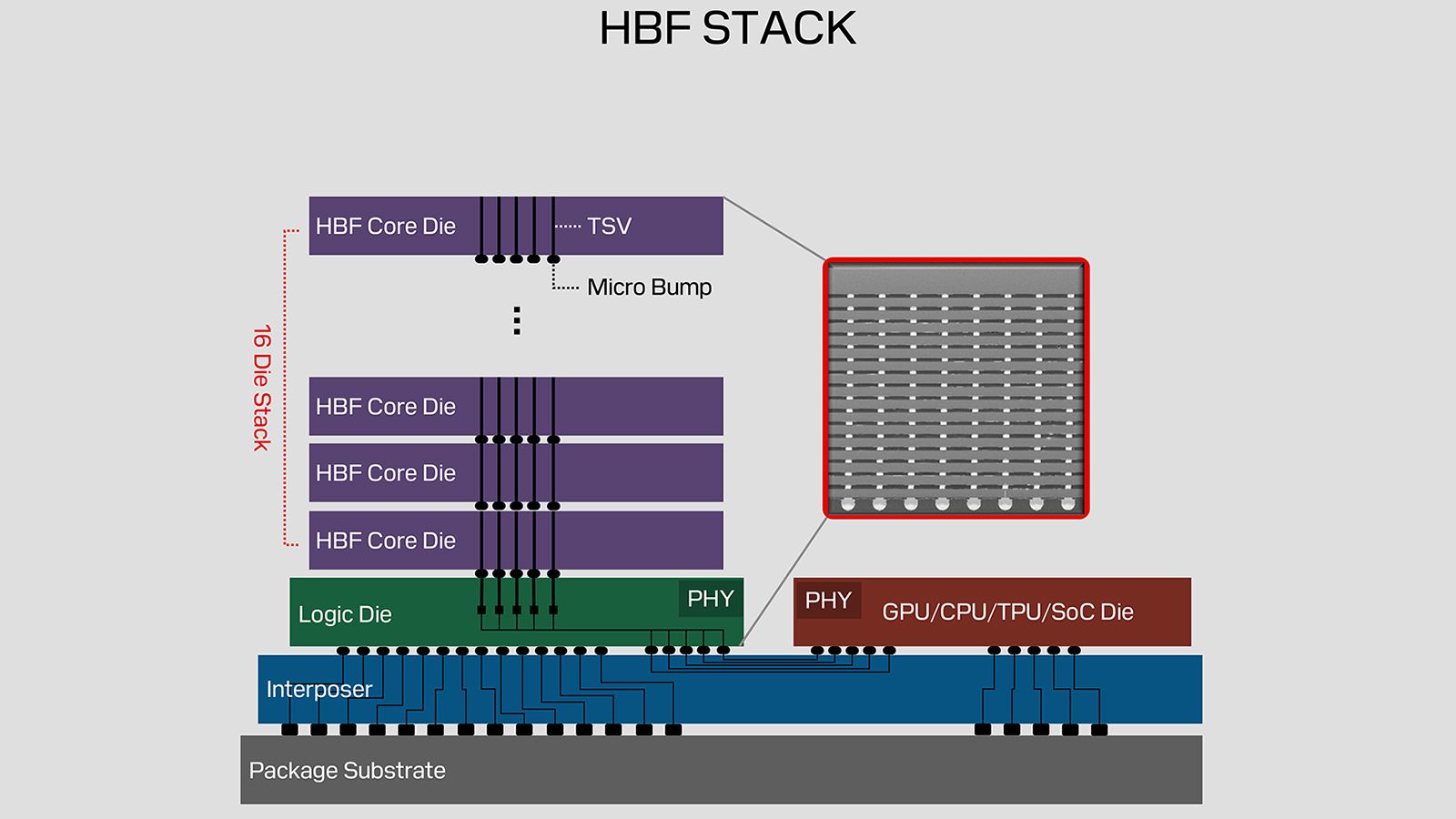
The initial HBF specification lays out some ambitious performance targets. Individual NAND stacks could support capacities up to 512 GB per package, a figure that dwarfs what’s currently possible with HBM modules.
Bandwidth ranges from hundreds of GB/s in baseline configurations to a peak of 3 TB/s when using UCIe connections. UCIe, or Universal Chiplet Interconnect Express, is an open standard for connecting chiplets inside a package.