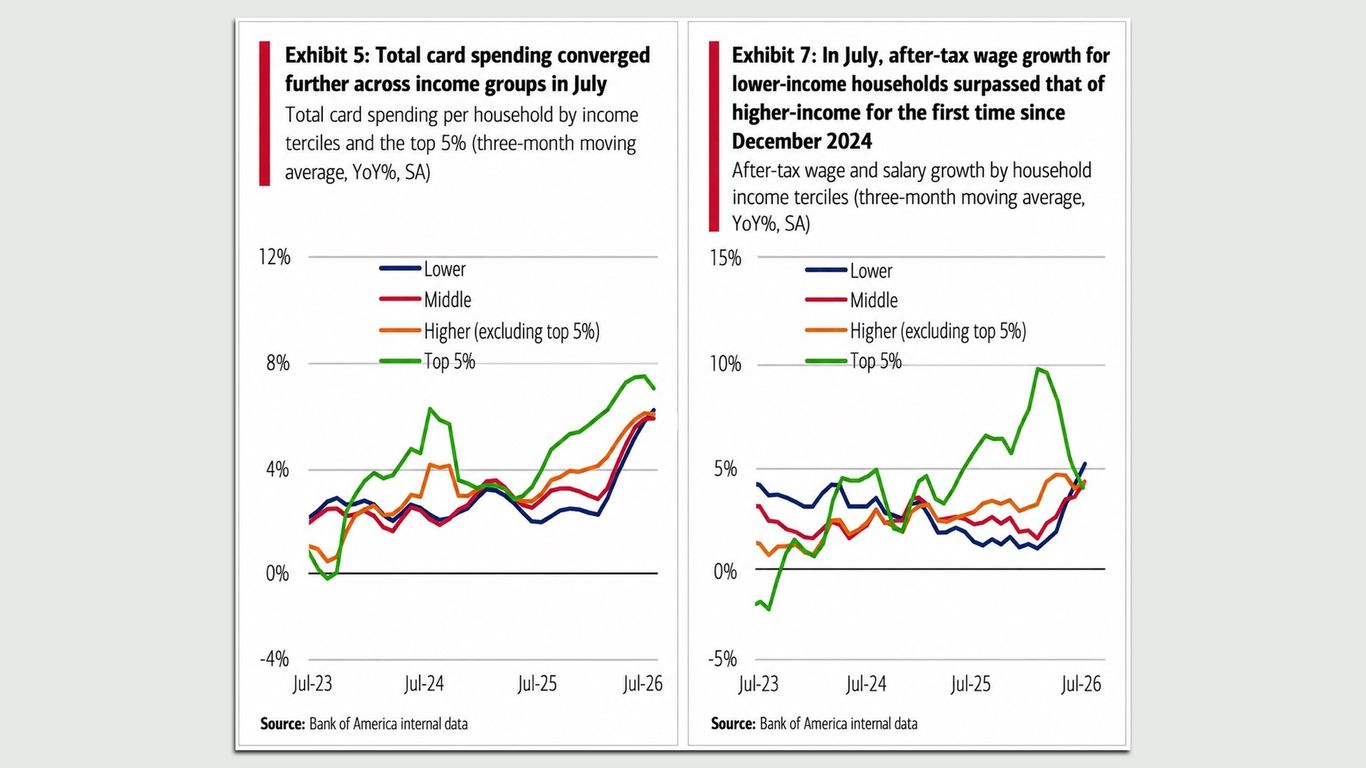
For years, the US economic recovery looked like the letter K: one arm shooting upward for the wealthy, the other sliding down for everyone else. That split appears to be closing, with new data showing lower-income households are finally gaining ground on their higher-earning counterparts in both wages and spending.
Bank of America Institute data shows after-tax wage growth for lower-income workers reached 4.1% in June 2026. Higher-income brackets came in at 4.2%. A gap of one-tenth of a percentage point is, for all practical purposes, a rounding error.
The spending story tells the same tale
In June 2026, lower-income household spending actually outpaced higher-income household spending. The gap in discretionary spending between income levels hit its narrowest point since July 2025.
PNC’s research tells a similar story. When you strip out gasoline purchases, which can distort the picture because fuel costs eat a proportionally larger share of lower-income budgets, the spending gap between upper and lower-income households is becoming noticeably less pronounced. PNC also flagged early signs that the savings gap between income groups is starting to close.