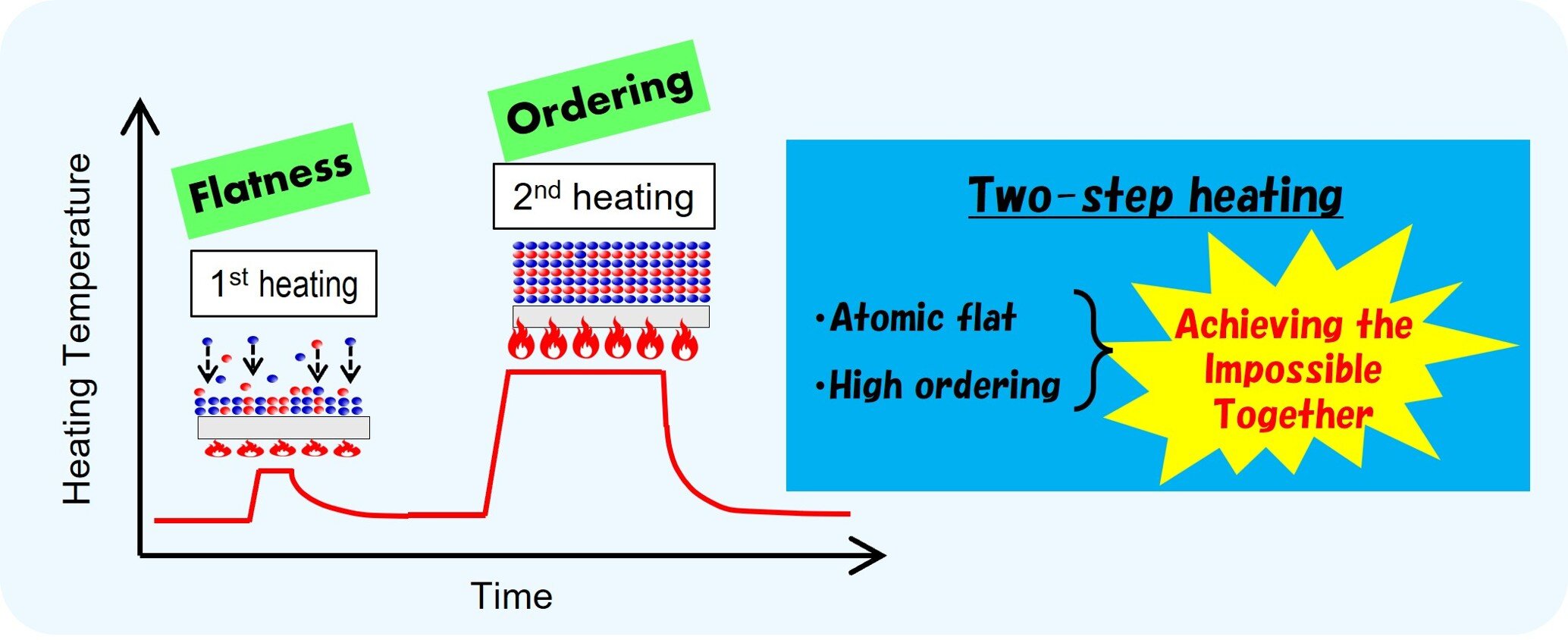
The researchers fabricated 5-nm-thick L10-FePd films using a two-step heating process: low-temperature deposition for smooth layer-by-layer growth, followed by 600°C annealing to promote atomic ordering. Credit: Professor Hiroshi Naganuma, University of Toyama, Japan
Magnetic storage technologies, which store information in the direction of magnetization, play an essential role in modern data storage. Hard disk drives (HDDs) are widely used for long-term storage, while nonvolatile magnetic random-access memory (MRAM) is emerging as a promising alternative to flash memory.
These devices rely on epitaxial ultrathin magnetic alloy films in which two atomic species are arranged in alternating layers along a single crystallographic direction. This structure creates a large magnetocrystalline anisotropy energy (MAE), making the magnetic state more stable and preventing stored bits from accidentally flipping.
The more perfectly ordered the atomic arrangement—measured by the degree of L10 ordering—the greater the MAE and thermal stability of each magnetic bit.
However, producing films with both a high degree of L10 ordering and an atomically flat surface has remained a major challenge. High-temperature heating improves atomic ordering but also makes the film rougher as grains grow larger.