Story audio is generated using AI
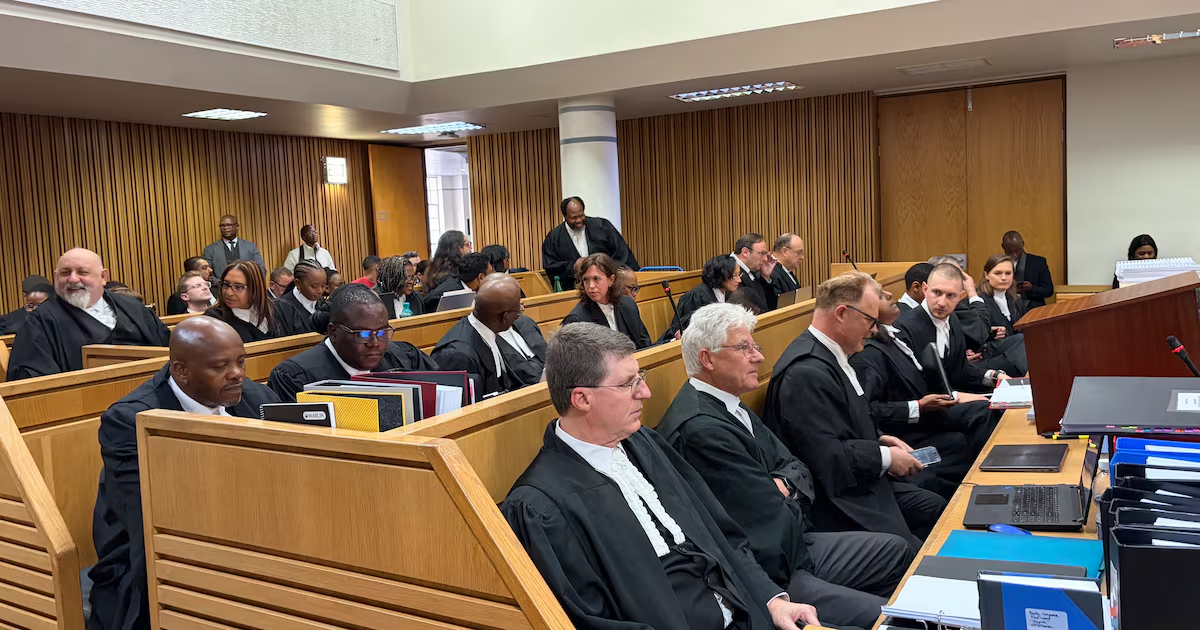
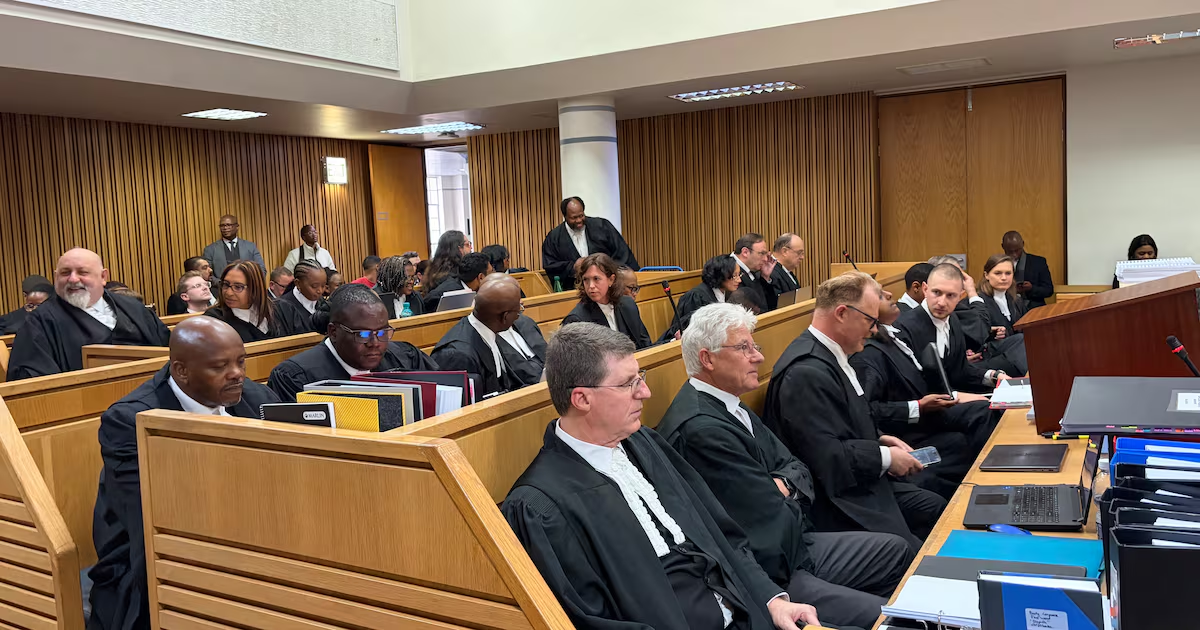
Lobby group AfriForum on Monday argued in the Western Cape High Court that parliament unlawfully tried to create statutory categories allowing land to be expropriated without compensation.It said the Expropriation Act, which was signed into law by President Cyril Ramaphosa earlier in 2026, fundamentally departs from the compensation framework set out in section 25 of the constitution. The section covers three main areas: protection against arbitrary deprivation, conditions for expropriation and the state’s duty to foster equitable access to land. In submissions before the court, the lobby group’s counsel, Av Henk Havenga, said the constitution permits land reform and expropriation in the public interest but does not authorise parliament to identify categories where no compensation may be paid through ordinary legislation.“The constitution does not create categories of uncompensated expropriations,” Havenga told the court, arguing that sections 12(3) and 12(4) of the act effectively try to amend section 25 of the constitution without an amendment.Read: DA defends its challenge to Expropriation Act in precedent-setting court caseThe arguments formed part of a consolidated constitutional challenge to the Expropriation Act. The court is hearing applications brought by AfriForum, the Vaderland Stigting, the DA and other applicants, each challenging different provisions of the legislation, while the president, parliament, the public works & infrastructure minister and the EFF oppose aspects of the applications.Havenga said AfriForum was not challenging land reform itself.“This is not a challenge to land reform. Land reform is a constitutional imperative,” he said.Instead, he argued the application sought to preserve “the constitutional method” by which expropriation is carried out. He submitted that section 25 already balances property rights with the state’s obligation to pursue land reform by permitting expropriation in the public interest, subject to the payment of just and equitable compensation.AfriForum argued that the act changes that constitutional framework by introducing an open-ended list of circumstances in which no compensation may be appropriate, which Havenga said the constitution itself deliberately does not do.He rejected the respondents’ argument that the provisions merely provide guidance to courts, saying they would instead influence the hundreds of expropriating authorities responsible for making decisions before disputes ever reached court.“There are about 400 expropriating authorities,” he said, arguing that many officials would begin by asking whether no compensation could be offered rather than first determining what constituted just and equitable compensation under section 25.According to Havenga, the constitution requires decision-makers to begin by determining the value of the property owner’s loss before adjusting that amount where appropriate.“The constitution starts at the other end of the spectrum,” he argued.While accepting that courts ultimately determine compensation disputes, Havenga said that offered little comfort to ordinary property owners because expropriation litigation is technically complex, expensive and can take years to resolve.He referred to previous expropriation cases that lasted for years before finalisation and argued that many disputes would never reach the courts.Judge Vincent Saldanha questioned whether the impugned provisions merely guided courts rather than compelling any particular outcome.Havenga agreed the provisions did not prescribe results but argued they nevertheless sent “the wrong signal” by encouraging expropriating authorities to begin with the possibility of paying nothing instead of assessing just and equitable compensation as required by the constitution.He accepted that courts could, in exceptional circumstances, conceivably award no compensation under the constitution but argued that did not justify parliament identifying statutory categories where that result should be considered.“If it is truly exceptional, why is it here in the act?” he asked.The court also heard submissions from Adv Roelof du Plessis, appearing for the Vaderland Stigting, a land rights grouping for “farming communities”. He argued that section 12(3) introduced constitutional principles that parliament had never agreed upon during the constitutional negotiations.Du Plessis argued that section 25 deliberately makes expropriation subject to compensation and that parliament had unnecessarily complicated the constitutional test by requiring courts to consider additional statutory factors alongside those already listed in the constitution.“What does a court do? Does one give more weight to the constitutional principles or those now contained in the act?”He criticised several of the examples contained in section 12(3), including provisions relating to unused land, abandoned property and previous state investment, arguing they were irrational, unnecessary or already catered for under existing expropriation law.According to Du Plessis, the provisions would create uncertainty by forcing courts to reconcile competing statutory and constitutional considerations that do not presently exist.He argued that section 25 already allows courts to award less than market value where appropriate and that the additional statutory provisions served no constitutional purpose.“The courts don’t need this,” he submitted.Du Plessis further argued that the act is inconsistent with customary international law protecting property rights and urged the court either to declare the entire act invalid or, at the least, strike down sections 12 and 19.The DA advanced a separate constitutional challenge focusing on both the drafting of the act and the parliamentary process through which it was adopted.Appearing for the DA, Adv Karrisha Pillay argued that the act had been unlawfully passed because several provincial legislatures failed to lawfully authorise their National Council of Provinces (NCOP) delegations before voting on the bill and that section 19 contains a drafting defect that makes it incapable of operating as intended.Saldanha repeatedly questioned why the Western Cape High Court should determine disputes relating to mandates issued by provincial legislatures outside its territorial jurisdiction.Pillay responded that the constitutional consequences of the allegedly defective mandates were ultimately realised when the NCOP voted on the legislation in Cape Town and argued that convenience and common sense favoured the court exercising jurisdiction.Turning to the merits, Pillay argued that section 19 creates an irresolvable circular process because section 8 requires a notice of expropriation to specify compensation while section 19 allows a court to determine compensation only after that notice has been issued.“The provisions cannot operate together,” she submitted.Pillay said all three principal state respondents accept that section 19 contains a constitutional defect but each proposes a different reading-in remedy.She told the court that parliament proposes linking the statutory time period to the owner’s written statement disputing compensation, while the president proposes tying it to the conclusion of mediation and the minister proposes using the notice of intention to expropriate as the trigger.“There are potentially nine different ways of resolving the difficulty,” Pillay argued, submitting that the competing proposals demonstrate why the court should not attempt to rewrite the legislation itself.She also argued that section 65 of the constitution and the Mandating Procedures of Provinces Act require provincial legislatures, rather than their speakers, to confer final voting mandates on NCOP delegations.According to the DA, in several provinces speakers purported to issue final mandates before legislatures had authorised them, with some mandates only being ratified afterwards.Saldanha asked whether the DA’s challenge elevated form over substance and whether any procedural defects were sufficiently material to justify invalidating an act of parliament.Pillay maintained that the constitution requires provincial legislatures themselves to confer authority.“If it’s not permitted under the constitutional statutory framework, the fact that it has historically occurred doesn’t give it validity,” she argued.The hearing continues on Tuesday, when the president, the public works & infrastructure minister, the rural development & land reform minister, parliament and the provincial legislatures are expected to present their arguments in defence of the act.