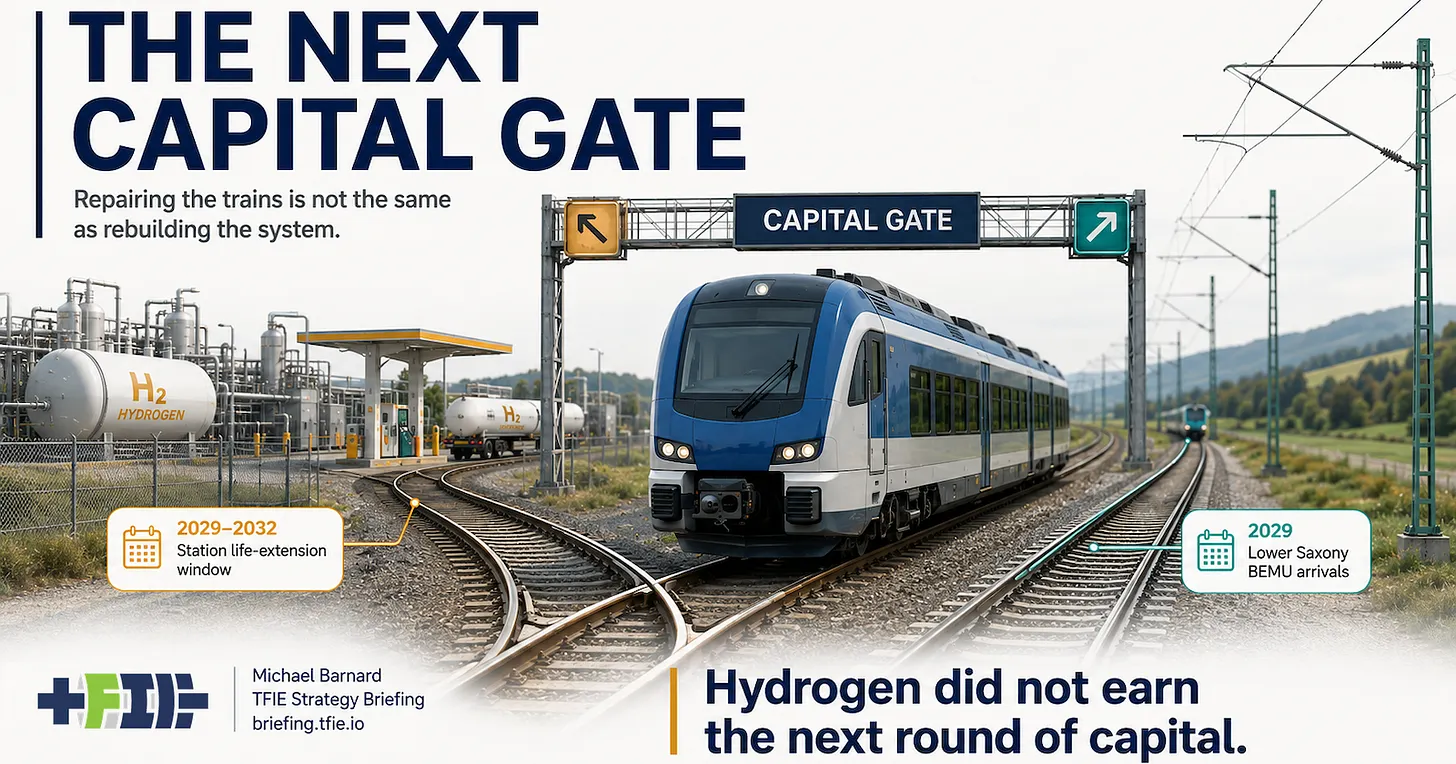
Lower Saxony’s decision point is not the next fuel-cell repair. It is whether to recapitalize a dedicated hydrogen system after the evidence has moved.
Support CleanTechnica's work through a Substack subscription, on Patreon, or on Stripe. Help us produce all of the high-quality, original content we publish week after week despite the challenges of content-scraping AI, antisocial media, inflation, and other hurdles.
Lower Saxony’s hydrogen trains will probably not be retired because a politician announces that battery-electric multiple units were the better technology. They will be retired when the bill arrives for extending the life of an underused, specialized hydrogen system and the state has to compare that cost with buying the battery-electric future it has already selected.
That decision point is approaching. The first major station recapitalization is likely to fall around 2029 to 2032. Lower Saxony’s first large battery-electric multiple-unit fleet is also expected from 2029. Those two timelines turn a technology argument into a capital-gate problem.
The full TFIE Strategy Briefing assessment applies Richard Rumelt’s strategy kernel to the case: diagnose the central challenge, choose a guiding policy and take coherent actions that reinforce one another. The diagnosis is not simply that hydrogen trains have had reliability problems. Lower Saxony owns a tightly coupled and increasingly orphaned transport system in which trainsets, proprietary fuel-cell modules, a dedicated station, trucked industrial hydrogen and long maintenance commitments only have value when every link works.