Hydrogen cargo has vessels. Battery cargo has the stronger pathway.
Support CleanTechnica's work through a Substack subscription or on Stripe.
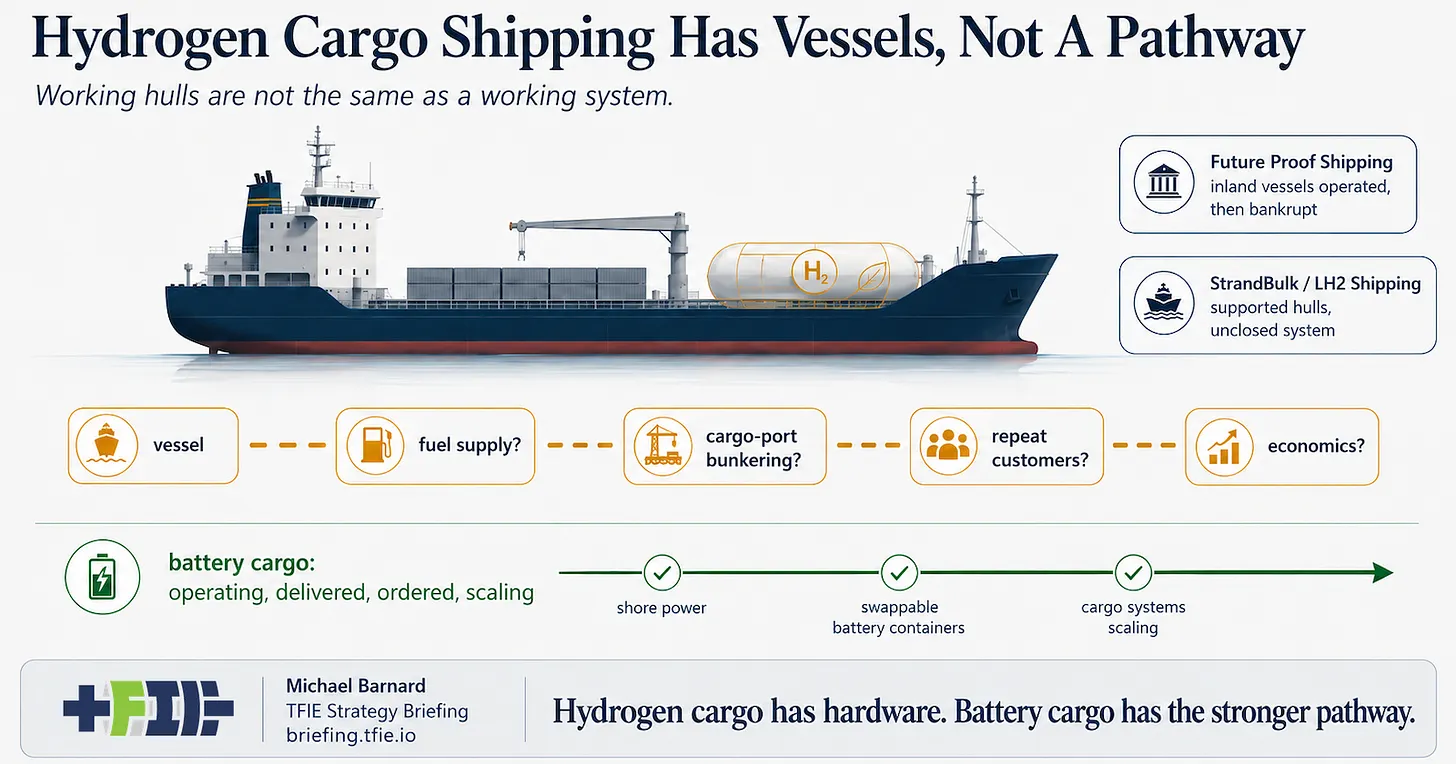
Future Proof Shipping gave hydrogen cargo shipping something most hydrogen shipping announcements never provide: working vessels. H2 Barge 1 and H2 Barge 2 were not artist renderings, conference-stage concepts or another memorandum of understanding. They were inland cargo vessels converted to hydrogen fuel-cell operation and put into real freight service in northern Europe. And, recently, it entered bankruptcy proceedings.
That they had hulls in the water in Northern Europe’s inland shipping lanes deserves to be taken seriously. In a sector where virtually all hydrogen proposals remain stuck at the announcement, feasibility-study or publicly supported design stage, Future Proof Shipping crossed an operating threshold. It assembled vessels, approvals, customers, route arrangements, fuel access and port interfaces tightly enough to move freight. For hydrogen advocates, that made the company a useful proof point. It showed that the machinery could be made to work in a bounded inland cargo case.
The bankruptcy of Future Proof Shipping does not erase that operating evidence. It changes what the evidence means. The barges showed that hydrogen fuel cells can propel cargo vessels, which wasn’t in doubt. They did not show that delivered hydrogen could be supplied at a competitive price, that the fuel system could be highly utilized, that customers would repeat the pattern without continued public risk absorption, or that a working vessel had become a repeatable business.