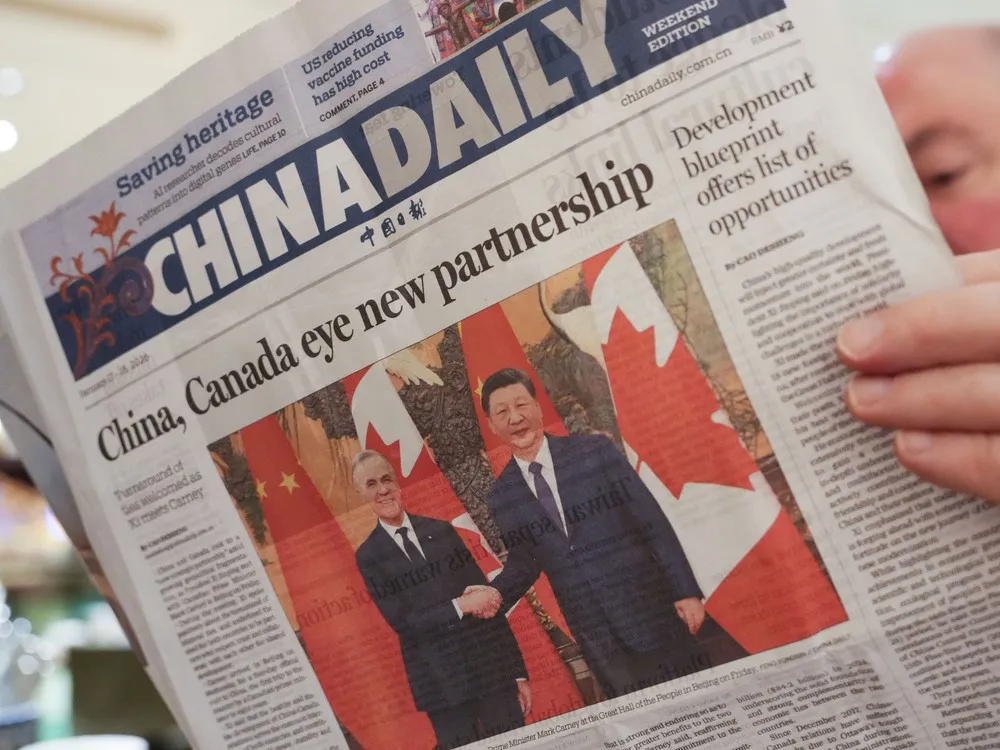
Skip to Content Subscribe Our Offers My Account Manage My Subscriptions FAQ Newsletters Canada Canadian True Crime Canadian Politics Health World Israel & Middle East Financial Post NP Comment Longreads Puzzmo Diversions Comics NP News Quiz New York Times Crossword Horoscopes Life Eating & Drinking Style Sponsored Play for Ontario Travel Travel Canada Travel USA Travel International Cruises Travel Essentials Culture Books Celebrity Movies Music Theatre Television Business Essentials Advice Lives Told Tails Told Shopping Buy Canadian Home Living Outdoor Living Kitchen & Dining Tech Style & Beauty Personal Care Entertainment & Hobbies Gift Guide Travel Guide Amazon Prime Day Deals Savings National Post Store More Sports Hockey Baseball Basketball Football Soccer Golf Tennis Driving Vehicle Research Reviews News Gear Guide Obituaries Place an Obituary Place an In Memoriam Classifieds Place an Ad Celebrations Working Business Ads Archives Healthing Epaper Manage Print Subscription Profile Settings My Subscriptions Saved Articles My Offers Newsletters Customer Service FAQ Newsletters Canada World Financial Post NP Comment Longreads Puzzmo Diversions Life Shopping Epaper Manage Print Subscription HomeNP CommentOpinion: Canada cannot trade away the danger of a Russia-China allianceNational security must come before greater economic engagementLast updated 34 minutes ago You can save this article by registering for free here. Or sign-in if you have an account.A photo of a smiling Prime Minister Mark Carney shaking hands with Chinese President Xi Jinping is seen on the cover of the China Daily newspaper as a reader thumbs through the pages in Beijing on Jan. 17, 2026. Photo by Sean Kilpatrick / The Canadian PressCanada’s debates about Russia, China and national security often remain trapped between two false assumptions.Enjoy the latest local, national and international news.Exclusive articles by Conrad Black, Barbara Kay and others. Plus, special edition NP Platformed and First Reading newsletters and virtual events.Unlimited online access to National Post.National Post ePaper, an electronic replica of the print edition to view on any device, share and comment on.Daily puzzles including the New York Times Crossword.Support local journalism.Enjoy the latest local, national and international news.Exclusive articles by Conrad Black, Barbara Kay and others. Plus, special edition NP Platformed and First Reading newsletters and virtual events.Unlimited online access to National Post.National Post ePaper, an electronic replica of the print edition to view on any device, share and comment on.Daily puzzles including the New York Times Crossword.Support local journalism.Create an account or sign in to continue with your reading experience.Access articles from across Canada with one account.Share your thoughts and join the conversation in the comments.Enjoy additional articles per month.Get email updates from your favourite authors.Create an account or sign in to continue with your reading experience.Access articles from across Canada with one accountShare your thoughts and join the conversation in the commentsEnjoy additional articles per monthGet email updates from your favourite authorsSign In or Create an AccountorThe first is that Ukraine is too distant to matter and that helping defend it against Russia is an act of charity. The second is that renewed engagement with China will strengthen Canada’s economy against U.S. tariffs and reshoring without creating new risks.Together, these assumptions ignore how closely national security and trade are connected, especially when Canada’s economic choices intersect with the Russia-China strategic alignment.The National Post newsletter that doesn’t hold back, giving readers the unvarnished truth on media, politics and culture.By signing up, you consent to receive the above newsletter from Postmedia Network Inc.A welcome email is on its way. If you don't see it, please check your junk folder.The next issue of Right? will soon be in your inbox.We encountered an issue signing you up. Please try againIn January, Prime Minister Mark Carney announced a strategic partnership with Beijing, arguing closer economic ties can diversify Canada’s trade. But Canada cannot simply treat China as a market while ignoring Beijing’s support for Russia’s war against Ukraine and the growing military and technological co-operation between the two regimes.Ukraine is not a distant conflict for Canada. It is the central battlefield in Moscow’s campaign to overturn Europe’s security order and a testing ground for threats Canada may face in the Arctic, cyberspace, space and through information warfare.Recent reporting by The Insider, Le Monde and Der Spiegel describes how Beijing is helping sustain Russia’s war and military-industrial base while gaining access to battlefield experience that strengthens the capabilities of both countries.Chinese exports of dual-use technology and components help Russia produce the weapons it needs. Russia is providing Beijing with lessons in drone warfare, electronic warfare, cyberattacks, sanctions evasion and the disruption of critical infrastructure. These capabilities will not likely remain confined to Ukraine. They will likely inform Chinese and Russian planning against NATO, North America and the Arctic.Canada’s allies have already drawn the same connection. Canada’s G7 partners have warned that China’s support is helping fuel Russia’s war, while NATO has identified China as a “decisive enabler” of Moscow’s aggression.According to reports, Russian and Chinese officials have formally discussed co-operation to develop weapons and hybrid-warfare capabilities designed to evade Western defences and disrupt satellite communications.One example is a proposed method for disabling Western satellite systems such as Starlink, which has played an important role in Ukraine’s defence. Disabling satellites could disrupt military operations, emergency services and civilian communications, while debris from their destruction could threaten other objects in orbit.For Canada, that threat is inseparable from Arctic security.Satellite communications are essential across the Canadian Arctic. During a military confrontation, climate-related crisis or security emergency, those systems would be vital to Northern communities, emergency responders and Canadian Armed Forces.China-Russia co-operation is already testing Canada’s Arctic security. The two countries have conducted joint bomber operations near Alaska, as well as naval and coast-guard patrols in northern waters. Those operations remained in international airspace and waters, but they show growing military co-ordination near North America’s northern approaches.Russia brings geography, military infrastructure and decades of Arctic experience; China brings technology, industrial capacity and capital. Their interests differ and distrust remains, but their shared objective of weakening Western power is drawing them closer.Economic engagement with China is not, by itself, the problem. The danger is allowing short-term trade concessions to obscure strategic risks. Beijing has repeatedly used market access, investment and economic dependence as tools of political pressure.Prime Minister Carney has said that Canada must be “clear-eyed” about its differences with China. That must mean assessing Beijing not only as Canada’s second-largest trading partner, but also as the principal economic and technological enabler of the country waging Europe’s largest war since 1945.Calling China a strategic partner while Beijing helps Russia strengthen capabilities that could eventually be directed against Canada arguably already undermines Canadian interests. National security must come before greater economic engagement.That means treating China’s support for Russia as a factor in trade, investment and procurement decisions. Canada must scrutinize Chinese investment in Arctic infrastructure, telecommunications, energy and critical minerals, reduce dependence on Chinese-controlled supply chains in strategic sectors, and strengthen export controls preventing Canadian and allied technology from reaching Russia through third countries.Canada must also accelerate investments to develop resilient northern communications, Arctic surveillance and defence infrastructure. Declarations of sovereignty mean little without the ability to detect, deter and respond to threats.Continued support for Ukraine is an essential part of that effort. It is not charity or distant idealism. It is forward defence against a Russian regime that has repeatedly challenged Canada and its allies — and against the wider authoritarian alignment sustaining it.The lessons being learned in Ukraine are already shaping the strategic environment in the Arctic, in space and across digital networks. Canada must not ignore Beijing’s role in that process for short-term commercial gains.National PostMarcus Kolga is a senior fellow at the Macdonald-Laurier Institute and co-founder of the Global Centre for Democratic Resilience.Charles Burton is a former diplomat at Canada’s embassy in Beijing, a senior fellow at Sinopsis.cz, a China-focused think tank based in Prague, and author of The Beaver and the Dragon: How China Out-Manoeuvred Canada’s Diplomacy, Security and Sovereignty. Join the Conversation This website uses cookies to personalize your content (including ads), and allows us to analyze our traffic. Read more about cookies here. By continuing to use our site, you agree to our Terms of Use and Privacy Policy.
Opinion: Canada cannot trade away the danger of a Russia-China alliance
National security must come before greater economic engagement
1,355 words~6 min read