New UC Berkeley-led research indicates that continued climate change could severely increase wildfire above natural levels in Yosemite, Sequoia, Kings Canyon, and Lassen Volcanic National Parks. The study, which was published today in Environmental Research Letters, also provides data for park managers to reduce risks by proactively targeting natural fire to decrease understory fuels.
“Fire is natural and necessary for forest health in California, but human-caused climate change is increasing wildfire above natural levels,” said lead author Patrick Gonzalez, an associate adjunct professor in the Department of Environmental Science, Policy, and Management. “Through this work, I aim to help National Park Service staff, who have previously told me of the need for park-specific data to inform field decisions on fire management that account for climate change.”
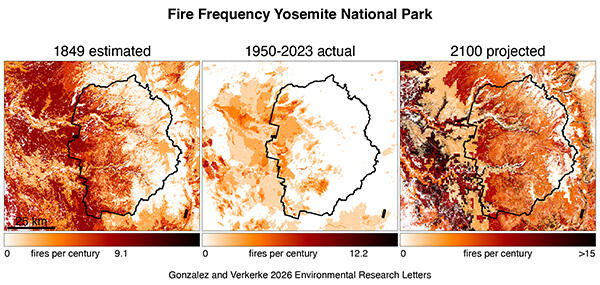
Fire frequency in Yosemite National Park. Left: Estimated 1849, Middle: Actual fire from1950–2023, Right: Projected 2071–2100. Credit: Gonzalez and Verkerke, 2026 in Environmental Research Letters.
Fire managers currently use pre-European American settlement in 1849 as a reference condition to select areas for letting naturally ignited fires burn or for low-severity prescribed burning to reduce understory fuels. However, the researchers found that, since 1895, climate change has already increased temperatures in the four national parks more than the global average.