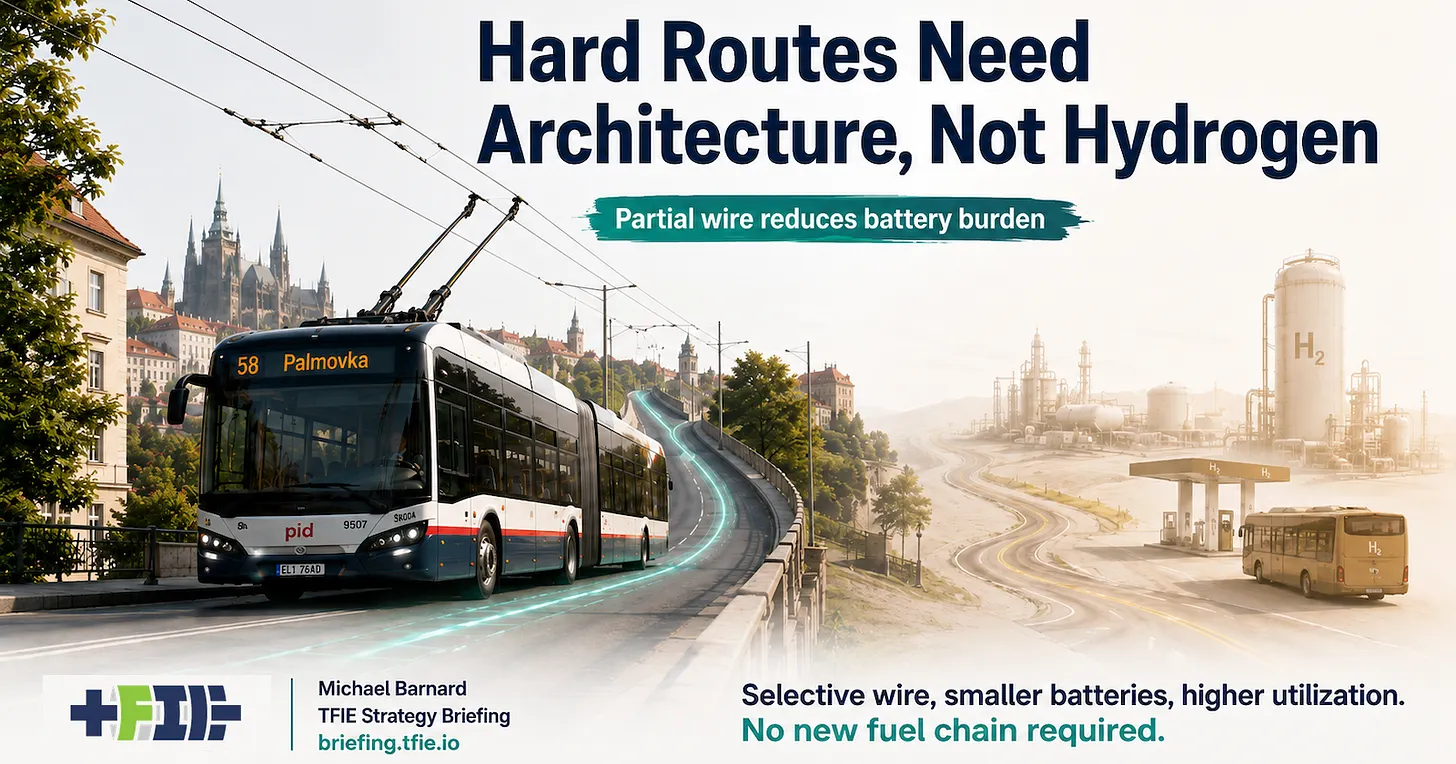
Prague’s early operating data suggest that selective wiring, smaller batteries and higher utilization can electrify difficult bus routes without hydrogen.
Support CleanTechnica's work through a Substack subscription, on Patreon, or on Stripe. Help us produce all of the high-quality, original content we publish week after week despite the challenges of content-scraping AI, antisocial media, inflation, and other hurdles.
Transit agencies often reach for hydrogen after starting with real operating constraints and skipping a systems-design step. Hills, long duties, heavy passenger loads, constrained depots and the need to keep buses moving are treated as evidence that batteries cannot do the work, so the route is labelled a hydrogen case. Prague’s early operating data suggest a better test: determine what combination of batteries, overhead wire, terminal charging, substations, layover time and annual utilization delivers the service most effectively. That changes the comparison from one vehicle against another to one transit architecture against another.
On line 58, Prague’s public transport company DPP compared electric buses and partial trolleybuses with diesel while including vehicle depreciation, infrastructure construction, infrastructure maintenance and related costs. DPP transport director Jan Barchánek said the complete cost per kilometer was about 10% above comparable diesel operation without subsidies and slightly below diesel once grants for vehicles and infrastructure were included. The result is early and route-specific, but that is precisely why it is useful. It shows that a direct-electric system can approach diesel economics on a demanding route when planners fit the infrastructure and operating model to the service instead of assuming that a depot-charged battery bus must reproduce diesel operation unchanged.