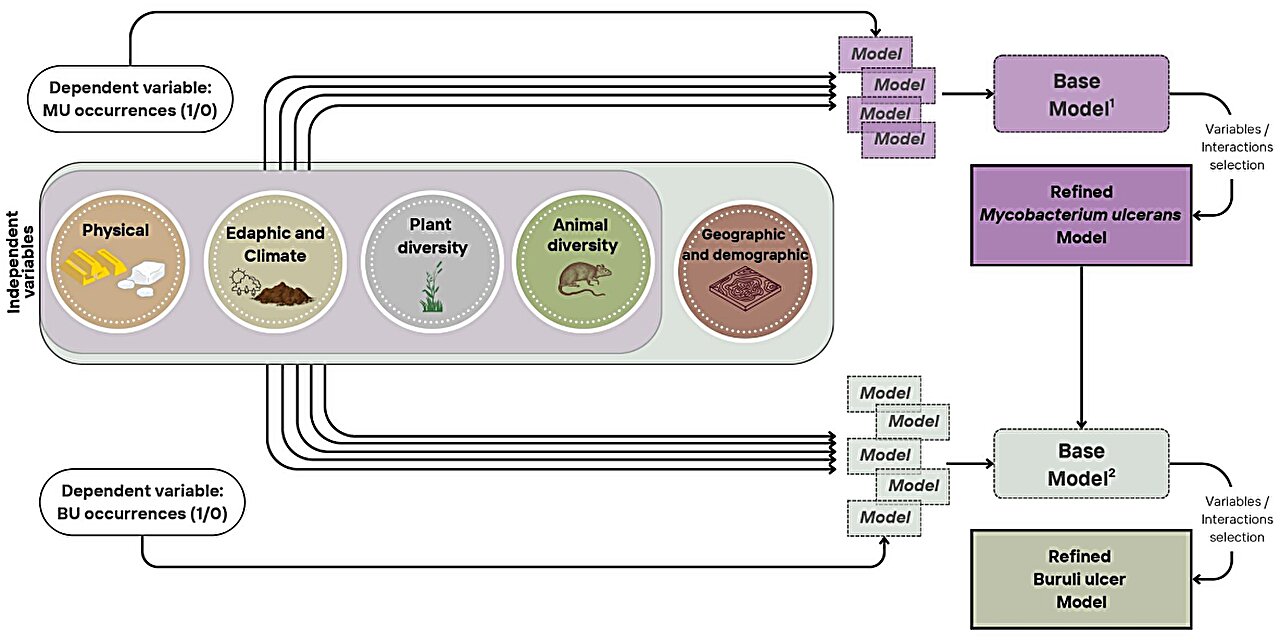
Methodological framework for Mycobacterium ulcerans and Buruli Ulcer modeling. Credit: Communications Medicine (2026). DOI: 10.1038/s43856-026-01692-6
When the COVID-19 pandemic shut down international travel in 2020, Michigan State University researcher Eric Benbow faced a problem. A $2.5 million research project designed to study an environmental pathogen in South America was suddenly on hold. With fieldwork canceled and uncertainty surrounding when travel might resume, Benbow and his collaborators needed a new plan.
That unexpected detour led to a surprising discovery—and new insights into a disease that has puzzled scientists for decades.
In their study published in Communications Medicine, the international team of researchers examined the environmental and human factors that influence the distribution of Buruli ulcer, a neglected tropical disease caused by the bacterium Mycobacterium ulcerans. The work helps explain how ecosystems, climate, land use and human activities interact to shape disease risk.
"People often think about infectious diseases in terms of person-to-person transmission," said Benbow, professor in the Department of Entomology in the College of Agriculture and Natural Resources and in the Department of Osteopathic Medical Specialties in the College of Osteopathic Medicine. "But this pathogen lives in the environment. To understand the disease, we have to understand the ecosystem."