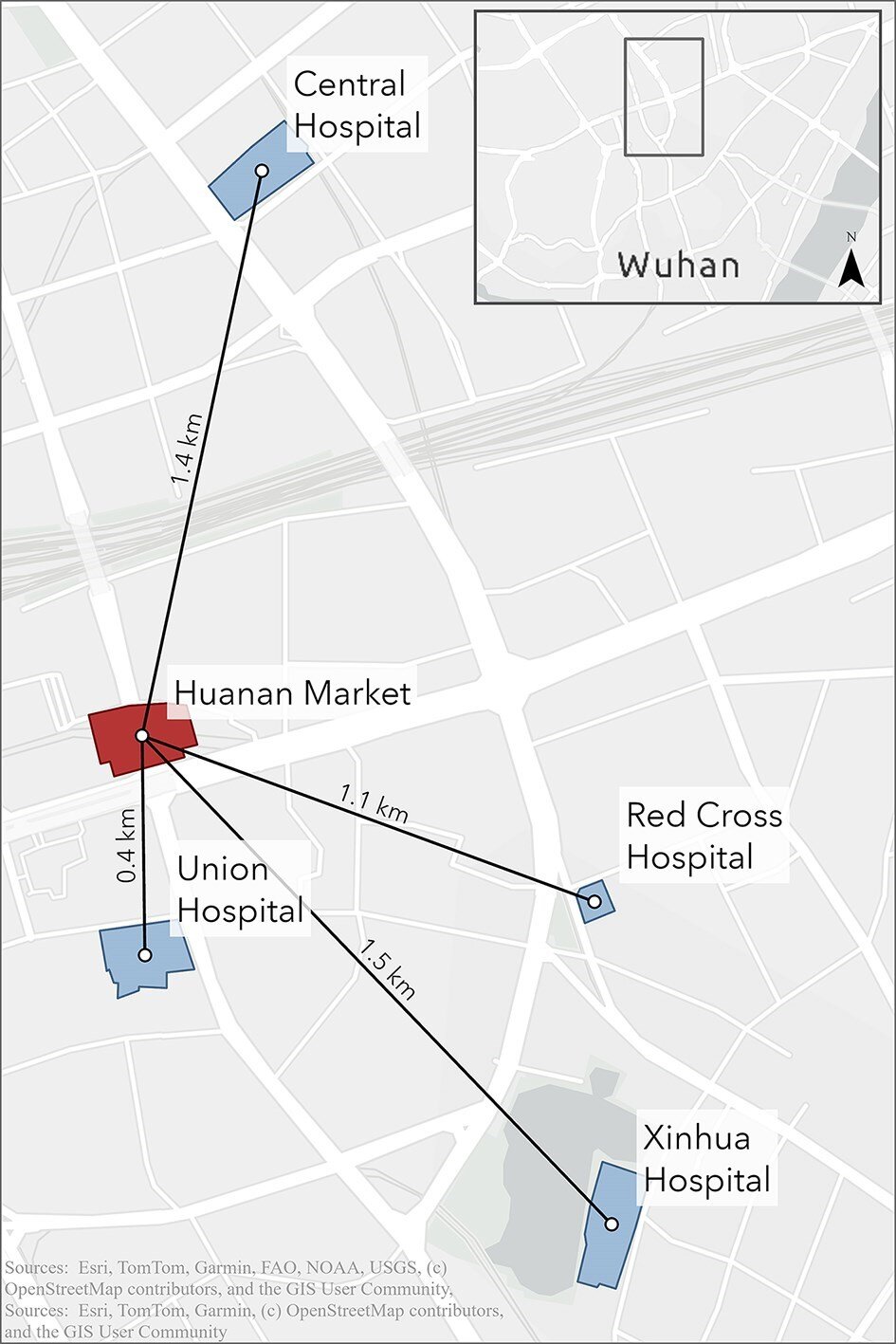
The proximity of four hospitals to the Huanan Seafood Wholesale Market in Wuhan, China. The Wuhan Red Cross hospital was transformed into a specialized treatment facility for COVID-19 patients early in the pandemic. Source: The figure was drawn by Gabrielle Quiroz-Croft Scientific Illustration. Credit: BioScience (2026). DOI: 10.1093/biosci/biag037
A Viewpoint article published in the journal BioScience argues that the contentious debate over the origins of SARS-CoV-2 could benefit from a well-established scientific approach for weighing competing explanations.
Author Alan B. Franklin (formerly of the USDA National Wildlife Research Center) argues that multiple working hypotheses and strong inference could break the logjam of single-hypothesis reasoning that has marked politically charged accusations that SARS-CoV-2 originated from either an intentional or unintentional release from the Wuhan Institute of Virology or the nearby live animal market.
In the article, Franklin pointedly avoids declaring the pandemic's origins, focusing instead on improving the analytical approach to such questions. As he puts it, "My goal here is not to support any particular hypothesis but to argue for a better process to distinguish among these competing hypotheses, a process that should be guided by an objective consortium of scientists rather than the media and politicians."