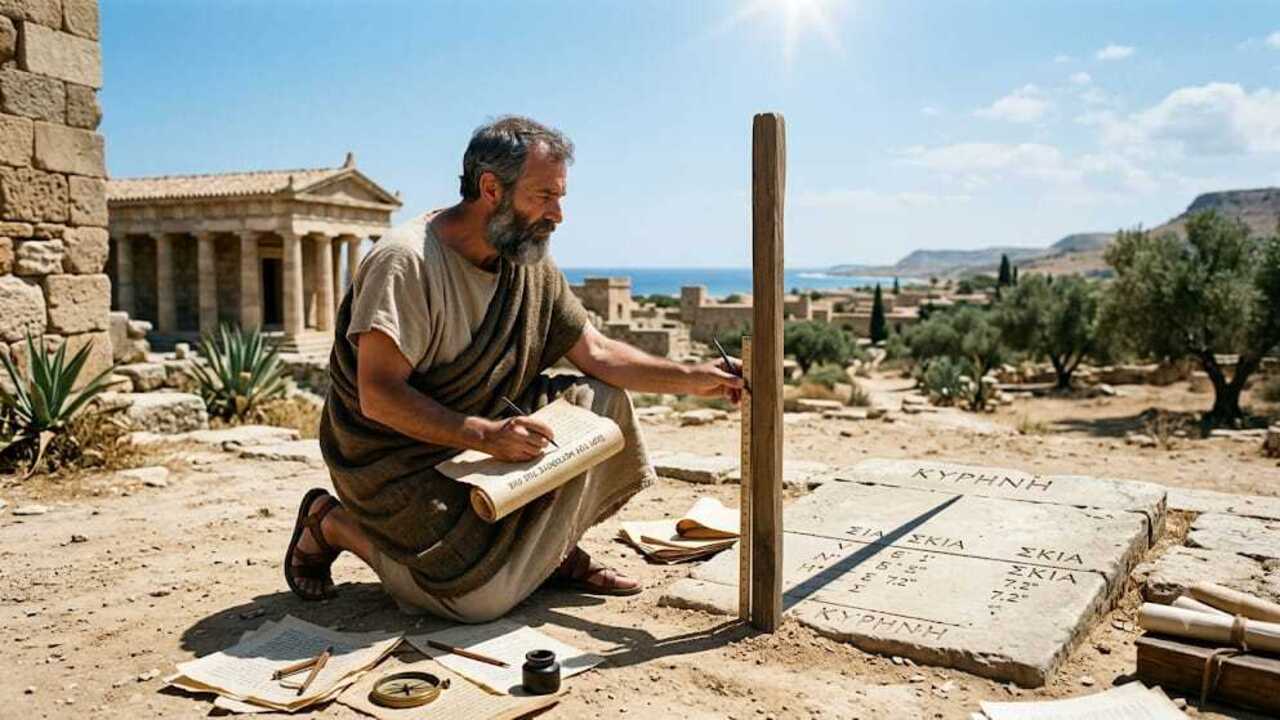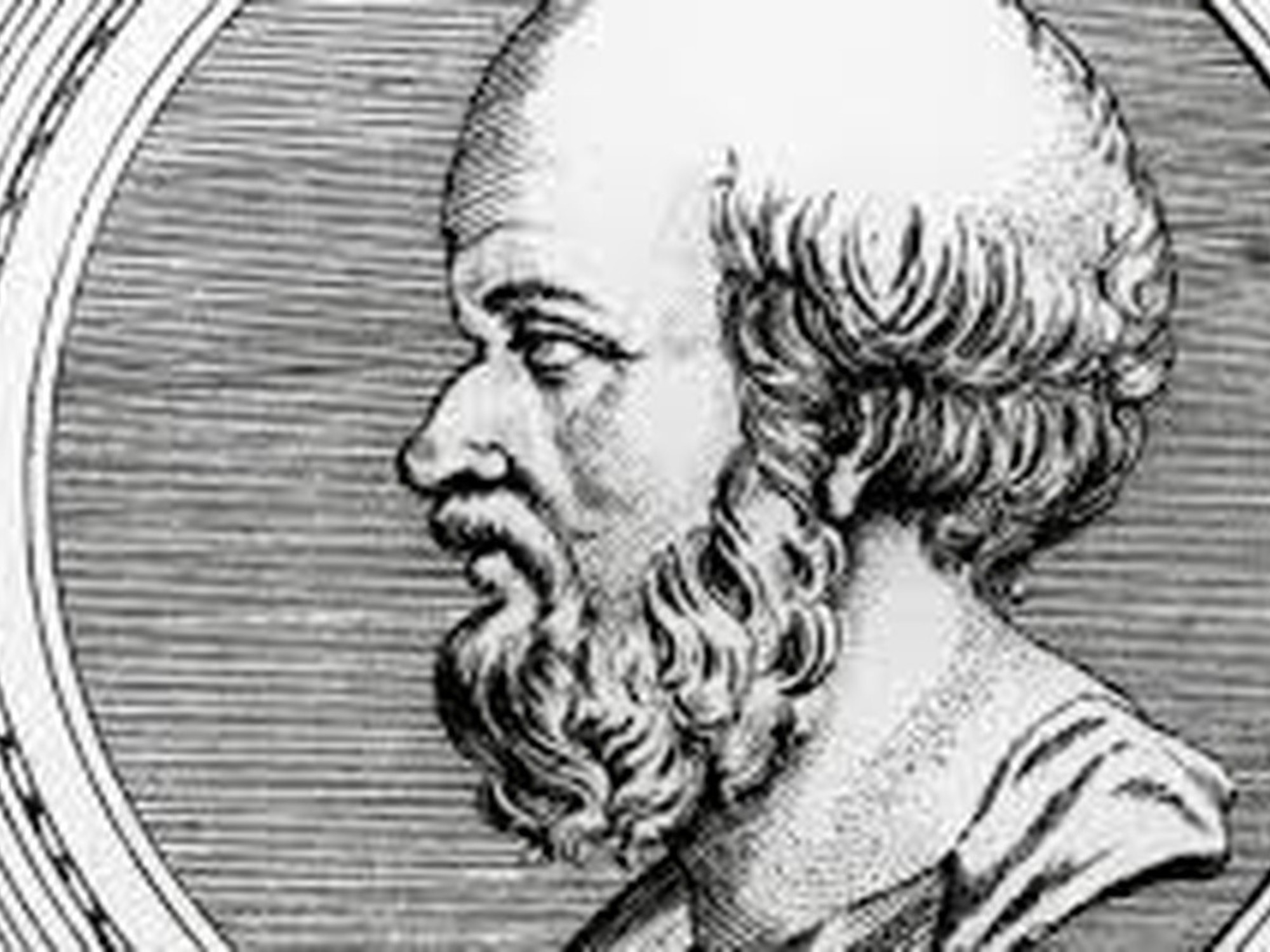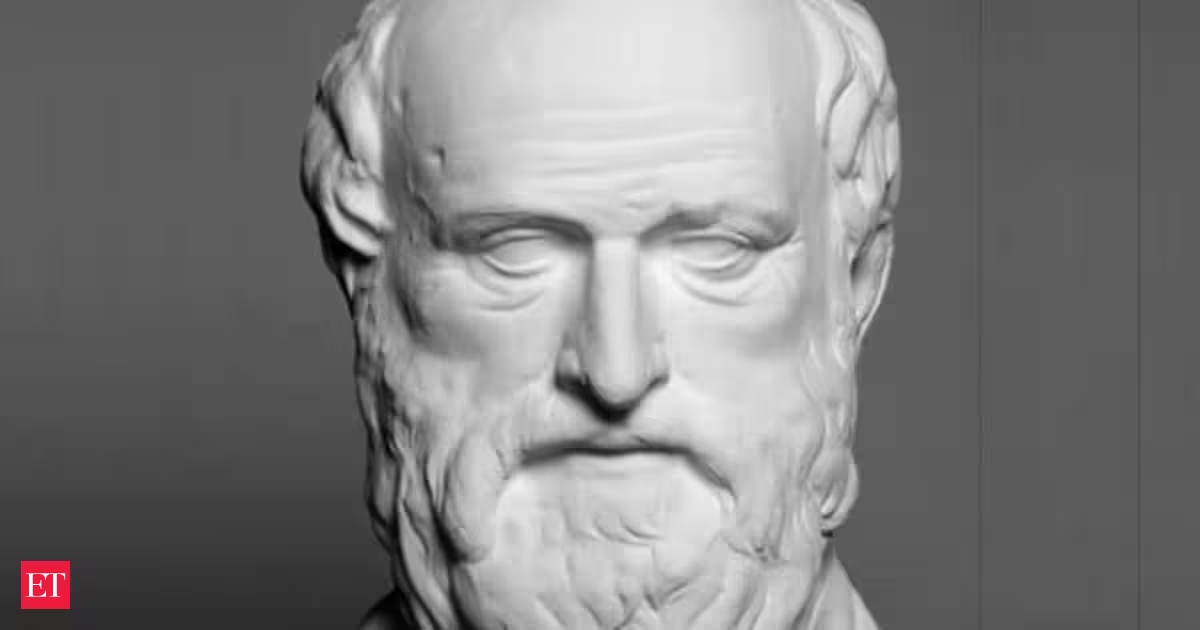
More than 2,200 years before satellites, GPS and space missions transformed our understanding of the planet, an ancient Greek scholar achieved something extraordinary. Using nothing more than a stick, sunlight and basic geometry, Eratosthenes calculated the Earth's circumference with remarkable accuracy.Around 240 BCE, Eratosthenes carried out an experiment that remains one of history's greatest scientific achievements. His estimate of the Earth's size came astonishingly close to the modern measurement, proving that careful observation and mathematics could answer some of humanity's biggest questions.Today, his work is still celebrated as a timeless example of how curiosity and logical thinking can lead to groundbreaking discoveries.How did Eratosthenes calculate the Earth's circumference?According to the American Physical Society, Eratosthenes learned that in Syene (modern-day Aswan, Egypt), something unusual happened every year during the summer solstice.At noon on the longest day of the year:The Sun appeared directly overhead.Sunlight reached the bottom of deep wells.Upright objects cast almost no shadow.Curious whether the same thing happened in Alexandria, about 800 kilometres north, Eratosthenes conducted his own observation at exactly the same time. Unlike Syene, a vertical stick in Alexandria produced a clear shadow.After measuring the angle between the stick and its shadow, he found it to be approximately 7.2 degrees. That small difference revealed something remarkable—the Earth could not be flat.If the Earth were flat, sunlight would strike both cities at the same angle, producing identical shadows.The simple math that measured an entire planetEratosthenes already knew the approximate distance between Alexandria and Syene.Professional surveyors estimated the journey to be around 5,000 stadia. He then made a brilliant mathematical observation.Since 7.2 degrees is one-fiftieth of a full circle (360 ÷ 7.2 = 50), the distance between the two cities must also represent one-fiftieth of the Earth's circumference.His calculation was surprisingly simple:Distance between the cities: 5,000 stadiaMultiply by 50Estimated Earth's circumference: 250,000 stadiaHe later refined the estimate to 252,000 stadia, making it easier to divide into degrees. Although historians still debate the exact length of a stadium used at the time, modern calculations suggest his estimate equals roughly 39,000 to 40,000 kilometres.For comparison, the Earth's actual equatorial circumference is 40,075 kilometres. That means Eratosthenes came astonishingly close—without telescopes, satellites or modern technology.Why Eratosthenes' experiment was so accurateThe success of Eratosthenes' calculation depended on three key ideas:Careful observationBasic geometryLogical reasoningHis method assumed that sunlight reaches Earth in nearly parallel rays and that the Earth is spherical—both ideas proved to be correct.There were small sources of error. Alexandria and Syene are not perfectly aligned north to south, and the distance between them was only an estimate. Yet despite these limitations, the final result remains one of the greatest scientific achievements of the ancient world.Who was Eratosthenes?Eratosthenes was a Greek mathematician, astronomer, geographer and philosopher. He also served as the chief librarian at the famous Library of Alexandria, one of the greatest centres of learning in the ancient world.Beyond measuring the Earth, he made lasting contributions to mathematics and geography. He is also credited with creating the Sieve of Eratosthenes, a simple method for identifying prime numbers that is still taught in schools today.A discovery that still inspires scientists todayMore than two millennia later, satellites can measure the Earth with incredible precision in seconds.Yet Eratosthenes' experiment continues to inspire scientists, mathematicians and students around the world because it demonstrates that extraordinary discoveries do not always require advanced technology.With nothing more than sunlight, a stick and a sharp mind, Eratosthenes showed that observation, curiosity and mathematics could reveal the true size of our planet—an achievement that remains one of history's most remarkable scientific milestones.
Over 2,000 years ago Eratosthenes, the ancient Greek scholar, measured the Earth's circumference with just a stick, sunlight and simple math
Ancient Greek scholar Eratosthenes calculated Earth's circumference using sunlight and geometry. He observed shadows in Syene and Alexandria to determine the planet's size. His experiment revealed the Earth was not flat, which was a significant discovery. Eratosthenes' calculation of 252,000 stadia closely matched modern measurements. This achievement demonstrates how curiosity and logic can lead to groundbreaking scientific insights.
590 words~3 min read