Guest Post By Jithesh Mithra, Independent Researcher, Jacksonville, Florida
Here is a result that should not happen. Take a quantum error correction (QEC) code, fix the physical error rate, and ask a simple question. Does adding more qubits make it work better? Under a single noise assumption, the answer would be yes. However under a different assumption at the exact same error rate, the answer would be no. This is the same code with the same error rate, yet there are opposite conclusions. The only thing that changed was the assumption about the structure of the noise.
I found this while building an open-source tool to test something the QEC field took mostly for granted.
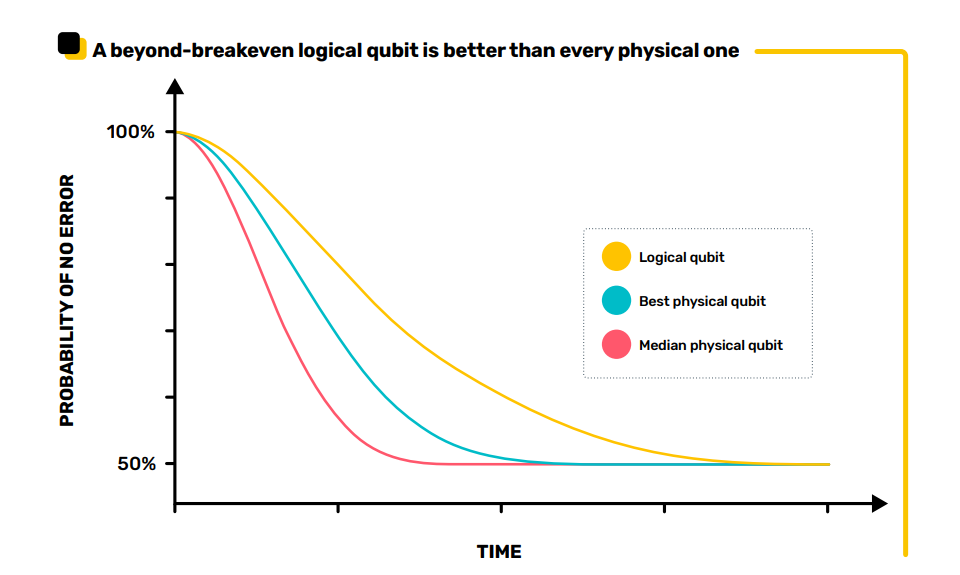
The quantity I explore is the pseudo-threshold. For finite-size codes, it is the physical error rate at which the logical error curves for two adjacent code distances cross. Below it, increasing distance helps. Above it, increasing distance hurts. Pseudo-thresholds are used constantly as comparative indicators, basically how good a code is under a given noise model. They are almost always reported as single point values, with no error bars and no sensitivity analysis attached.
That seemed strange. A pseudo-threshold is estimated from Monte Carlo data, which means it carries statistical uncertainty like any other estimate. Yet the numbers get passed around like it was exact. So I started asking a narrower question. If you change the assumed noise model slightly, how much does the pseudo-threshold move, and is that movement large enough to change the conclusions people draw from it?