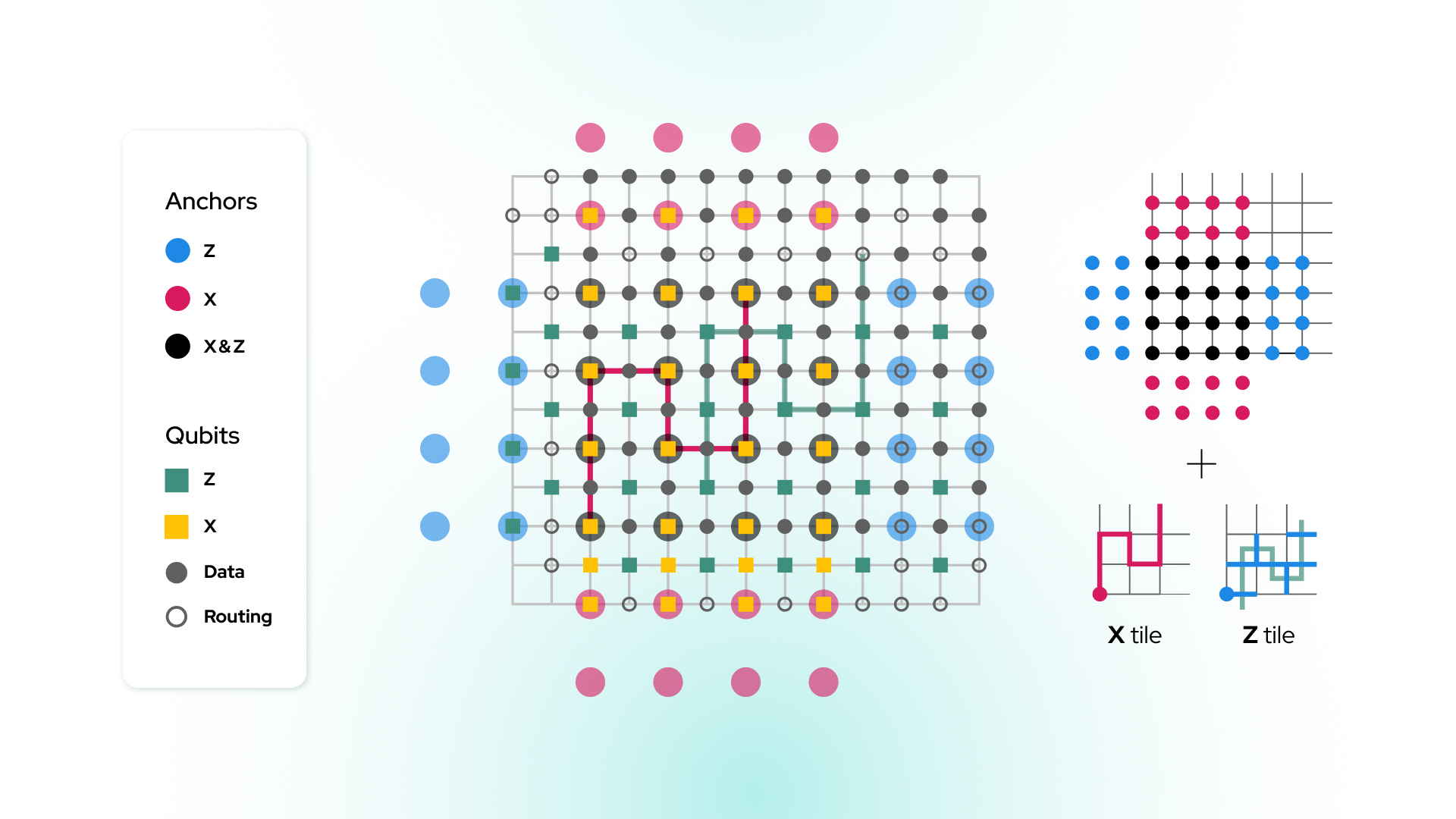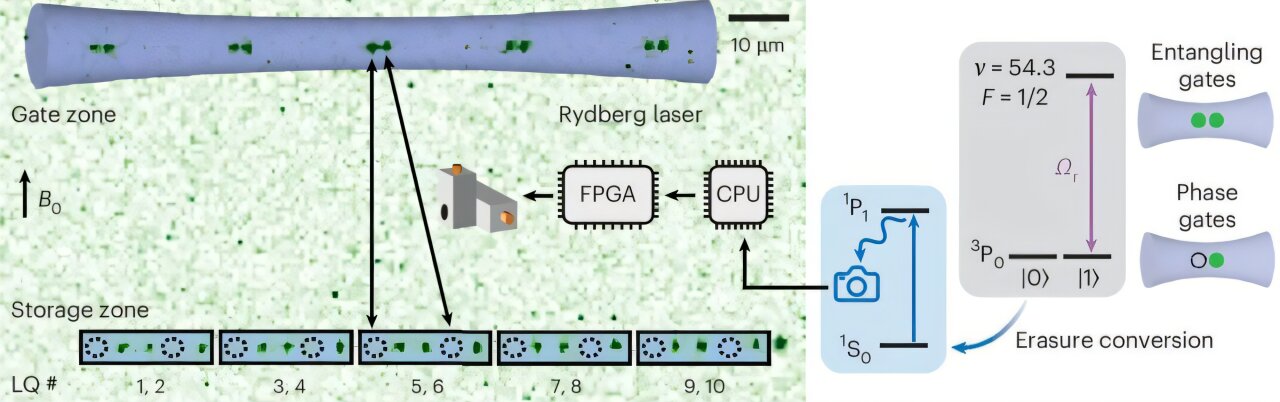
Schematic of storage and gate zones for implementing the [[4,2,2]] code, showing ten logical qubits (LQ # 1–10) in the storage zone. Credit: Nature Physics (2026). DOI: 10.1038/s41567-026-03309-0
Quantum computers, devices that process information by leveraging the laws of quantum mechanics, have been found to outperform classical computers in some advanced tasks. Instead of storing information in the form of classical binary bits (i.e., 0 or 1), quantum computers rely on quantum bits (i.e., qubits), which can also exist in combinations of 0 and 1 states.
Despite their potential, quantum computers are known to be highly prone to errors. This is because qubits are very sensitive to heat, magnetic fields and other changes in their surroundings, which can disrupt the delicate quantum states they rely on to store and process data.
Researchers at Princeton University recently introduced a new approach for developing quantum computers that make fewer errors and whose errors are easier to detect and correct.
Their proposed strategy, published in Nature Physics, entails developing a quantum computing platform based on metastable ytterbium-171 atoms, neutral atoms of a specific ytterbium isotope that are in a long-lived excited energy state.