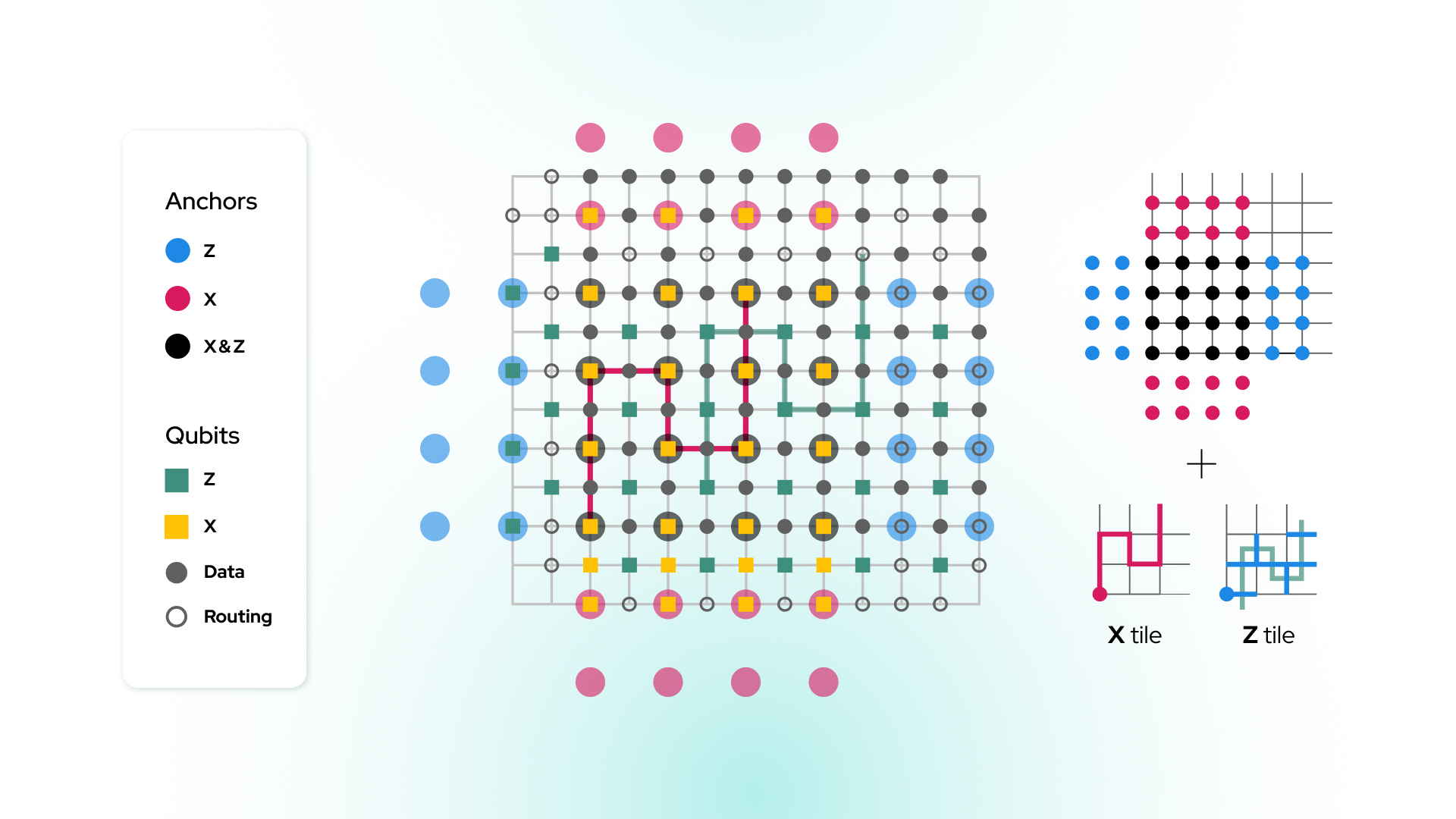
Useful quantum computers will require fault tolerant logical operations. Researchers are actively exploring many different quantum error correction (QEC) codes to enable this, improving the Logical Error Rates (LER) of Quantum Processing Units (QPUs). While it is well understood how to run logical operations with surface codes (which belong to the topological code family) via lattice surgery, they are qubit efficient for memory but suboptimal relative to other topological codes for performing fault-tolerant logical computation.
Quantum low-density parity-check (QLDPC) codes are another type of QEC scheme that require the least physical qubits for memory due to their constant rates. However, it is still unclear how both Clifford and non-Clifford gates can be performed efficiently at the logical level with QLDPC codes.
Color Codes are another type of topological code that are well understood. Although they require more physical qubits for memory than surface codes to achieve the same target logical failure rate, they can perform logical gates more efficiently than surface codes due to their ability to do all Clifford gates transversally and the symmetry of their representation resulting in simpler lattice surgery operations. With fast and accurate decoders, it is likely that parameter regimes exist where logic with color codes could be more efficient than logic with surface codes.