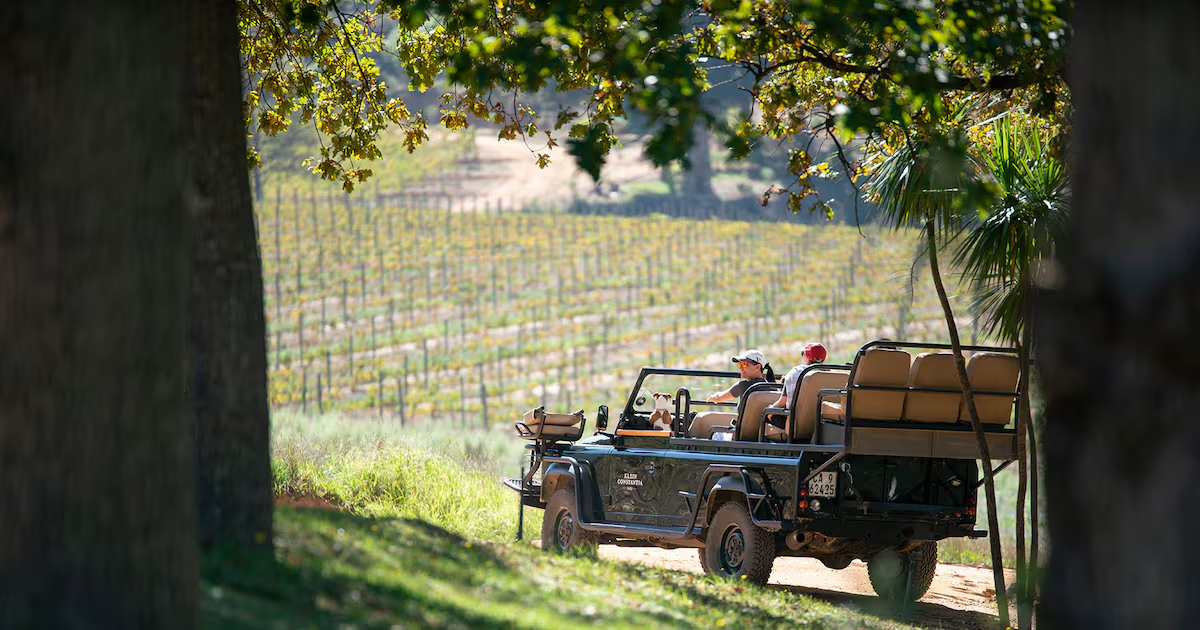
Anyone who still believes that writers and influencers can really drive fashion trends needs only consider the well-intentioned but largely unsuccessful attempts by several of the world’s authoritative wine writers to generate interest in riesling. Twenty-five years of relentlessly singing its praises, sometimes as soloists, often in chorus, and nothing, as far as I can tell, has changed. We all recognise how extraordinary the best rieslings are, how they evolve, acquiring complexity with age (which they do, magnificently) — and still zilch.Growers, a few of them, have been inspired, some even planting small blocks of vines, but always — at least in South Africa — more riesling vineyards are removed than replaced. In Europe, the reality is better expressed by prices. You can buy an Alsace single-vineyard Grand Cru from an impeccable source for one fifth the price of a Grand Cru white burgundy. Even in Germany, where the finest examples are produced on terraced vineyards where the labour costs are among the world’s highest, only a handful of growers can claim they are earning an appropriate amount for their effort and risk.Part of the problem is that German wines and German varieties are out of fashion. So are white wines (relative to reds) so they don’t attract a premium, making it more difficult to spotlight them effectively. Then there’s the small matter of sugar — it’s not exactly a la mode. Whatever the pundits of the trocken (dry) style of German riesling may claim the variety is more complex and more expressive with a little sugar and it achieves its crowning glory when it packs a nuclear dose of hyperglycaemia. In the world of riesling, as with all categories in which sugar plays an essential role, exactly what adds depth and interest to the wine is exactly what compromises the promotion. As things stand, the negative perception associated with it exerts a more powerful impact than any influencer or critic can hope to countermand. This helps to explain the long-term decline in the sale of port and port-style wines, of the great German late-harvested rieslings, of Loire Quarts de Chaume and the fabulous Sauternes from Bordeaux, and most (but not all) of South Africa’s noble late harvests.The extraordinary sweet wines of the Cape are not simply world-class. They are also the most underpriced of our vinous treasures. The port-style wines produced in Calitzdorp and Stellenbosch stand shoulder-to-shoulder with the best of the Douro Valley. Boplaas has long enjoyed a reputation for its Cape Vintage Reserve, as has neighbouring De Krans. At 10 years of age (try the Boplaas 2016 and the De Krans 2015), they are on the plateau of maturity, yet still with a long way to go. Older bottles of Axe Hill can still be found, and they are sublime. Delaire Graff, more famous by far for its unfortified wines, often walks off with the Trophy Wine Show best-in-class award for its current release Cape port. Tawnies — from Boplaas and from the KWV — can be kept open for months without marked deterioration. They are perfect if you are looking for the occasional glass of something spectacular to savour in front of the fire after dinner.Then there are the noble late harvest (botrytis) white wines pioneered in the modern era by Gunther Brozel of Nederburg. Bottles of Edelkeur, Eminence and the Nederburg Winemasters Noble Late Harvest are readily available and at a pittance, relative to value. Finally, there’s the Vin de Constance of Klein Constantia, the only Cape wine that comes to market alongside Petrus and the First Growths of the Medoc on the Place de Bordeaux exchange. I’ve written elsewhere about the latest (2023) release — sumptuous rather than opulent and with the tell-tale honeyed notes of botrytis (noble rot). Only three times in the modern era of the estate have the weather conditions conspired to produce botrytis at Klein Constantia, making this vintage a legend in its own time.Business Day
MICHAEL FRIDJHON | Just desserts: skip the pasta, drink the wine
The sweet wines of the Cape are the most underpriced of our vinous treasures
656 words~3 min read