About 20 years ago a Wine Magazine Pinot Noir tasting panel awarded one of its highest ratings to an unknown wine from an unknown farm in an unknown region along the Outeniqua Mountains. Wine panels don’t always get things right, though competent tasters working “blind” (so labels out of sight) are more likely to be correct than equally competent palates succumbing to the message of brand. Confirmation bias is a more dangerous enemy to skill and integrity than a momentary lapse in concentration.The wine in question was the Herold pinot noir produced on what had once been a hops farm supplying South African Breweries. The site is pretty much due north of George, south of Oudtshoorn and east of the Montague Pass. In the early 2000s this was so far off the known wine map it was easy to assume that the tasters had been high on their own supply. I wasn’t on that panel, but when I sampled the wine I was properly impressed. I discovered only recently that at least part of the reason for its success was Hannes Storm — a then-unknown winemaker who accepted the gig to vinify the Herold vineyards’ fruit.Fast forward to 2026 and if you were to ask any serious Cape wine buff which South African cellarmasters best understand pinot — the so-called “heartbreak grape” — the odds are that Storm’s name would feature at the top of the list. A year after his sortie into the world of the Outeniqua, he became the winemaker at Hamilton Russell Vineyards. Ten years later he set out to make wines under his own name, in his own cellar, using fruit sourced from three specific sites in the Hemel-en-Aarde Valley.Storm’s pinots are not simply the end result of access to three different vineyards: they are part of a quest to understand the region’s terroir. Anyone who really engages with pinot feels a compulsion to understand the variety in the context of place — a very specific place. In the Burgundian heartland of the grape a mere 100m can be the difference between gold and dross, between bottles which sell for hundreds of thousands of rand and bottles non-oligarchs can still afford. Sure, marketing and rarity drive the extremes of Burgundy pricing, but the differences (before they are magnified by the overheated trading environment) arise from nuances so fine that no-one can fully account for them.So Storm and his wife, Nathalia, work three sites — “Vrede” at the valley entrance close to the town of Hermanus, “Ignis” in the upper valley and one on the ridge. The wines are vinified in the same way, with the same coopers supplying the barrels and pretty much the same percentages of new and older oak. Storm also makes chardonnay from the Vrede and Ridge sites. Back when the Platter guide still rated his wines, all but one of the five bottlings enjoyed five-star status — an indication of the evenness of their quality and of their status as industry benchmarks.The 2024 pinots and the 2025 chardonnays have just been released. They are of course too young to express fully their inherent complexity. The Vrede is quite Burgundian, the Ignis more forward, more New World if you like. The Ridge — dark-fruited and more intense — is still too restrained to reveal its future direction. The chardonnays are steely, precise, linear: there are no concessions to cuddliness. It’s too soon to say whether there are other undiscovered Herold-type sites that will rewrite the story of Cape pinot: there are fine wines coming from Hemel-en-Aarde and Elgin, all much better than they were when virus issues dominated the purity of the fruit. Pinot, because good examples are hard to find, is overpriced everywhere and enjoys disproportionate cult status. But of its exponents in the Cape, Storm (who has now also made his own Grand Cru Clos Vougeot with fruit sourced from Philippe Chéron’s vineyards) is comfortably the man to follow.
MICHAEL FRIDJHON | Unknown winemaker put pinot noir on the map
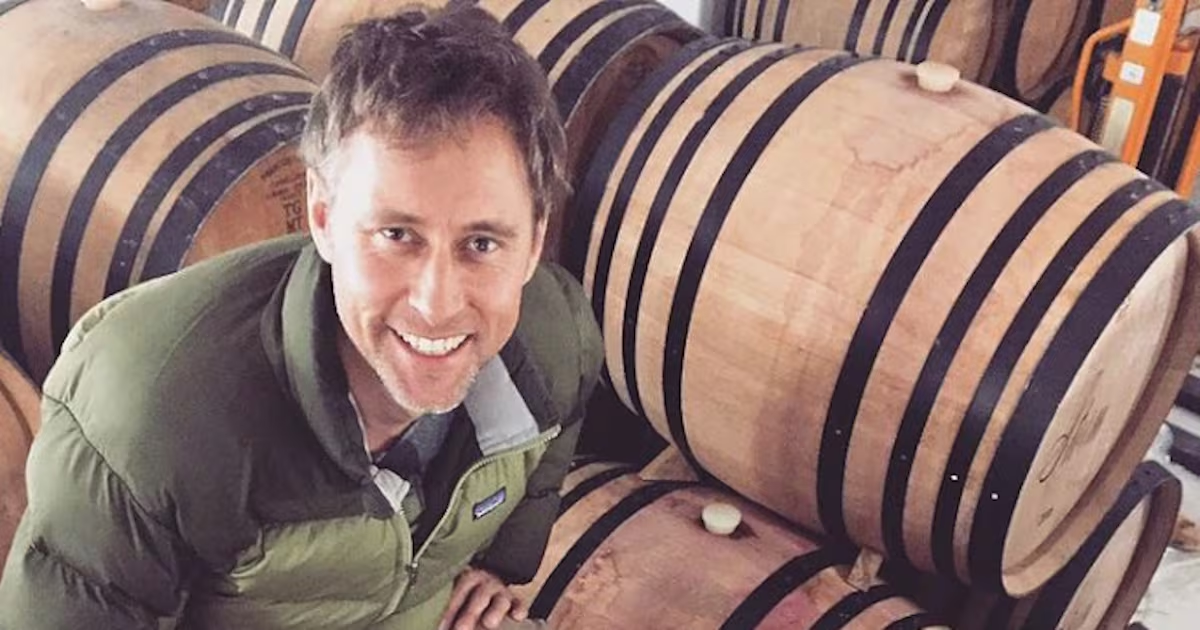
Hannes Storm is now a South African cellarmaster who best understands pinot
658 words~3 min read