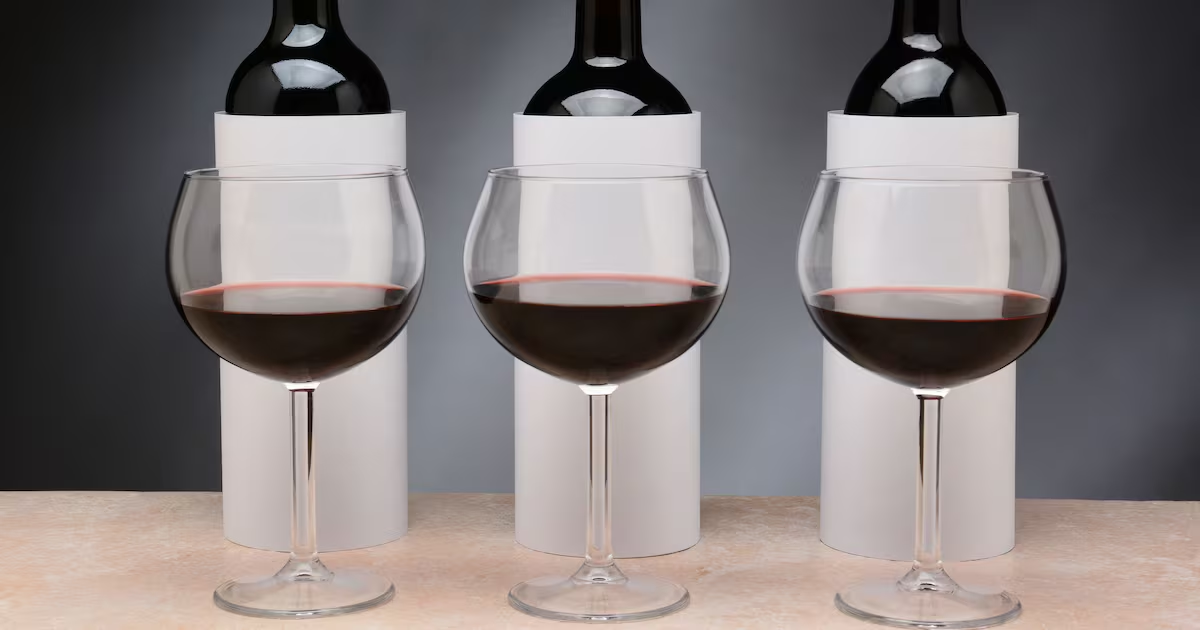
The adage about why academic controversies are so virulent (“because the stakes are so low”) could easily be applied to debates in the wine industry. It doesn’t much matter what critics think — the market has a life of its own. Some of the biggest selling wines are made and sold by producers unloved by the commentariat.The latest in a long line of such spats relates to how critics choose and approve of the wines they review: where they come from and what tasting criteria are applied. In an industry that produces more than 9,000 different labels, very few ever get to bathe in the limelight. Most spend their entire existence off stage.The primary reason for their invisibility is the same as it is for all manufactured products seeking a market. Unless they fill a gap or satisfy a specific demand, they compete with many other similar beverages made from the same grapes and selling at about the same price point. Marketing helps to create visibility and with wine there’s no shortage of specialists claiming to be able to hugely enhance the profile of one wine over all others. It’s self-evident that if everyone invests the same budget, nothing changes except the noise level — the solution merely accentuates the problem. The alternative — the less visibly paid-for publicity route — involves accessing credible critics or entering blind-tasting competitions to advance the cause. This is even more fraught: there are few critics or commentators with a platform and there are vastly more wines than any individual can possibly review between one vintage and the next.There’s also no way to separate the really finely nuanced differences in a way that provides specific, useful guidance. Scoring is falling out of fashion: score inflation with the narrow range are the primary reasons. If a wine worth buying must score at least 90 points, and if only a fraction have ever been awarded (or perhaps “deserved”) a 100-point score, then everything has to fit into a range of 10. Since taste isn’t absolute (whatever some of the critics might say), you would be crazy to pay a premium to buy a 96-point wine in preference to a 95 or 94.You probably wouldn’t need to. Wherever the reviewers are tasting blind (a rarity nowadays since there are only a countable number of occasions where judgment is passed without the label in sight) it is often the less expensive wines that score higher. Many producers (and their marketing gurus) use price as a proxy. As long as enough wine buyers are gullible enough to assume that a wine costing R500 must be better than one selling for R400, this will be the strategy of choice.Then there’s simply the matter of style. As WineMag editor Christian Eedes put it, “South African wine increasingly risks mistaking aesthetic coherence for intrinsic quality. Fine wine has become not merely a standard but a look, a tone and a set of coded references.” Here he is addressing a concern that, at least in his publication, preference is given to the geekier, less mainstream, examples. This is not unreasonable: he presumably knows his audience and doesn’t expect that they want to read reviews about brands that have been around for decades.Herein lies a problem for many of these well-established producers: they were once the height of fashion (Nederburg in the 1970s, Meerlust in the 1980s, Thelema in the 1990s, Vergelegen in the 2000s). They are no longer edgy. Their wines may be as good as they ever were — perhaps better. But they are not getting the airtime they enjoyed when they burst on the scene. I don’t think this should be an issue: they are now properly established. Every year sees a new wave of wineries and winemakers trying to gain a toehold in an overtraded market. Surely the job of the critic and blind tasting competitions is to identify the best of them. After that they’re on their own.Business Day
MICHAEL FRIDJHON | There is more to fine wine than taste alone
Debates over critics’ selection and evaluation methods are largely irrelevant to the broader market, as most wines remain obscure unless marketing or critical acclaim gives them visibility
660 words~3 min read