Onboard hydrogen injection may reduce visible smoke, but opacity does not prove lower fuel use or CO₂e.
Support CleanTechnica's work through a Substack subscription or on Stripe.
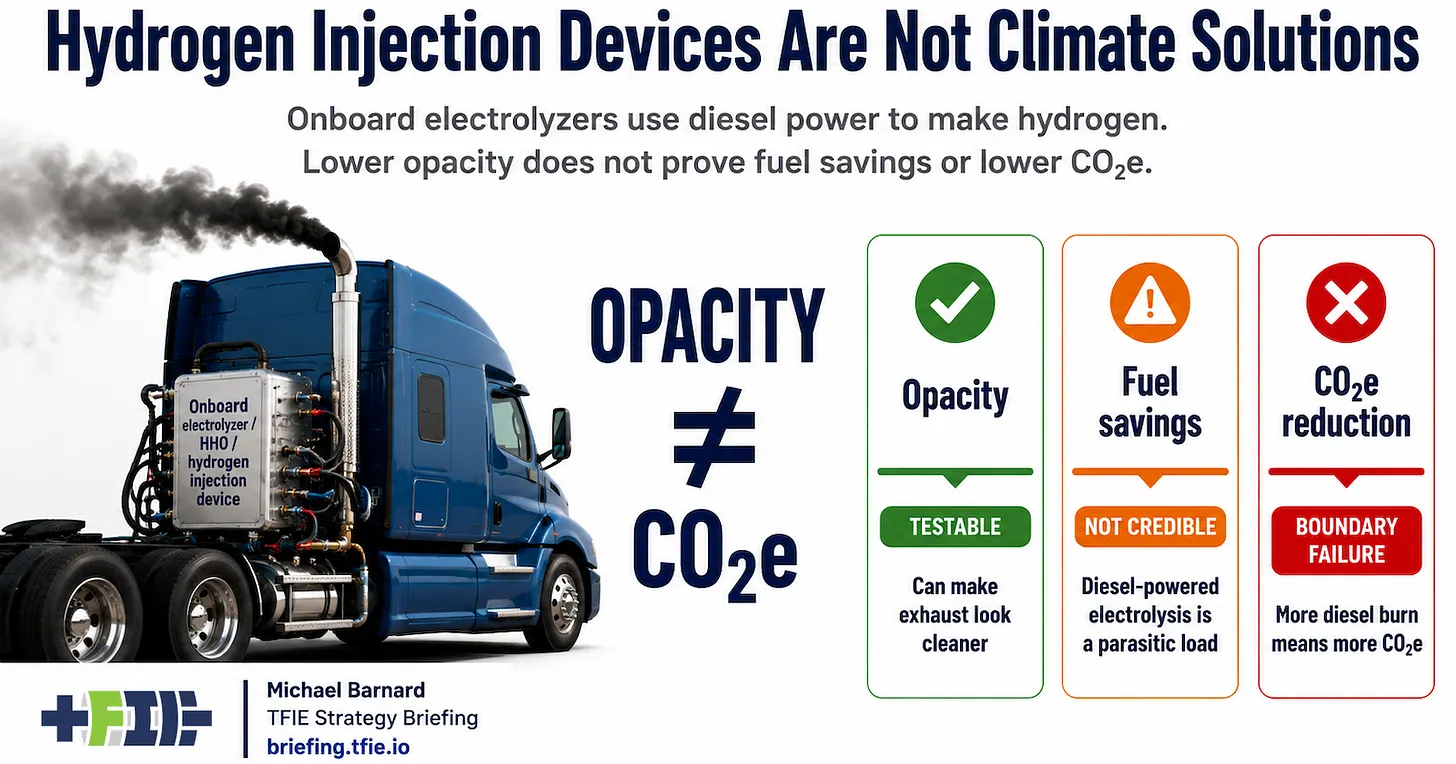
A cleaner-looking diesel exhaust plume is evidence about smoke, not climate performance. Onboard hydrogen-injection systems ask customers to skip that distinction: they use electricity produced by the diesel engine to split water, feed the resulting hydrogen or oxyhydrogen back into the same engine, and then present a change in exhaust opacity as evidence of fuel and carbon savings.
There is a legitimate technical observation underneath the pitch. Hydrogen can alter ignition, flame propagation, and soot formation, so a small injected gas stream may reduce visible smoke under some operating conditions. Opacity is a real measurement of how much an exhaust plume blocks light, but it does not measure diesel consumption, particulate mass, particle number, nitrogen oxides, or carbon dioxide equivalent emissions. A stack can look cleaner without the engine becoming more efficient or lower-carbon.
The claim usually expands from that narrow result. Cleaner-looking exhaust becomes cleaner emissions, which becomes lower fuel consumption, lower Scope 1 carbon, reduced maintenance, and sometimes an assertion that diesel particulate filters or diesel exhaust fluid are no longer required. Each step moves into a different measurement and requires additional evidence. An opacity test cannot carry the entire ladder.