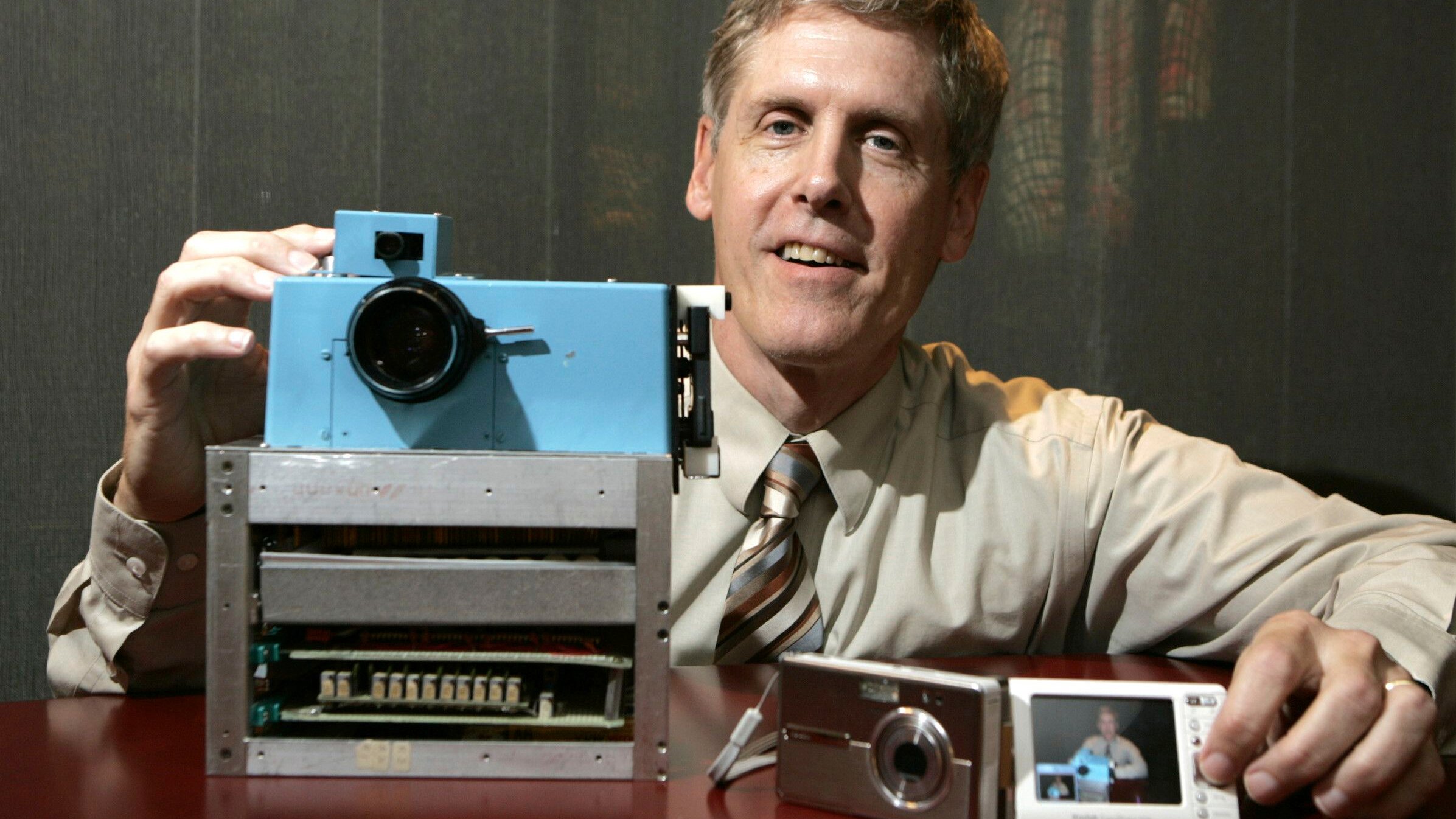
Every camera-equipped connected device you build today, from a smart doorbell to an ESP32-CAM streaming frames over Wi-Fi to a factory machine-vision rig, is a descendant of one clunky, toaster-sized prototype: the first digital camera, built at Eastman Kodak in December 1975. It weighed about 8 pounds, took 23 seconds to capture a single 0.01-megapixel black-and-white image, and recorded that image to a cassette tape. It looked like a science-fair project, but it proved a radical idea that underpins the entire IoT sensing industry: an image could be captured, digitized, and stored as data with no film at all.
An engineer, a side project, and a CCD
The camera was built by a 24-year-old Kodak engineer named Steven Sasson. His manager had handed him a loose assignment: could the newly invented charge-coupled device (CCD) image sensor be used to build a camera with no moving film? The CCD, developed at Bell Labs in 1969, converts light falling on an array of tiny capacitors into electrical charge, pixel by pixel. Sasson took a Fairchild 100-by-100-pixel CCD, bolted it to a lens from a Super 8 movie camera, added a digitizer, and wired the output to a portable cassette recorder.
The result captured just 0.01 megapixels, a grid of 10,000 pixels. To view a photo, Sasson's team built a custom playback rig that read the tape and painted the image onto a television screen. That first image, a Kodak lab technician, took 23 seconds to write to tape and several more to display. Crude, yes, but it was the first fully electronic, filmless photograph.