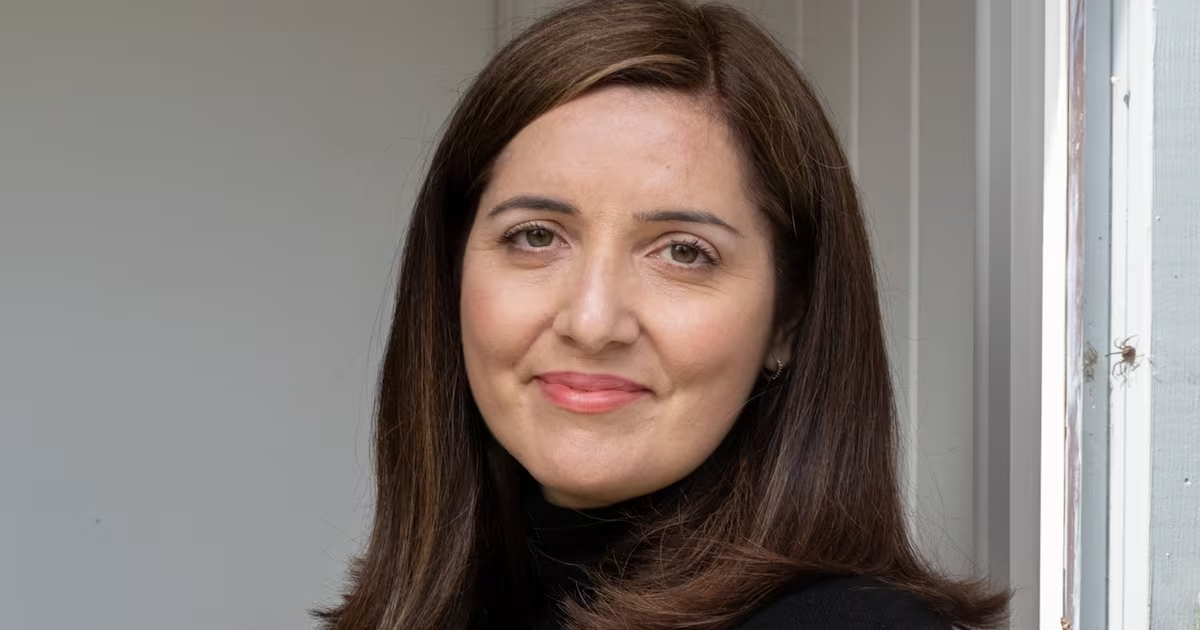
I grew up in Castleknock, just over the wall of the Phoenix Park in Dublin. It was a lovely place to grow up, because it’s very quiet, and feels like you’re a long way out of town, even though you’re not. In the 1980s, Castleknock was much less developed than it is now. There was a corner shop, and the church. Mount Sackville was the main school for girls, Castleknock College the main school for boys. That dictated the rhythm of life in the area – when it was term time, you’d have the students coming and going, and not much else going on. I went to Mount Sackville from when I was four until I was 17.I credit my sister with my decision to go to university in Oxford. She got into one of the colleges to read law. She was very happy and had this amazing life, and I thought I might as well apply. I was only 16 when went over for the interviews. I think they could see how young I was, so they offered me a place, but I had to take a gap year. I was also really shy. I had never spoken to a boy before in my life. I ended up going to DIT and doing the first year of the journalism diploma. I did a lot of growing up there. In the meantime, I got the medal for English in the Leaving. I was feeling fairly confident going off to Oxford. That was a mistake. I was totally out of my depth from day one. It wasn’t bad – it was exciting and interesting and I was surrounded by these very clever people, but I really found it hard to be in this totally different environment.England was different, and Oxford another level of different. It was a very weird place to be for three years, but I wouldn’t change it.In 1998 I came back and did the Masters in Anglo Irish Literature in Trinity College Dublin. At the time, I was in a fairly serious relationship. For almost five years, we had a long-distance relationship. He was training to be a barrister, so that was very London focused. I was working for the publisher, Mercier Press. When they decided to close their Dublin office, instead of getting another job, I decided I would try my luck in London. I came over in 2003, but I never thought of it as emigrating – never thought: I’m leaving Ireland and going to live in another country.I really had my heart set on trying to come back and live in Dublin. My family and I came back in 2017 and had a run of appallingly bad luck. I was writing a book at the time and it just didn’t work. That was my income for the year. I’m self-employed. My husband is self-employed. ‘I was really nervous about it. I thought: what if I’ve lost touch too much?’— Jane CaseyHe was spending a lot of money travelling back and forth to London for work. We got to Christmas. We were living in Rathmines. I took the boys to the shop and while we were out, somebody burgled the house and stole all their Christmas presents. It just made me so sad. Then my older son was in a freak accident at school.He was very lucky – he could have died. But I thought: this is not working. In the end, we moved back to London. In my life, I’ve been very lucky generally, and that is probably the only thing that has broken my heart.When I came to England first, there was a lot more anti-Irish sentiment. When I was at university, the IRA were on ceasefire and there was this huge bomb in Canary Wharf that ended the ceasefire. I got a lot of stick for that. I think that hostility has receded, ironically, even while they are more suspicious generally.Most of my novels are about Maeve Kerrigan, who is London-Irish – her parents are Irish, but she’s grown up in London. There’s a huge population of people who have that experience who are unrepresented in culture. We’re better at talking and writing about Irish people abroad than people with Irish heritage trying to balance that with other ways of living.My latest novel, Everything She Didn’t Say, is my first set in Ireland. I started thinking about it while I was living in Ireland in 2018. I was really nervous about it. I thought: what if I’ve lost touch too much? I got a retired guard to read from the point-of-view of procedure and she was amazing. I won’t give spoilers, but there’s a bit at the end and she said something exactly like that happened to her. It made me really happy to think that the thing I’d made up actually happened.It’s set in Mayo. My mum grew up in Westport, and it was always the place she cared about most in the world. She passed away during the pandemic, but every spring my aunt and my sister and I go have a holiday there.We went up to north Mayo when I was thinking about the book – down the little boreens and to beaches and historic buildings that were well hidden from view. It’s a magical place. I’m always conscious that my books are read all over the world, hopefully in lots of different languages. Some of it is saying: look, there’s this extraordinary place!Telling the world: this exists, you can go and see it, this is waiting for you, if you want it.In conversation with Niamh DonnellyEverything She Didn’t Say by Jane Casey is published by Hemlock Press
‘I’ve been very lucky in life but leaving Ireland broke my heart’
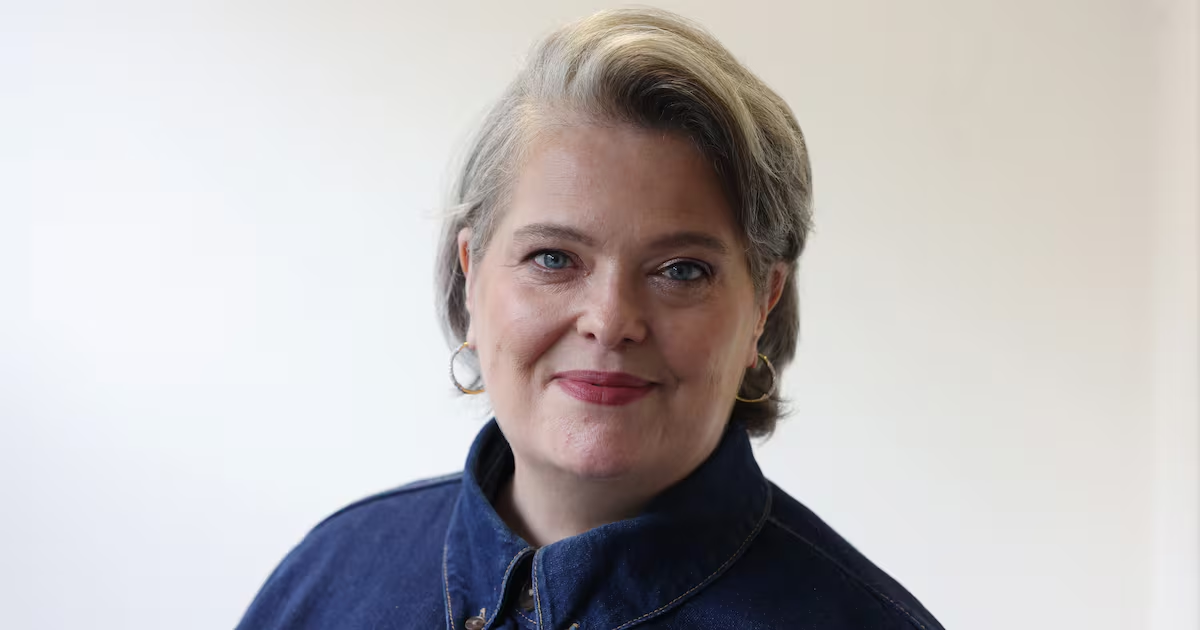
Irish author Jane Casey on growing up in Dublin and realising living there as an adult with her family wasn’t working
948 words~4 min read