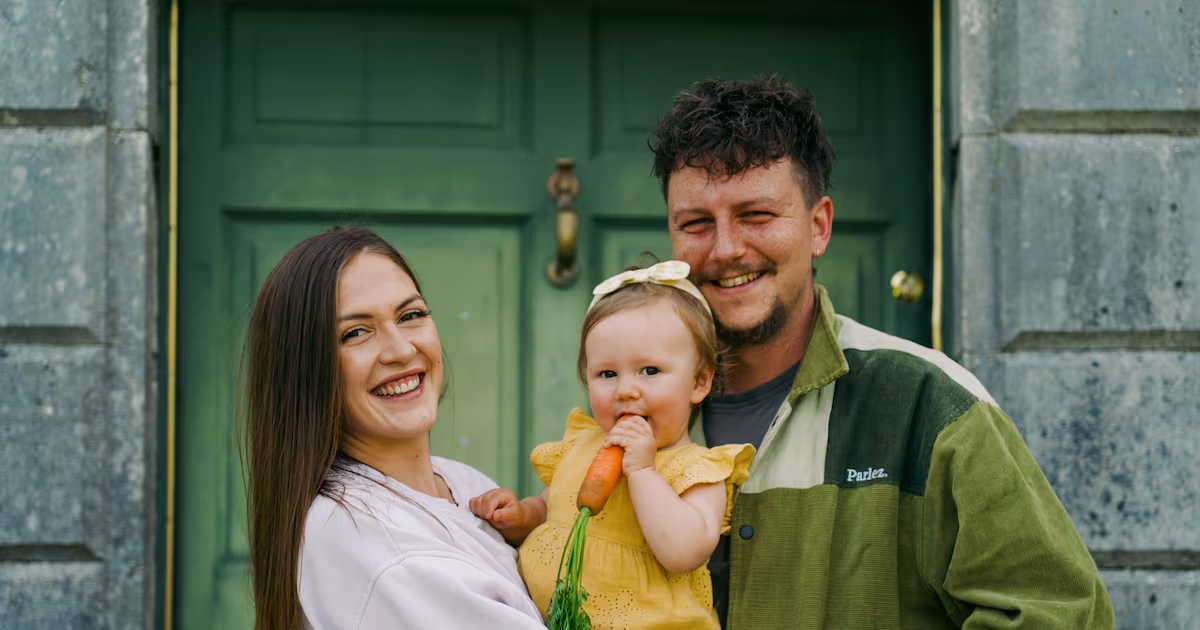
The daydream of escaping to the country for a better life is one shared by many city and suburban dwellers. Waking up to the sound of birdsong and sheep bleating in the rolling hills is an attractive prospect if you’ve ever watched a packed bus sail by your stop, or sat in a traffic jam on the M50. The thought of growing your own vegetables and collecting eggs from the hen house is a pleasant replacement for the worry that your landlord is about to sell your home from under you.The Covid-19 pandemic made the idea of a simpler life possible and some people never returned to their desks in the city. That small exodus has continued since, with young people and families abandoning urban life for a variety of reasons. Some are looking for a slower life, some people move because they will never be able to afford to buy a house where they are, while others want to return to their rural roots.But how does it work out when the novelty wears off? Here are the experiences of some people who turned their rural fantasies into reality.‘There’s a lovely sense of community here, really decent, down-to-earth people’Mark Ryan and Louise ButlerDublin to MayoIf you have ever dreamed of fleeing the city for the countryside, then the life created by Dubliners Mark Ryan and Louise Butler will tick all your boxes. Stunning scenery and stone walls surround their picture-perfect thatched cottage in Cross, Co Mayo. Mabel the potbellied pig ambles around while the children collect eggs from the hens.It was all so different when they had their first date in Dublin six years ago. Mark, from Shankill, was working as a landscape gardener and Louise, from Rathfarnham, was an art teacher with Youthreach.Louise Butler and Mark Ryan with their children Ferne and Sonny at Houndswood Farm in Cross, Co Mayo. Photograph: Pedro Souza A few months later, Mark got a call from his uncle John Joe. He was ready to retire from farming and wondered if his nephew wanted to take over. Mark’s father had grown up on the sheep and cattle farm and Mark had spent all his school holidays there. “I just loved being on the farm all the time,” he says. But he was no city boy with a rose-tinted view of rural life. He had gone to agricultural college after school, and regularly travelled down to the farm in the years since to help his uncle during busy times. “I did 10 or 12 lambing seasons and learned all the ropes, so it was not new to me,” he says. Knowing that his uncle would be on hand for advice also made the prospect less daunting.The couple bit the bullet, moving into a mobile home on the farm in December 2020, in between Covid lockdowns. It was hard when we were living in a mobile home with a newborn baby and the gas would run out. We didn’t have the comforts that we were used to, but we knew there was light at the end of the tunnel— Louise Butler“It was all very quick, but when it’s right, it’s right,” Louise says. Mark saw it as a good trial run for their future. “When we knew we could live in the countryside in the middle of winter in a mobile home, we knew we could do this,” he says.They were still travelling back to Dublin for work until it became unsustainable and they eventually moved to Cross in January 2022 with their new baby, Sonny. His sister Ferne arrived the following year. Louise says there were moments when they wondered if they were crazy, but there were also moments that confirmed they were doing the right thing. “It was hard when we were living in a mobile home with a newborn baby and the gas would run out. We didn’t have the comforts that we were used to, but we knew there was light at the end of the tunnel.”They are now living in the original house on the farm, a 130-year-old thatched cottage built by Mark’s ancestors. Guaranteeing that he would never have an idle moment, Mark helped to renovate the cottage, becoming an unofficial thatcher’s apprentice when local thatcher Mike Hardiman arrived with his tools. “I went up on the roof with him and learned the ropes and I documented it all with videos, so when it needs to be done again, hopefully I’ll remember how to do it.”They were determined that any work done to the cottage respected its heritage, even though that meant it would take longer to finish the house. “It was very time-consuming to finish it traditionally. It has the half-door, the timber sash windows and flagstone floors and that took more time, but it’s worth it in the end,” Mark says. [ Moving from Dublin to rural Ireland: ‘Every time we went away we loved all the green around us. Then we thought, let’s just go do it’Opens in new window ]Family records show he is the sixth generation of the family to farm this land. A fire in the Custom House destroyed older records, so it’s impossible to tell whether the family roots go even deeper.They eased themselves into sheep farming, with 20 ewes lambing in their first year. That has now increased to 180. “We could probably go to 250 in another few years,” Mark says. When they took over the farm they were buying yearling cattle and fattening them, but this became more challenging recently as the price of cattle rose. “Because we don’t breed them, buying cattle has become prohibitively expensive, so this year we bought calves and we will raise them,” he says.Louise has been doing most of this work – and it was a steep learning curve. “It takes a lot of time feeding them twice a day and they need a lot of care, almost like babies,” she says. “They are very fragile. We’ve definitely learned a lot.”One of their most challenging setbacks was Storm Éowyn last year. “That was a real kick in the teeth,” he says. The polytunnel they had built to grow a wide range of vegetables was obliterated. “There were trees down everywhere, walls down everywhere. We wouldn’t want to experience that again. We’re still repairing the damage, building walls and reroofing sheds,” he says.When they moved, Louise feared they might be perceived as blow-ins, but “because of Mark’s uncle John Joe and his late wife Aggie, people knew the family already, so that was also a big stepping stone for us. And we’ve made some really nice new friends”.The original house on the farm is the 130-year-old thatched cottage, which was built by Mark’s ancestors. Photograph: Pedro Souza I love being out in the countryside, working with abstract landscapes. You get a lot of ideas. You can really notice the change in the seasons here, much more so than when you are living in the city— Louise ButlerMark Ryan and Louise Butler with their children Sonny and Ferne, who are fully immersed in farming life, feeding the calves and collecting their hens' eggs. Photograph: Pedro Souza Mark agrees. “There’s a lovely sense of community here, really decent, down-to-earth people. You hear some places where there’s lots of bickering and feuds but you just don’t hear about that here. It is a harmonious place to live.”His brother Andrew has since moved to Cross to work with him, while their children, now aged three and four, are fully immersed in farming life. “They have a great life here, coming with us to feed the calves, and getting the eggs from the hens,” he says. “It’s nice to give them the opportunity of this life.”Moving west also gave Louise the opportunity to become a full-time artist. She doesn’t have to look too far for inspiration. “I love being out in the countryside, working with abstract landscapes. You get a lot of ideas. You can really notice the change in the seasons here, much more so than when you are living in the city.” She was lucky to be granted the Basic Income for the Arts and this allowed her to pay for childcare so she could focus on her work.They recently finished renovating an old grain store to provide a studio for Louise. Last year she put on an exhibition in the hay shed with a group of local artists. “We got such an amazing reaction to it, with everyone asking when will the next one be happening. It gave us the idea of doing more to bring the community into the farm.”Having lived most of their lives in Dublin, there must be some things they miss now? Leaving family and close friends behind was their biggest challenge. “It was definitely difficult as a first-time mother not to have my mother around,” Louise says. When her father fell ill and died last year, she found it tough that she couldn’t be near him all the time. “I felt guilty about that, but if you lived abroad it would be even harder,” she says.“The one thing I miss about Dublin is spontaneously meeting people and going for a few pints,” Mark says. “I miss the ease of being able to do that and get a taxi or bus home. When I lived in Dublin 8 I could walk.” Now they are 4km from their nearest village, Cross. “But Galway city is only 30 minutes away,” Louise says. Mark Ryan and Louise Butler's children, Sonny and Ferne, at their cottage in Cross, Co Mayo. Photograph: Pedro Souza It has been a hectic few years for the young family, especially over the last few months – on a sunny weekend in June, the couple were married in a church on the grounds of nearby Ashford Castle, with a hooley afterwards for family and friends in the hayshed on the farm.They recently renovated the stables to offer self-catering accommodation, and their focus now the wedding is over is to build a business providing workshops in art and dry stone walling. Mark learned the building skill from his neighbour John Langan. “It’s like an intense game of Tetris and when it clicks, it clicks. You’re looking down at the ground at hundreds of stones and searching for the right one to fill a gap and you can see it instantly,” he says. “As John says, the stone talks to you. When you step back and see a wall built well, it’s a lovely thing.”Escaping to rural Mayo has brought a rollercoaster of highs and lows, but do they have any regrets about the big move? “Oh, none at all,” Mark says. “It rains more down here than in the east for sure, but even this evening I was back in the fields and the sun came through the clouds and it was spectacular. The landscape is really beautiful here. Everyone is blown away by it when they come.”They are acutely conscious of their good fortune in being offered this opportunity. “No matter how hard we work our whole lives, we would never be able to build up what we have here if it wasn’t for inheritance,” he says. “There have been a number of lifetimes of work before us to make this possible and we are very thankful for it.”houndswoodfarm.ieLaoise Murtagh, Rowan Barlow and daughter Danu at Ballinderry Park, Kilconnell, Co Galway. Photograph: John Margetts ‘People who’ve been here two generations are still considered blow-ins’Rowan Barlow and Laoise MurtaghOranmore to rural GalwayRowan Barlow and Laoise Murtagh moved from the city to the countryside while also setting up a new business and caring for a newborn baby. Rowan was originally from east Clare, and Laoise’s parents were both from rural areas, so you could say they were returning to their roots. Previously, they lived in Oranmore in Galway where she worked in the post office and he ran his marketing company. “But city life was never for me,” he says. “Having grown up in the country, with space and calm around, [it] was always a part of who I was, and as I grew the business it became more and more apparent. It feels like the only true way to live as a human being now is around nature and with people, rather than being in front of a screen and talking to bots.”Their turning point came in January 2024 when they heard that Ballinderry Park, in Kilconnell, Co Galway, was for sale. The country house, which dates to about 1740, was owned by George and Susan Gossip, who had rescued it from near dereliction and restored it two decades earlier. “We went to look at it for a laugh really, because we didn’t have the funds to do it, but we thought that one day we might be able to,” he recalls.But once they viewed the two-storey over basement house, set in a 41-acre estate, their future was laid before them. “We saw it as a place that could bring people together and help them disconnect from the fast-moving tech world,” he says. The grounds are teeming with wildlife, including badgers, squirrels and red deer, and the house is surrounded by ancient trees, including many specimen trees such as a striking London plane tree.The diningroom at Ballinderry Park, Kilconnell, Co Galway. Photograph: Sid Marek The previous owners ran a guesthouse, and the couple could see the potential to extend that into a countryside retreat and event venue. They bought the six-bedroom house and surrounding land for €710,000, and panicked slightly when they realised the closing date for the sale fell on the same day as the due date for their baby girl. “Luckily the house was delayed,” Laoise says. “Danu was two months and two days old when we moved in.” That was September 2024, and they lost no time in starting renovations. Rowan continued to run the marketing business remotely, sometimes logging on to a Zoom call while sitting on a tractor or digger.Their first task was to restore the coach house and turn it into a four-bedroom holiday rental. They also set up a glamping village, and are now converting the stables for use as an event space with accommodation above. Including the six-bedroom house, the estate can cater for up to 50 people. “People can book the manor, the coach house and the glamping for a large event like a wedding, birthday party or hen, and that’s becoming more popular now,” Rowan says.I won’t lie, there are days when I get to the end of a 16-hour day and I think, ‘A 9-to-5 job wouldn’t be so bad now’— Rowan BarlowThey’ve already hosted weddings, corporate days out and family reunions. Guests tell them the peaceful setting encourages them to unwind, put the phone down and reconnect with friends and family.But escaping to the country has not been without its challenges. They’ve struggled to get any State support for their tourism project, and Rowan notes that east Galway is poorly served from a funding perspective. “Despite very actively hunting down opportunities for funding and grants, it’s been a ‘no’ at every turn. The money is either already spent or just not available in the area.”But they did get help after they began documenting their experiences on their YouTube channel Call of the Curlew. Through online platforms such as Workaway and WWOOF, volunteers arrived to help with the work in exchange for accommodation and food. And the work continues. The couple are now replanting 27 acres of the property with native woodland, while the restoration of the Georgian walled garden is ongoing.They have thrown themselves into the local community and are working to put Kilconnell on the map. “The village has one of the best-preserved Franciscan friaries in the country and has lots on offer for tourists,” Rowan says. “Tim Broderick’s in Kilconnell is a great pub with a great gig programme, and we’d be down there often enough.” So have they lost their blow-in status yet? “Even people who’ve been here two generations are still considered blow-ins,” he laughs. “But we were absolutely blown away by the support and the welcome we received, and that does speak to the story of rural Irish villages in general.The Grey Room at Ballinderry Park, Kilconnell, Co Galway. Photograph: Sid Marek “Once you’re going about it respectfully and are kind to your new community, generally these villages and rural areas are delighted to see things happening, because so much has been taken away from them.”Not long after they bought the house, they were asked to host the music and arts festival Éalú Le Grá. They consulted the locals, and when people encouraged them to do it, they went ahead with the boutique event. They hosted it again this year, drawing 1,000 people to the area.Laoise’s gardening skills have come in useful with the polytunnel, orchard and walled garden, and she is enjoying getting back to nature. “The fresh air is second to none,” she says. Seeing their home through the eyes of their toddler reassures them that they did the right thing. “It’s been really good for her, the social side of things and the freedom of living in a place like this,” Laoise says.[ ‘I remain a country boy at heart despite spending my twenties and thirties in the city’Opens in new window ]But both agree that the move is not for the faint-hearted. “I won’t lie, there are days when I get to the end of a 16-hour day and I think, ‘A 9-to-5 job wouldn’t be so bad now,’” says Rowan. “I’m good at marketing and Laoise has green fingers, but running a hospitality business is a whole new challenge when you’re trying to manage all aspects – family life, two businesses and guests coming and going.”What advice would they give to people thinking of taking on a project like this? “If you are living in the city and it’s all a bit much and you are sick of the rat race, then you definitely won’t be disappointed. But doing what we are doing is a huge amount of work,” he says. “The nice thing about this is that everything you do is yours and that nourishes you.” And while it’s hectic now, they know their lives will settle down. “This is a big, building year, and by next year a lot of the work will be done and then it’s more about the day-to-day running of the operation,” Rowan says.Despite the challenges, they wouldn’t trade their new life for anything. “It’s waking up on those quiet mornings and watching the sun come up over the countryside and just being in complete peace,” he says. “Our lives have changed unimaginably, in the most incredible ways.”ballinderrypark.com‘I feel really happy when I go outside, and I see the change in seasons, and the green grass’Jessica StrawbridgeDerry city to camper van Jessica Strawbridge, from Derry, with her campervan beside Rossbeg Beach, Co Donegal. Photograph: Joe Dunne Jessica Strawbridge has mastered the art of rural living even though she doesn’t live in the countryside. While Derry city is her base, she spends all her free time exploring the island of Ireland in her camper van.As a child growing up in Derry, she always knew she would leave but never thought she would return. “I’m a bit of an adventurer, an explorer, and I wanted to see the world,” she says. After studying business in Britain and getting her teaching qualification, she moved to the Middle East to work as a primary schoolteacher. A year in Kuwait led to six years in Dubai, followed by a six-month adventure travelling through Asia.“I didn’t plan to come back to Ireland but I found myself back here again for Christmas in 2024. I had the intention of moving to Australia, and while I was waiting for my documents and safeguarding checks to come through, I decided to take a trip down the Wild Atlantic Way.”That was when she had her epiphany. “I just fell in love with Ireland when I went on that trip and I thought, ‘What on Earth am I doing going away when this is the most beautiful country in the world?’”She says it was the first time she felt settled in her life. “I felt really content with who I was. So content that I couldn’t picture myself going to Australia and starting that expat lifestyle again with the meet-and-greets and the icebreaker sessions.”Jessica Strawbridge in a mobile home in Portnoo, Donegal.
‘Our lives have changed unimaginably’: The people who quit city life for rural Ireland
Families who moved from city life share the freedoms, challenges and surprises of building a new life in the countryside
4,506 words~20 min read