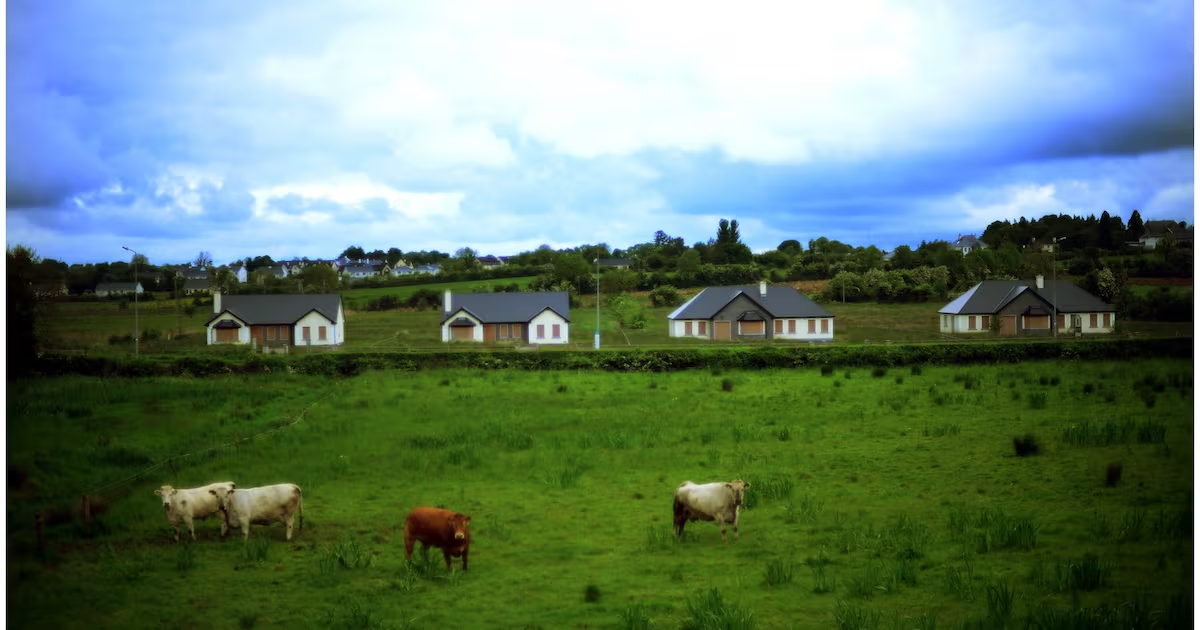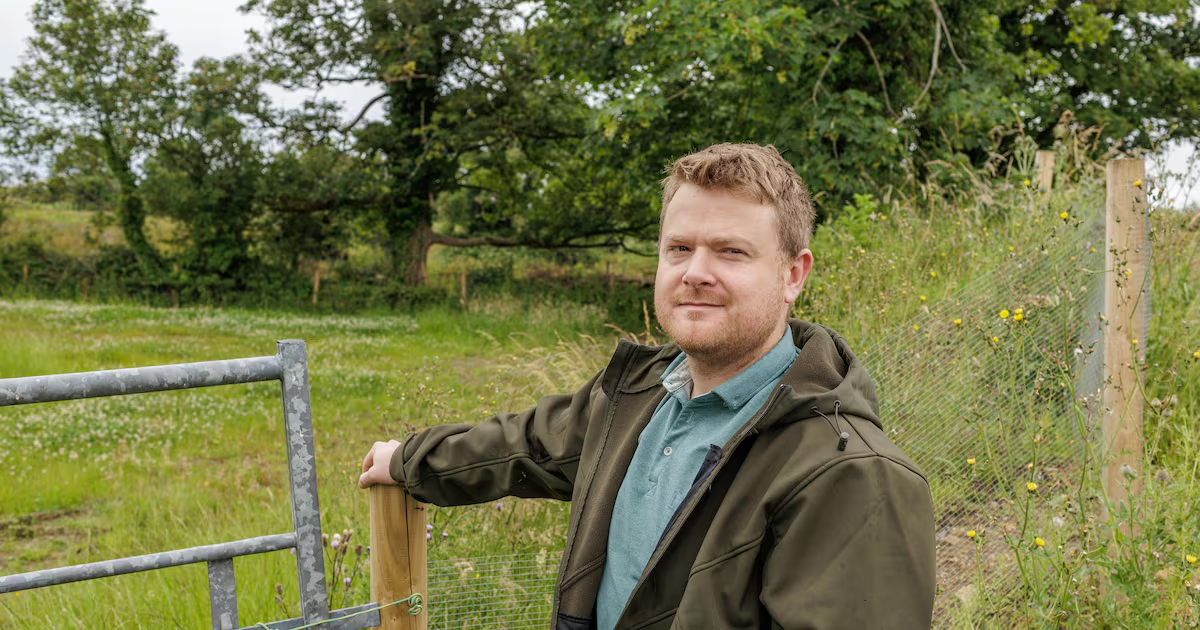
Stuck in his childhood bedroom, 29-year-old Christopher Nicholson has been wondering why he does not leave Sligo and head for Australia.Nicholson, who manages his family’s chemist in Sligo Town, was recently deemed ineligible to build a house on nearby lands gifted him by his late grandmother.“I said to myself when I got refused: ‘Sure why am I even here? Why am I bothering to stay?’” he says.Many of his childhood friends have left for Dublin, Britain, America and Australia, he says. So far, just one of his close peers has managed to buy a house locally. He says there is a “lack of young people” in Sligo, and he doubts many of his friends will return while the housing crisis has such a strong effect on the availability of local accommodation.Nicholson says he spent about €12,000 on architects, environmental inspections and other tests of the land where he wants to build. As part of a pre-planning application consultation, he submitted documents showing he would be helping care for a nearby relative and explained he has lived his entire life within 5km of the site, just outside Sligo Town.He says he usually chooses cycling and walking over driving and it would take him just 20 minutes to walk into town from his proposed new build.After waiting 14 months for a response to his application, Sligo County Council last summer said he did not meet the strict criteria for building on the green belt classified zone. To qualify, he needed to be employed in a “rural-based activity” such as agriculture, forestry or horticulture.For Nicholson, the Government’s proposed loosening of one-off rural housing rules cannot come soon enough. This week, Minister for Housing James Browne announced a planned end to the “Eircode lottery” that he said saw some local authorities apply “arbitrary” and “ad hoc” standards for rural housing applications.The draft planning statement, which is to undergo environmental screening before final approval, says people hoping to build in rural areas close to commuter towns or metropolitan areas must demonstrate a social or economic need for such housing.To demonstrate a “social need” they must have lived within 10km of their site for at least seven years; an economic need can be met if a person’s primary work is directly related to the vicinity. Farming and other outdoor jobs qualify, but so too do essential services roles such as local teachers. In an effort to avoid urban sprawl, the new guidelines permit local authorities to apply green belt-type designations and stricter rules to areas near cities or large towns.[ Will new planning rules make it easier to build?Opens in new window ]Nicholson is hopeful the changes will see him qualify in a future planning application. Regardless, the proposals are a positive step, he says, adding: “There are a lot of people all over the country in the same situation as me.”The planning statement has been welcomed by rural groups that have long campaigned for an overhaul of the 2005 rural housing guidelines, which they saw as rigid and overly restrictive. The Irish Farmers’ Association says the new policy is an “important step towards supporting rural communities, increasing housing supply and strengthening generational renewal across rural Ireland”.Irish Rural Link, a national network representing rural communities, says the statement should provide certainty and fairness. The group’s chief executive, Briain Smyth, who faced his own planning setbacks when looking to build in his countryside area five years ago, says the document must be followed by the provision of services to communities.“We want to see rural vitality,” he says, adding that rural buses are important for meeting climate targets.[ New rural housing policy will end ‘Eircode lottery’ approach to planning, Minister saysOpens in new window ]Less enthusiastic about the proposals is chartered planner and University College Cork lecturer Brendan O’Sullivan. He fears the new policy could exacerbate an already “chaotic” and “unsustainable” rural settlement pattern that is difficult to service.People looking to build in country areas with a population of under 1,500 have fewer criteria to meet. They must show they are living or working there to satisfy a “rural generated housing need” criterion, the planning statement says. Greater restrictions can be imposed on highly sensitive scenic areas.O’Sullivan believes a move away from a supposed “Eircode lottery” is not necessarily positive, as it seeks to deploy a “uniform” approach to a diverse countryside. Local authorities have a deep understanding of their landscapes and apply varying restrictions, but this does not equate to a “lottery”, he says.As a former council planning officer covering rural areas, he is sceptical of claims that farmers’ children are frequently refused planning permission for reasonable homes on appropriate sites. He recalls “very occasional” refusals, and these were for “common sense” technical reasons.Planners must “zoom out” and look at the effect of housing patterns, says O’Sullivan, expressing concern that rural villages and towns will not be sustained when homes are scattered across the countryside. Rural isolation, particularly among the elderly, is a real issue, while remote households often rely on three or four cars, he adds.[ Brave new world of remote working in rural areas yet to materialiseOpens in new window ]He also worries that this policy and the long-pending updated guidelines on wind farm development are “about to hit each other like two express trains”. Current advice is for wind farms to be placed at least 300 metres away from homes, but more houses dotted throughout the landscape will make it difficult for Ireland to meet its obligation of adding another 1,000 turbines, he says.Overall, the policy is a “huge departure from sustainable development”, he says, adding that “Europe will be keeping an eye”.An Taisce’s planning and environmental policy officer, Phoebe Duvall, says loosening rural planning restrictions will make it harder and more expensive for the State to provide infrastructure and services to all homes.While recognising that farmers need to live rurally, she says there are already lots of individual rural homes. The new policy will “exacerbate” this trend, causing more people to depend upon cars, while more septic tanks could heap further pressure on Ireland’s waterways and biodiversity, she says.A more economic and environmentally sound approach to revitalising rural Ireland would have been to encourage vibrant town centres, she says.The draft planning statement also covers one-off and multi-unit developments in Gaeltacht areas. A person looking to build a home in the Gaeltacht must have lived within 3km of their site for 10 years. However, this relaxes to five years for Irish speakers who demonstrate a local social need.The guidelines set out the prevalence of daily Irish speaking across different Gaeltacht areas, ranging from 75 per cent of the population of Tory Island off Co Donegal to 3 per cent in east Galway city. To enhance the daily use of Irish in these areas, the proportion of Irish-speaking residents of new multi-unit developments should be 10 per cent higher than the local Irish speaking population.Donncha Ó hÉallaithe, spokesman for Gaeltacht housing pressure group Bánú, believes the changes are a retrograde step for Irish speakers.He gives the example of Cois Fharraige in Connemara, in which multi-unit developers are currently required by Galway County Council to reserve 80 per cent of the homes for Irish speakers. With 48 per cent of the area’s population speaking Irish each day, the new guidance would require only 58 per cent of multi-unit houses to go to Gaeilgeoirs.For single houses, he says the requirement to have lived within 3km of a site is “very limiting”.But planning decisions can ultimately come down to more than a person’s job and place of origin. The new guidelines are unlikely to assist Pearse Ó Tuathail (43) who has been trying to build a home for himself in the Galway Gaeltacht area of Spidéal for 17 years.Born and raised in the parish, Ó Tuathail works from there as an Irish language guidance counsellor. His plans to build on a site gifted him by his parents were rejected four times on various environmental grounds, mostly citing percolation issues.I moved back to the area thinking I would be able to build here— Pearse Ó TuathailÓ Tuathail would accept the defeats if he felt the council consistently applied its rules to applications, but he cannot make sense of the rejections when two adjacent lower sites received housing approvals. He and his brother purchased another site, which he says passed an environmental engineer’s groundwater tests. But their housing plans for this land were also rejected due to ground conditions.He carries deep frustration at what he sees as “complete inconsistencies” in the planning process and in seeing others secure permission on sites he believes are similar to his.“I’m living in my parents’ house at 43 years of age. I moved back to the area thinking I would be able to build here,” he says, adding that he has put more than €100,000 into his efforts. “This has completely upset what my plans for life were: how many kids to have; where to settle. I don’t think they [the council] realise the impact on families.”
‘Why am I bothering to stay?’ New rules on one-off housing divide opinion
Rural housing plan welcomed in local communities, but it is a ‘huge departure from sustainable development’, says planner
1,503 words~7 min read