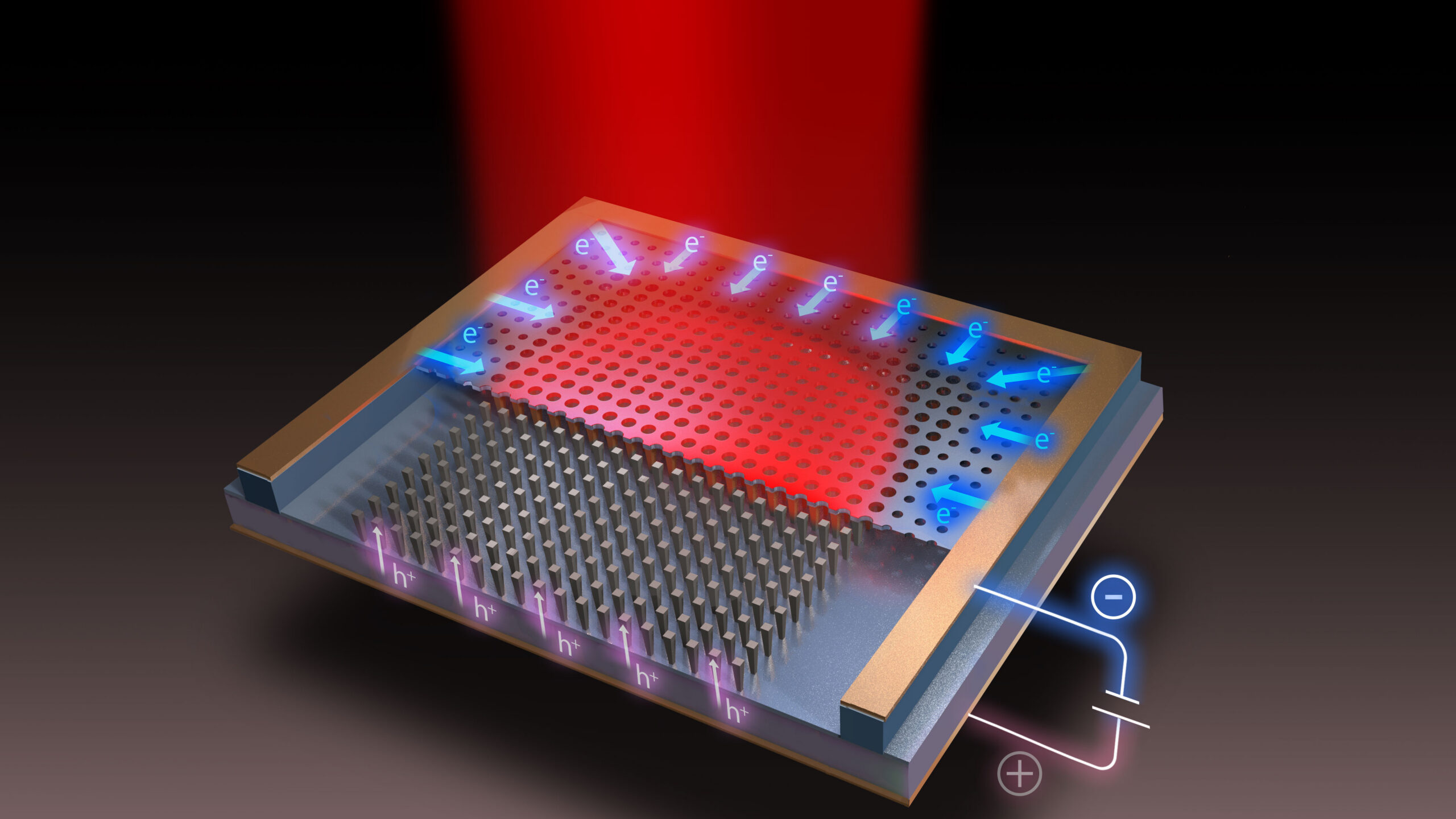
Discovery could lead to a new generation of compact and energy-efficient photonic technologiesMarking a breakthrough in the field of nanophotonics, a team of researchers from UC Berkeley and Lawrence Berkeley National Laboratory (Berkeley Lab) has unlocked a new way to power nanoscale light-generating devices with electricity while preserving the delicate optical properties needed for efficient operation. In addition, they developed a monolithic fabrication process capable of producing hundreds of nano-post electrical contacts with the uniformity required for laser operation.
This work overcomes a longstanding challenge in nanophotonics in which the electrical connections needed to operate a device often disrupt the very light-confining nanostructures that make the device useful.
As reported in Nature Nanotechnology, engineers solved this problem by introducing an architecture that decouples electrical injection from optical confinement. This allows electricity to be delivered where it is needed while leaving the light-guiding structure largely undisturbed.
“This breakthrough could help enable a new generation of compact and energy-efficient photonic technologies,” said principal investigator Boubacar Kanté, a professor of electrical engineering and computer sciences at UC Berkeley and a faculty scientist at Berkeley Lab. “More broadly, our approach, which I call orthogonal optoelectronics, enables engineering electrical pathways and optical modes independently, so that each can be optimized without compromising the other.”