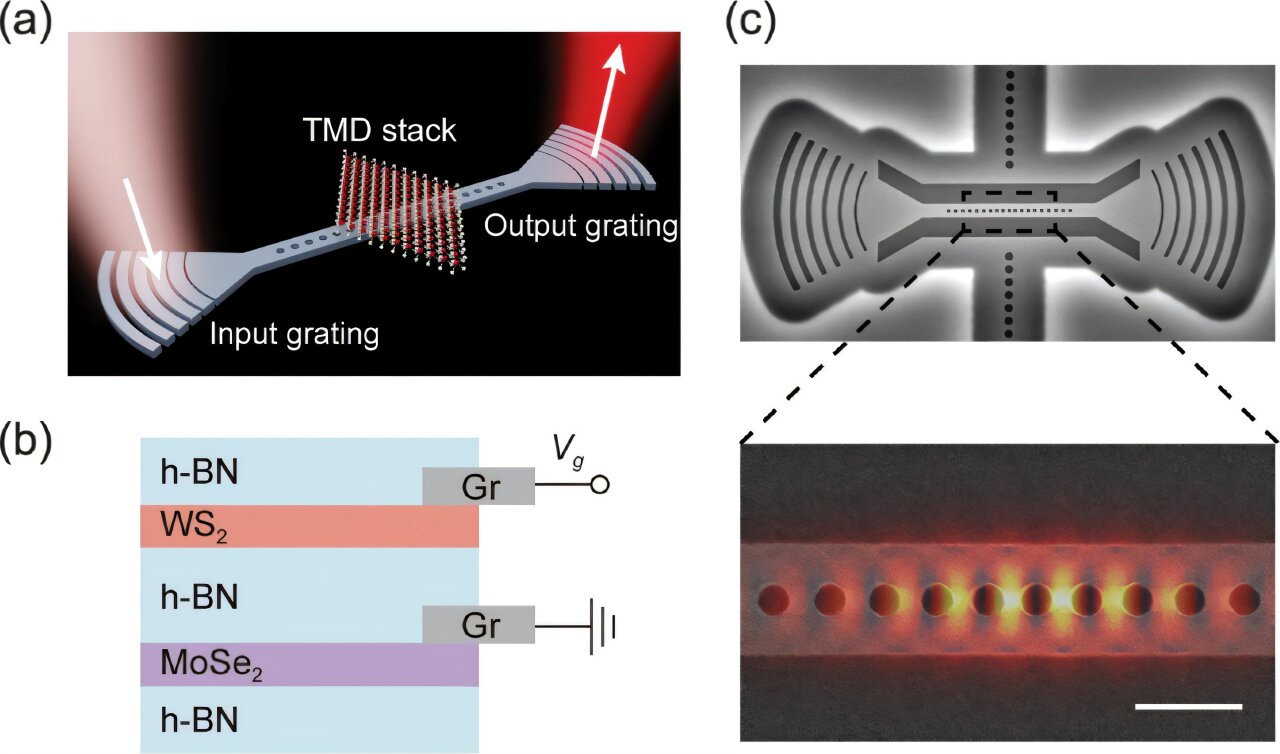
2D nanocavity exciton polaritons. (a) Schematic of the coupled TMD-PhC nanocavity. (b) Schematic of the gate-tunable TMD stack. (c) Scanning electron microscope image of the suspended Si3N4 nanobeam cavity, with the inset showing the simulated cavity mode profile. The dark area is suspended from the SiO2 substrate. Scale bar, 500 nm. Credit: Physical Review Letters (2026). DOI: 10.1103/gc15-qsvf
Photonic devices are hardware systems that can process information using light instead of electricity. These systems could potentially perform computations faster than electronic devices, while also consuming less energy.
A key challenge faced by engineers developing photonic systems is achieving strong optical nonlinearities, or in other words, developing approaches that enable the control of light signals using light, all while consuming little power. A proposed solution to attain these light-light interactions entails the use of exciton polaritons, hybrid particles that are formed when photons couple with excitons (i.e., bound pairs of electrons and holes inside semiconductors).
Researchers at University of Pennsylvania and Montana State University recently introduced a new photonic system that enables the reliable control of light signals using light.