The old investment playbook was built around low inflation, cheap money, globalised supply chains and central banks that could cushion nearly every shock. That world has changed. Debt is higher, geopolitical risk is sharper, industrial policy is back, and AI has turned compute into a strategic asset.The result is a market that looks expensive through one lens but more understandable through another.The biggest force is debt. The US and other major economies are carrying fiscal burdens that are hard to solve through austerity alone. That makes nominal growth more valuable. Governments need economies to expand faster, tax receipts to rise and debt ratios to look more manageable over time.This is why industrial policy matters again. Tax incentives, energy policy, chip supply chains, reshoring and data centre buildouts are no longer niche themes. They are part of a wider attempt to rebuild productive capacity.AI is the engine of that shift. It is no longer only a software story. It is a physical infrastructure story. Chips, servers, memory, power grids, cooling systems, fibre networks and data centres have become the new industrial base.That helps explain why parts of the equity market keep defying bubble warnings. The strongest AI-linked companies are not merely selling a dream. They are converting scarcity into contracts, backlog and earnings. In that environment, investors may be willing to pay higher multiples for companies with real exposure to the compute cycle.Still, this is not a free pass for every AI stock. The market is already showing signs of excess. The next phase will likely be more selective. Companies with pricing power, durable demand and control of bottleneck assets should fare better than those simply using AI as a marketing label.The second shift is happening in money itself.Stablecoins are becoming a new distribution layer for the dollar. For users outside the US banking system, they offer a faster way to hold and move dollar exposure. For Washington, they may extend dollar influence into digital finance. For banks, they are a warning.Traditional banks have long benefited from deposits, payment friction and customer inertia. Stablecoins challenge all three. If dollars can move at internet speed, banks will need to compete harder for deposits, settlement and yield. The winners will be those that adapt, not those that defend old margins.Bitcoin sits in a different category. It is still volatile, still controversial and still driven in part by liquidity cycles. But its long-term role is changing. The more financial markets move towards digital settlement, tokenised assets and programmable collateral, the more bitcoin’s appeal as a neutral, non-sovereign asset becomes relevant.That does not mean bitcoin replaces the dollar. A more realistic scenario is that bitcoin, stablecoins and tokenised treasury assets coexist. Stablecoins carry digital dollars. Treasuries provide yield and collateral. Bitcoin serves as a scarce reserve asset outside the liability of any single institution.The investment implication is not blind bullishness. It is regime awareness.The next decade may be defined less by traditional sector labels and more by control over compute, energy, collateral, payment rails and settlement systems. That is where capital is moving. That is where governments are focusing. That is where the market is likely to keep repricing risk and reward.Investors do not need to chase every parabolic chart. They need to understand the plumbing beneath the price.The old playbook asked whether stocks, bonds or crypto were cheap. The new playbook asks who owns the infrastructure of the next financial system.• Muchena is founder of Proudly Associated.
HEATH MUCHENA | AI infrastructure and digital money are changing how investors see risk
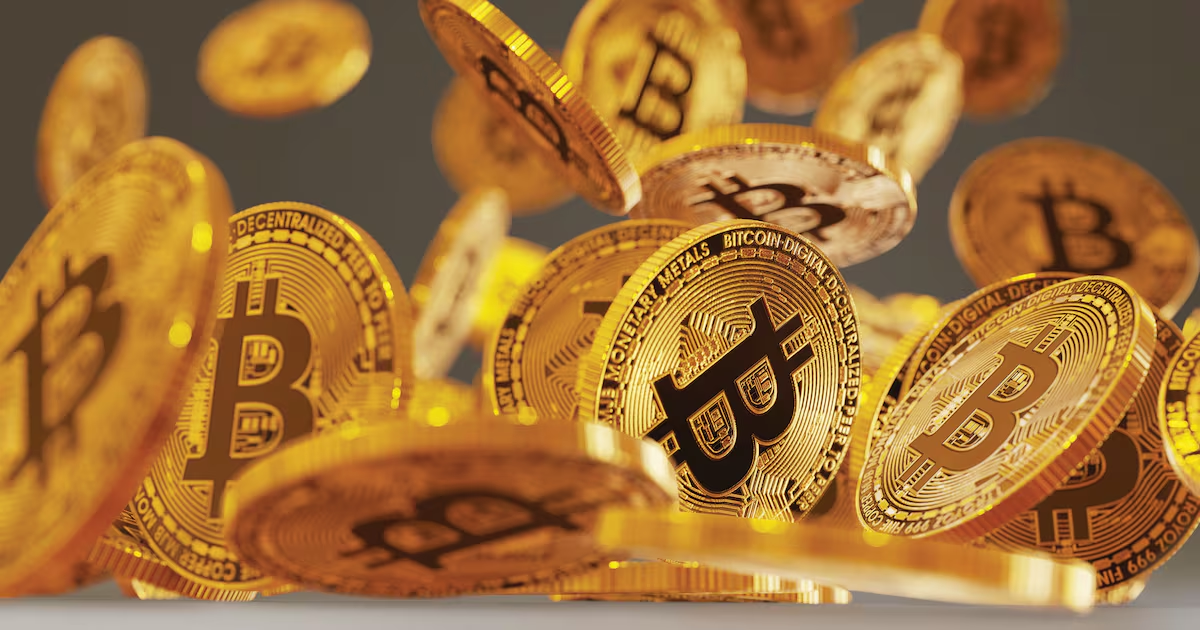
Bitcoin’s appeal as a non-sovereign asset becomes relevant as financial markets move towards digital settlement, tokenised assets and programmable collateral
573 words~3 min read