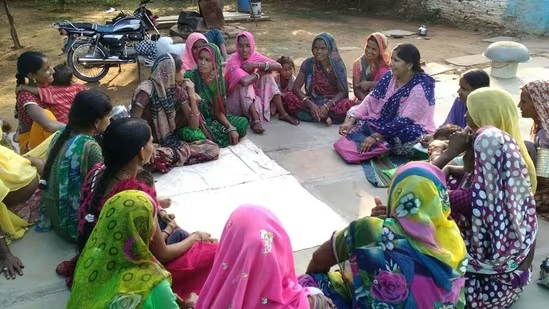
Every MSME Day, discussions around women-owned enterprises tend to converge on a familiar challenge: the credit gap. The concern is legitimate. According to estimates by the International Finance Corporation, women-owned micro, small and medium enterprises in India face a substantial financing shortfall, while only a fraction have access to formal borrowing channels.Women empowerment (Voices of Youth)Yet the debate often assumes that expanding credit alone will automatically translate into enterprise growth. That assumption deserves closer scrutiny.Across India, millions of women operate nano enterprises that sustain household incomes and local economies. They run kirana stores, tailoring businesses, beauty services, food enterprises and home-based ventures. Many of these businesses have customers, generate revenues and demonstrate clear market demand. The problem is not always the absence of entrepreneurial ability. More often, it is the absence of systems that make these businesses invisible and accessible to formal finance.This distinction matters because access and readiness are not the same thing.Women-owned nano enterprises are frequently treated as a homogeneous category, but the reality is far more diverse. Some businesses are still in survival mode, with irregular cash flows and high vulnerability to household shocks. Others have achieved operational stability and growing customer demand but continue to function through informal financial practices. Only a smaller segment is genuinely prepared to engage with formal lenders and absorb growth capital productively.Applying the same intervention to all entrepreneurs ignores these differences. Credit introduced too early can create repayment stress rather than growth. For enterprises still struggling to stabilise incomes or build basic financial discipline, loans may add pressure without addressing underlying constraints.Market demand itself is rarely the principal challenge. Many women-owned businesses already have loyal customers and opportunities for expansion. Their growth constraints often emerge elsewhere.One of the most significant barriers is financial visibility. India's digital payments revolution has dramatically expanded financial inclusion. Smartphone adoption and QR-based transactions are now common among nano enterprises. However, digital adoption has not necessarily translated into lender readiness.Business revenues and household expenditures often flow through the same bank account. Customer payments, school fees, medical expenses and daily household purchases become intertwined. In many cases, accounts are registered in the name of another family member. As a result, lenders reviewing transaction histories struggle to distinguish enterprise performance from household spending patterns. A viable business, therefore, does not always become a visible business.Another overlooked challenge is the difference between financial literacy and credit literacy. Many entrepreneurs understand how to manage customers, pricing and inventory, but far fewer understand how formal financial systems evaluate them. Credit scores, bureau records and historical defaults remain poorly understood. Legacy issues arising from earlier crises or restructuring exercises can continue affecting eligibility years later, often without the entrepreneur's knowledge.As lending increasingly becomes data-driven, understanding credit histories and remediation pathways is becoming as important as understanding business operations.Documentation and navigation barriers further complicate access. Registration gaps, outdated records and procedural requirements frequently delay or prevent otherwise viable enterprises from obtaining finance. These are not failures of entrepreneurship. They are failures of system navigation.The challenge, therefore, extends beyond the supply of capital. It concerns the infrastructure that prepares entrepreneurs to engage with formal finance effectively.India's next frontier in financial inclusion should be the creation of what may be called readiness infrastructure.Such infrastructure would begin by recognising that entrepreneurs are at different stages of development and require differentiated support. Stage-based assessments should precede financial interventions. Businesses struggling with volatility require stabilisation support, while those approaching formalisation need assistance with documentation and lender engagement.Financial visibility must also become a priority. Encouraging record-keeping, separating business and household transactions, and building transaction histories linked to the entrepreneur herself can significantly improve assessability.Credit literacy deserves dedicated attention. Entrepreneurs need to understand bureau reports, credit scores and their rights within the financial system. Equally important is the availability of navigation support to help them address documentation gaps, complete registrations and resolve procedural bottlenecks.Financial institutions, too, have a role to play. Traditional underwriting methods often fail to capture the realities of nano enterprises. Cash-flow-based assessments, alternative data and products tailored to small businesses can help bridge this gap.Readiness infrastructure does not shift responsibility solely onto entrepreneurs. It recognises that the distance between entrepreneurial capability and lender readiness is real, and that closing this gap requires collective effort from policymakers, financial institutions and support ecosystems.The future of women's enterprise development cannot be measured only by the volume of loans disbursed. It must also be judged by how many viable businesses become visible enough for the system to recognise, assess and support.India has invested significantly in expanding access to finance. The next challenge is ensuring that capable women entrepreneurs are truly ready to benefit from it.(The views expressed are personal)This article is authored by Arya Raj, programme manager, Vrutti-Livelihood Impact Partners.
Why women-owned nano enterprises need readiness infrastructure
This article is authored by Arya Raj, programme manager, Vrutti-Livelihood Impact Partners.
788 words~4 min read