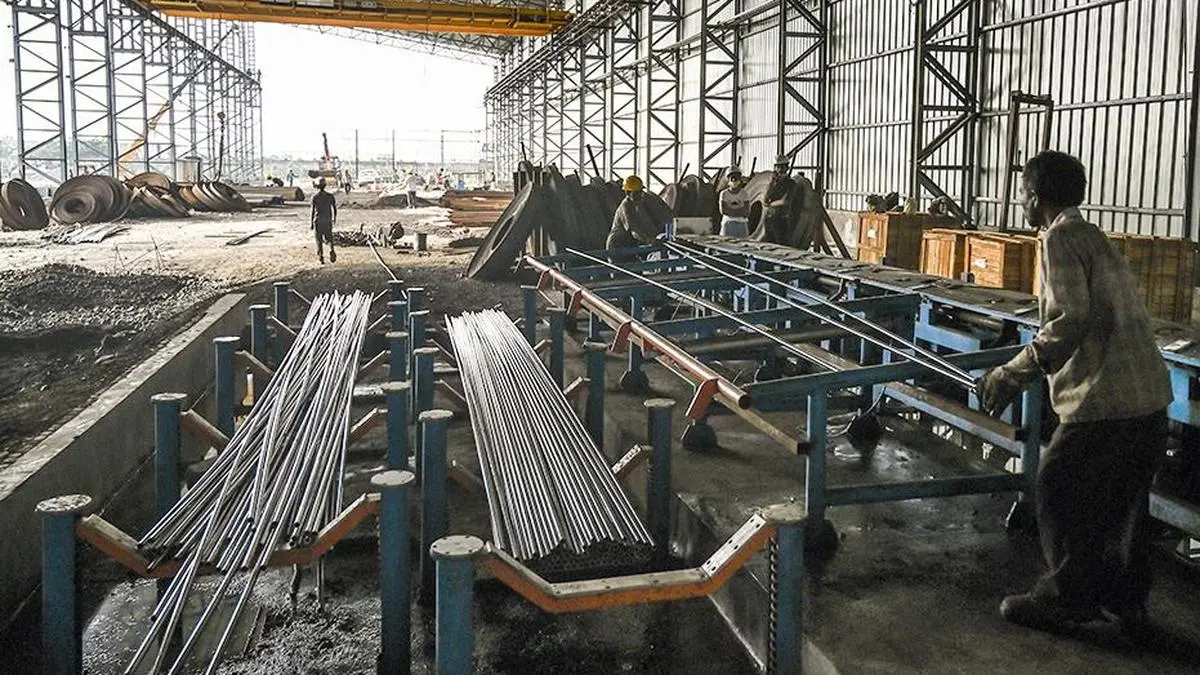
MSMEs are India’s second-largest employer after agriculture
| Photo Credit:
mantosh
June 27 is observed as International MSME Day, an occasion that reaffirms a foundational truth: no economy can achieve durable, inclusive growth without nurturing its small and medium enterprises. The day draws global attention to the imperative of strengthening MSMEs’ access to finance, markets, technology and policy support, and serves as a reminder that the path to sustainable development must be built through the millions of entrepreneurs who create value at the grassroots level. Globally, MSMEs form the backbone of economic ecosystems, accounting for nearly 90 per cent of all business enterprises and more than 50 per cent of employment worldwide. In India, the sector contributes 31.1 per cent to the nation’s GDP, 35.4 per cent to manufacturing Gross Value Added (GVA), and nearly 48.6 per cent to total exports.As the country’s second-largest employer after agriculture, the sector sustains over 32.82 crore livelihoods across 7.47 crore formal enterprises. This formal layer continues to expand rapidly; driven by digital integration through the Udyam and Udyam Assist platforms, systematically shrinking the informal shadow economy and integrating millions of micro-entrepreneurs into the structured financial ecosystem.Untapped potentialThe scale places India as the third-largest MSME ecosystem in the world after the US and China. Yet, the comparison with advanced manufacturing-led economies such as Germany, Japan and South Korea, where MSMEs contribute around 55 per cent, 52 per cent and 47 per cent, respectively, to economic output clearly underlines India’s untapped potential.The rapid scaling of this sector is being heavily supported by influx of capital and deliberate policy frameworks. This momentum is further bolstered by the Self-Reliant India (SRI) Fund, an equity-infusion mechanism that has already deployed ₹15,442 crore across 682 high-growth enterprises, allowing mid-sized firms to scale up without collapsing under heavy debt burdens.The FY27 Budget adopts a focused three-pronged approach in the form of equity support, liquidity enhancement and professional enablement, to help MSMEs scale into future-ready “Champion Enterprises”. Key initiatives include ₹10,000 crore SME Growth Fund, an additional ₹2,000 crore infusion into the Self-Reliant India Fund and strengthened credit guarantee support through CGTMSE to improve access to collateral-free finance for micro and small enterprises.Further, the mandated use of TReDS for CPSE procurement from MSMEs, integration of GeM with TReDS and proposed securitisation of trade receivables are expected to accelerate invoice realisation, improve working capital efficiency and broaden institutional participation. Collectively, these measures provide a strong policy impetus for formalisation, technology adoption, export readiness and long-term competitiveness of the MSME ecosystem.The banking sector has played the vital role to meet the credit needs of MSMEs through collateral-free loan schemes, and digital platforms like the Jan Samarth Portal. Lenders are increasingly moving towards cash-flow-based lending, using GST data and account aggregators instead of physical collateral. Yet the financing gap persists and narrowing it is the defining challenge for India’s banking sector in the Viksit Bharat decade.Going forward, the true strength of India’s MSME sector will lie in its ability to evolve into a future-ready engine of inclusive and sustainable growth. The sector must be supported to transition from informal to formal, from small-scale production to value-added manufacturing, from local markets to global value chains, and from survival-led enterprise to technology-led competitiveness. A vibrant, digitally enabled, financially empowered and globally connected MSME ecosystem will be imperative for building a developed and inclusive India.The writer is MD and CEO, PNBPublished on June 30, 2026