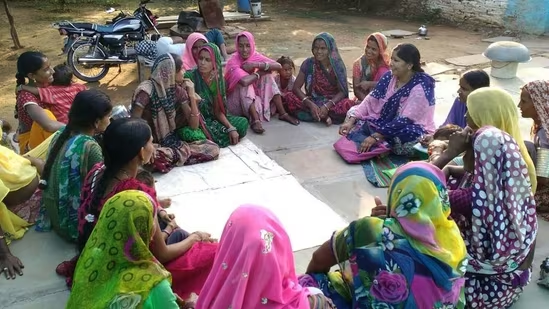
When Sunita began selling her home-made spice blends from her home in Ujjain, Madhya Pradesh, it was not a leap of entrepreneurial ambition but an act of necessity. With her husband’s income uncertain, her enterprise became the household’s spine. She negotiates orders on WhatsApp, accepts payments from customers on Unified Payments Interface (UPI), and keeps a careful mental account of costs and margins. Yet when she thinks about savings, insurance, or retirement, the answers thin out quickly. Sunita has a bank account. But when she tried to take a loan from her bank, she didn’t have the creditworthiness to qualify for a loan, despite several government schemes available for her. She has a smartphone and transacts digitally. By conventional metrics, she is financially included. And yet, finance in her life remains fragmented—useful in parts, but never whole. Her experience reflects a deeper truth about women’s financial wellbeing in India: access has expanded, but agency remains elusive.Women continue to face challenges to access loans and government schemes. Lack of ownership of registered assets in their names and limited or no credit history make it difficult for financial institutions to assess their creditworthiness. The socio-cultural norms that necessitate the need for a male family member’s permission for financial transactions, and the primary burden of household duties limit the time and opportunity for women to engage with formal banking channels. The algorithms of digital lending platforms, too, can have embedded biasness which can penalise factors common among women entrepreneurs, such as home-based businesses. Furthermore, many women are not aware of government schemes, their eligibility criteria, or the ways to navigate the complex application processes despite awareness initiatives by the government and the fintech ecosystem.By many measures, India’s financial inclusion looks like a success. On closer scrutiny, however, the numbers mask limited engagement for women. Targeted initiatives, such as the MUDRA Yojana, along with financial literacy training and simplified applications, help bridge the credit gap. Yet savings, investments, and long-term security products remain scarce for women.After analysing data from nine states based on 1,500 interactions with women, findings show that women consistently expressed concerns about old-age security and future vulnerability, particularly related to children’s education, health burdens, and wedding expenses for dependents. Baseline data also reveals that across most demographics, financial product uptake and sustained use rely heavily on informal intermediaries rather than direct engagement with government, the private sector, or digital channels, highlighting a gap between policy design and lived access. This is where intermediation becomes most important: agents who bridge the distance between a bank and a woman at the grassroots, and platforms that provide financial and digital literacy in a gender-intentional way, rather than assuming women will navigate apps independently.“The agent helps us get approvals from the bank via video calls from the comfort of our home during the day when we are free from housework. Having limited access of transport to the nearest bank is no longer a restriction.”— Women customers in Uttar Pradesh during Focus Group DiscussionsWhile schemes such as the Atal Pension Yojana and the National Pension System are formally available, their design assumes regular incomes and predictable contribution patterns, conditions that rarely match women’s entrepreneurial realities. For a woman managing irregular cash flows, retirement planning feels abstract and distant. Yet the appetite to save is clearly there. In tribal belts of Gujarat, we found women who are remarkably disciplined savers but lack products built for micro-investments they can access easily, a gap that newer savings models, including those anchored in familiar instruments like gold, are beginning to close.The key lies not in introducing new schemes but in designing gender-intentional financial products across credit, savings, insurance, and pensions, supported by sustained last-mile facilitation. UPI-enabled micro-pension contributions—small, frequent, and embedded in familiar digital behaviour—offer a practical pathway to normalise long-term savings for self-employed women.The gaps are not only in the nature of products but also in delivery. Findings from the study demonstrate that awareness, onboarding, grievance redress, and repeat usage among women, especially those who are semi-literate, live in remote areas, or belong to marginalised communities, are driven overwhelmingly by field agents and staff. They help women open accounts, understand schemes, resolve errors, and ask questions they might hesitate to raise at a bank branch. In many communities, they are the first point of financial advice. Our findings show that even in areas where smartphone access among women is high, independent use of financial apps remains extremely limited. This highlights the need for trust-based and human-centred product and service designs to increase uptake and utility. Strengthening these networks could significantly improve not just access but also informed and sustained usage.As we track the acceleration of women’s financial inclusion across demographics, livelihoods, and states, our focus stays on a single shift: whether women can use these products on their own terms — to plan beyond the next loan cycle, to withstand shocks, and to secure their futures. For women like Sunita, a bank account should be the beginning of a balance sheet, not the end of the story. If India is serious about women-led growth, it must move beyond credit access and design finance for the agency of women.Anamika Gupta is head of Strategy & Knowledge Management, NITI Consulting; Meena Vaidyanathan is Founder, Niti Consulting, and Vijeth Acharya, Senior Manager, Insights IIMA Ventures. Views are personal. (Disclaimer: The opinions expressed in this column are that of the writer. The facts and opinions expressed here do not reflect the views of www.economictimes.com.)
Mind the gap: Financial products that women in India need but don’t have
If India is serious about women-led growth, it must move beyond credit access and design finance for the agency of women.
911 words~4 min read