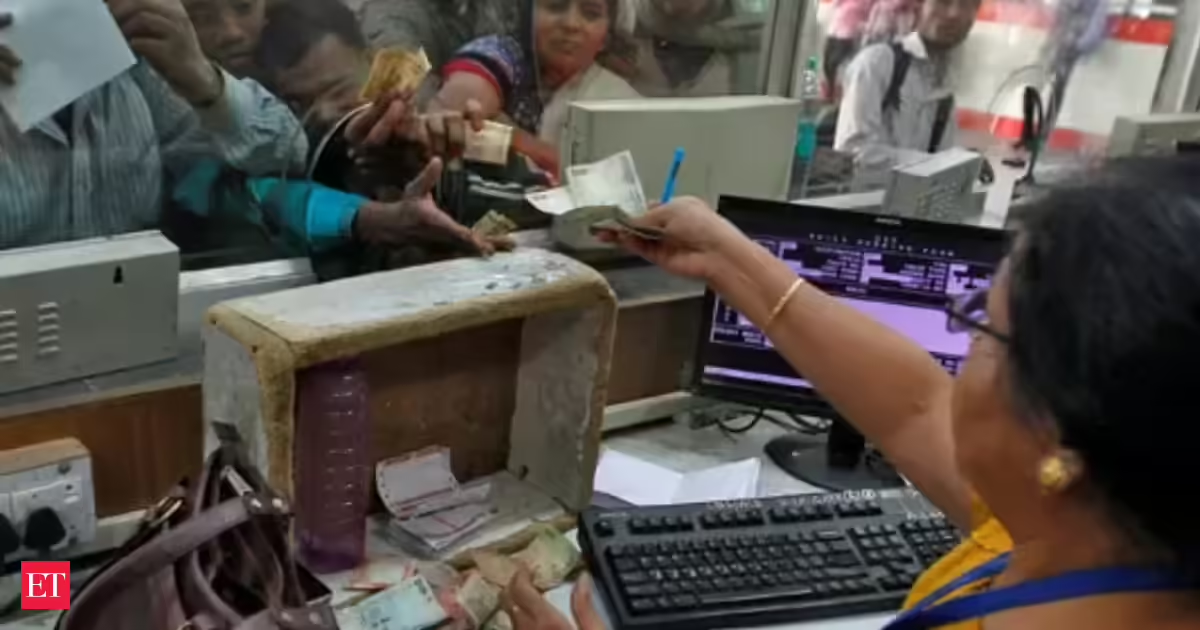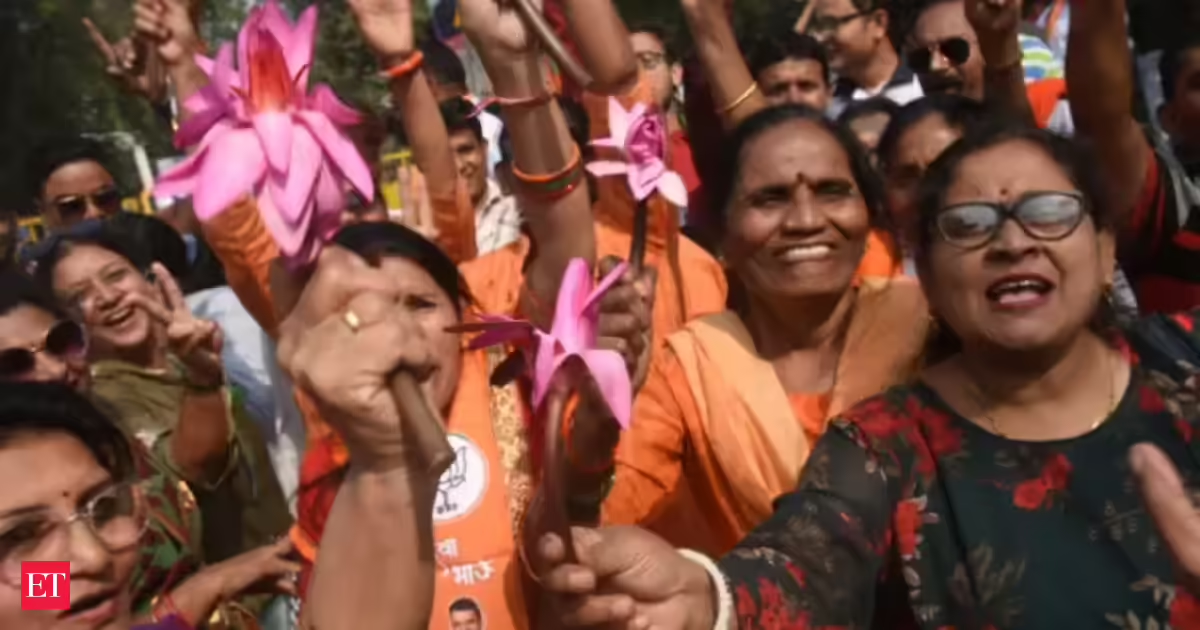
Almost a decade ago, the majority of Indian women were effectively excluded from the formal financial system. Despite participating in various state welfare programs, most had no bank account. In response, the government launched the Pradhan Mantri Jan Dhan Yojana (PMJDY) in 2014, one of the most ambitious financial inclusion drives in recorded history. Over the following decade, more than 500 million bank accounts had been opened in India. Combined with Aadhaar-based identification and expanding mobile connectivity, the JAM Trinity created a new architecture for direct benefit transfers that enabled the routing of government benefits into individual accounts at scale. By 2024, account ownership among both men and women in India had reached 90%. On paper, the gender gap had almost closed.Gender Equality (Getty Images/iStockphoto)Formal account ownership, however, is not the same as financial inclusion in any meaningful sense. PMJDY attracted consistent criticism on exactly this point. High volumes of dormant accounts, limited financial literacy among account holders, uneven service quality in rural areas, and, in some cases, misuse of accounts for illicit transactions. According to the World Bank, one to three women in India had an inactive account in 2021. Our research, using the World Bank's Global Findex 2021 data, examines where the gender gap now lies and why. The findings show that while India has largely closed the access gap, it has not closed the usage gap. Indian women are 16.8 percentage points less likely than men to own a debit or credit card, 21.7 percentage points less likely to use mobile phones or the internet for financial transactions, and 12 percentage points less likely to use mobile money services. These are not marginal differences. At the larger population level, they represent millions of women who are formally enrolled in the financial system but are not active participants in the digital economy.The research applies a statistical decomposition method to separate the drivers of the access and usage gaps across financial products and services. Four observable factors account for a significant portion of the divide, namely education level, income, employment status, and location. Women with lower educational attainment are substantially less likely to use digital financial services. Women in lower-income brackets face the sharpest barriers to card ownership and digital transactions. Women in rural areas face disadvantages at the access stage; however, the urban-rural divide becomes less determinative once basic digital infrastructure is in place. The more consequential finding, however, concerns what the observable factors cannot explain. Even after fully accounting for education, income, employment, and location, a substantial portion of the usage gap remains. Two individuals with identical observable characteristics, one male and one female, do not achieve equal financial outcomes. The woman is systematically less likely to own a card, conduct a digital transaction, or use UPI. This residual gap reflects structural barriers that lie beyond the reach of any government’s access-focused interventions, including constrained household decision-making agency, limited digital confidence, and social norms around women's engagement with financial technology. Across South Asia, women are at least 19 percentage points more likely than men to report needing assistance to use a financial account. That figure captures the problem precisely. It is not a question of whether women have accounts. The question is whether they can use them independently.The direct benefit transfers have indeed been a meaningful lever. The share of women with inactive accounts fell from approximately one-third in 2021 to 18% by 2024. This decline is closely associated with the expansion of DBT-linked programmes. Receiving government transfers gave women a concrete and recurring reason to engage with their accounts. However, the DBT engagement is a narrow form of financial participation. Women's independent use of digital finance for everyday purchases, savings, and self-initiated transactions continues to lag significantly behind men. The infrastructure has created a pipeline for transfers. It has not yet created a foundation for autonomous financial engagement.The recently released World Bank Global Findex 2025 report supports this conclusion. India now faces a second-generation financial inclusion challenge that requires a fundamentally different policy response. Expanding female education remains the single highest-leverage intervention, particularly at the secondary level and in rural areas. Its effects extend across every dimension of financial usage and compound over time. Beyond education, the policy agenda needs to address four areas concurrently. First, affordable access to digital devices. Women cannot participate in digital finance without the tools to do so. Device affordability remains a constraint, especially in lower-income and rural households. Second, capability-building programs that go beyond awareness. Financial and digital literacy initiatives must move from informational campaigns to structured programs that build practical, independent capability. Third, infrastructure designed around women's needs. Digital financial services have largely been designed for contexts and users that do not reflect the reality of most Indian women, particularly in rural and semi-urban areas. Fourth, merchant ecosystems that make digital payments practical for daily life. UPI processes billions of transactions every month. On that front, the infrastructure is exceptional. But if women can use it only to receive government transfers, the system is serving only a fraction of its potential.India has accomplished something significant. A country where the majority of women were unbanked a decade ago now has near-universal account ownership. That achievement should not be understated, but the next challenge is more crucial. It requires moving beyond enrollment toward genuine participation and ensuring that women are not merely at the receiving end of India's digital financial architecture, but active, confident, and equal contributors to it.(The views expressed are personal)This article is authored by Pawan Ashok Kamble, assistant professor, Birla Institute of Management Technology and Atul Mehta, assistant professor, Indian Institute of Management, Shillong.
Shifting gender gap in India's financial inclusion
This article is authored by Pawan Ashok Kamble and Atul Mehta.
936 words~4 min read