India’s financial inclusion story is, by most standard narratives, a success. Since January 2015, over 540 million new bank accounts have been opened under the Pradhan Mantri Jan Dhan Yojana. More than half (about 60 per cent) are held by women.Digital transactions under the Unified Payment Interface (UPI) now processes over 700 million transactions daily. The RBI’s Financial Inclusion Index climbed from 53.9 in 2021 to 67 in March 2025. These are real achievements, and they have been duly recognised both domestically and globally.But headline numbers can flatter to deceive. Having a bank account may not necessarily imply participation in the formal banking sector operations. Access is not necessarily meaningful participation in it. And on that question, the district-level Reserve Bank of India (RBI) data tells an interesting story.The Geography of MoneyEvery quarter, the RBI publishes district-level data on deposits and credit for scheduled commercial banks through Statement No. 4A. Examining data across 762 districts from Q4 2022-23 to Q3 2025-26 reveals a financial system marked by extreme geographic concentration.As of Q3 2025-26, just 11 of the 762 districts account for more than 50 per cent of total bank credit in India. The top three — Mumbai, Mumbai Suburban, and New Delhi — alone account for 30.3 per cent. Seven districts together hold 43.4 per cent of all formal credit in the country.Now consider the other end of the distribution. The bottom 381 districts — exactly half of all reporting districts — account for only 4.9 per cent of national credit. The median district’s share is just 0.029 per cent.The deposit picture is only slightly less concentrated, but it reveals something important. It takes 17 districts to account for 50 per cent of total commercial bank deposits, but only 11 account for 50 per cent of credit. The top 10 per cent of districts hold 73.1 per cent of credit and 70.4 per cent of deposits (see map online).This points to a centripetal financial system: savings are mobilised across a wide geography, including through Jan Dhan accounts in villages and small towns, but credit is deployed within a much narrower metropolitan geography. India has widened the savings funnel without widening the credit spout.Stubborn concentrationA high concentration at a single point in time could perhaps be explained as a transitional legacy gradually correcting itself. But the time-series evidence suggests otherwise.Across all the observed 10 quarters, the share of the top 10 districts by both credit and deposit remains exactly the same. Not even one additional district entered or exited the top tier. Rankings shifted marginally within the group, but the hierarchy itself remained frozen.The largest increase in any district’s credit share over this period — excluding Mumbai’s administrative reclassification — was just 0.72 percentage points, recorded in Medchal-Malkajgiri on Hyderabad’s periphery. For most districts, changes were statistically negligible.This is especially striking because the period studied was one of rapid financial expansion. UPI transaction volumes roughly tripled. Jan Dhan balances rose substantially. The RBI’s Financial Inclusion (FI)-Index improved meaningfully. Yet the geography of credit barely changed.Whatever India’s financial inclusion architecture has achieved, it has not redistributed the geography of finance.Some spatial concentration is economically rational. Economic activity, infrastructure, and firm density are not evenly distributed, and financial systems naturally reflect those realities. But the magnitude of concentration in India far exceeds what standard economic geography would predict.According to the 2011 Census, the top 10 credit districts together contain roughly 7.3 per cent of India’s population. Yet they account for 38.3 per cent of total credit — more than five times their population share.Even after accounting for the higher economic density of metros, this scale of concentration is difficult to justify. RBI data is based on the “place of sanction” of credit, meaning loans are attributed to the district of the lending branch rather than necessarily where the borrower has its actual operations. But that explanation only partially addresses the anomaly. These districts would effectively need to serve as the formal registration hubs for a disproportionate share of India’s productive economy for such concentration to appear normal.What the metrics missWhat makes this even more troubling is that mainstream financial inclusion metrics are not designed to detect it.The World Bank’s Global Findex measures account ownership and usage through household surveys. The RBI’s Financial Inclusion Index combines access, usage, and quality indicators into a national score. Both are useful tools, but neither measures how formal financial flows are distributed across geography.As a result, India risks conflating financial access with financial participation.A farmer may hold a Jan Dhan account yet still borrow from a moneylender at exorbitant rates because no bank in her district extends crop credit at scale. A small enterprise may operate digitally while remaining dependent on informal finance for working capital. In both cases, the individual is formally included but substantively excluded from the benefits inclusion promises.The concentration of credit is the aggregate expression of this exclusion.What Needs to ChangeThe first step toward correcting this problem is surprisingly simple: measure it properly.The RBI already publishes the underlying data every quarter. What is missing is the incorporation of concentration metrics into the country’s financial inclusion framework. India should track indicators such as the share of national credit held by the top decile of districts or the number of districts required to account for half of all formal credit. It will also be useful to identify with lowest credit penetration to focus attention on improving the credit flow. What gets measured gets governed.The next step would be to simplify the processing of credit flows specially for the MSMEs across the country. Smaller borrowers, as in the case of about nine million women self-help groups, have very low net NPAs.Similarly, it can be safely assumed that the plethora of compliances and collateral requirement may not really be necessary in extending credit to MSMEs specially in districts where at present credit availability is negligible at present.India has built remarkable infrastructure for financial access. But access alone does not guarantee financial inclusion. A truly inclusive financial system is not one where every citizen can open a bank account. It is one where the geography of opportunity is not determined by the geography of banking concentration.Kumar is Chairperson and Prakash is Associate-Strategy & Research at Pahlé India FoundationPublished on June 5, 2026
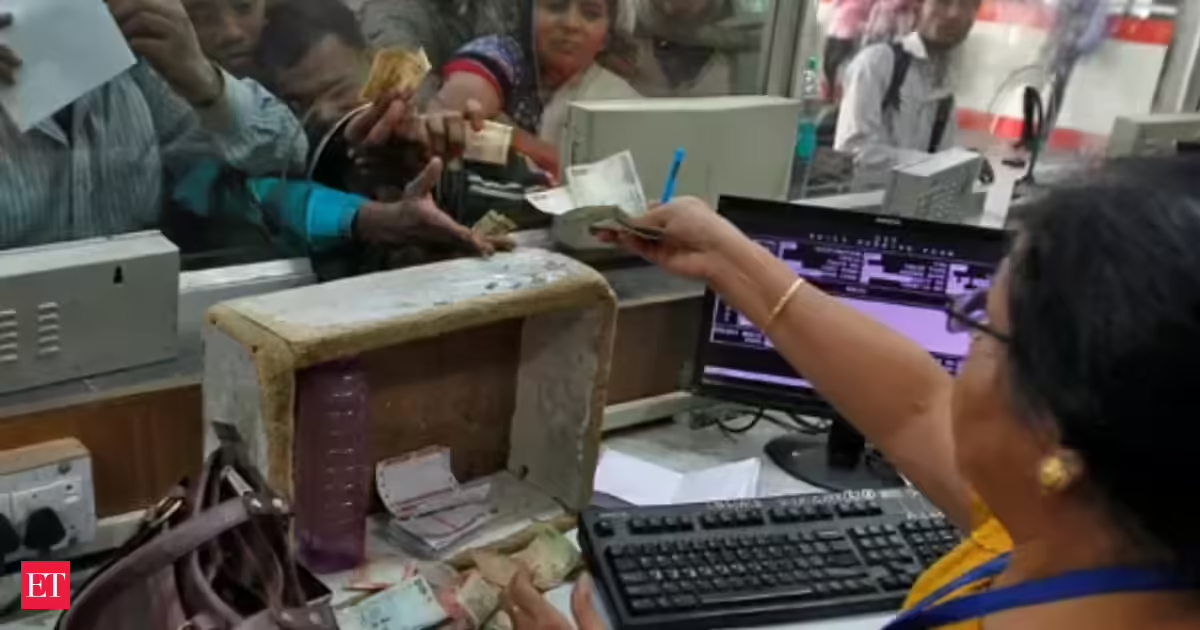
Regional skew in credit flows
India opens bank accounts for millions, but as much as half of total credit flows to just 11 districts
1,043 words~5 min read